 Lord Agni in one of the adhyayas of Agni Purana has discussed the disease curing Mantras. He has said that the Mantra running as Om, Hrum, Hansa has the capacity to even ward off death. It has been said that the Homa performed in connection with the Mantra, should be performed by pouring out a hundred thousand libations of clarified butter, containing bunches of Durva grass, on the fire, whereby the health and general peace of the life of the performer would be increased. In the alternative, weird and portentous phenomena occurring in the sky or in the earth, or those which owe their origin to the agency of the gods, as well as auguries of evil omen, such as the unnatural blossoming of trees, etc., should be atoned for by repetitions of such Mantras as the Pranavas, the Maya, etc.
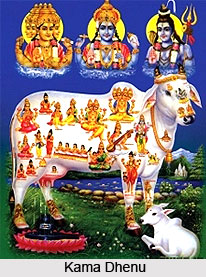
Agni Purana mentions that the Mantra should be repeated a hundred thousand times, and libations, numbering a tenth part thereof, should be poured on the fire. It has been said that a man by repeating the Mantra, and doing the necessary Homa would subjugate the mind of the lord of the celestials, not to speak of men. With the help of the Mantra, a votary would be able to remain invisible to all men. It is the best of all charms, and is potent enough to bring one`s enemies under control, and to paralyse all their intellectual faculties. The Mantra, seven times repeated, should be looked upon as same as the celestial cow or Kama-Dhenu.
It has been said that in peril, and during the prevalence of pestilential epidemics, the Mantra, worshipped by the mighty Shiva, should be repeated a hundred thousand times, and libations numbering a tenth part thereof, should be poured on the fire.
Agni Purana says that since the goddess succours men from distressed conditions (Durgas), she is called Durga. It has also been said in the Purana that after having made offerings to the god Kshetrapala, the votary should practise the rite of Graha-Nyasa, whereby he would bring the whole world under his control. The enemies of such a person would meet their doom, and his antagonists would be carried away in battle.
It has been said that a man, having performed the rite of Nyasa with the Hansa-Vija, should procure three sorts of poison, and mix them up with the powders of the drugs, known as the gam, the Sandal, the Kushtha, the Saffron, the Nagakesharam, the Nakha, and the Devadaru, taken in equal parts, and made into a paste with honey. Then he should fumigate the clothes of an idol with the vapours thereof, whereby he would meet with good luck in quarrels, charms, and literary disquisitions. The same fumigation should be consecrated with Maya-Mantra, where the object would be to win a bride. A Tilak mark made of Gorochana, Nagapushpa, Saffron, and Manahshila, and put on the forehead of a person, consecrated with the Hreem-Mantra, would act as an irresistible charm.
Thus it can be said that various Mantras are uttered in the hope that all malignant forms of disease are removed from the human body and men become free from all kinds of diseases.