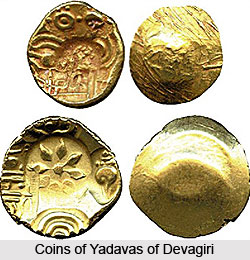
 Coins of Yadavas of Devagiri included both gold and silver coins although the former was common. Coinages of South India have been regarded as forming a separate field of investigation. That this distinction is substantive and not arbitrary is obvious from the very different currency systems of the Deccan and the South. The major gold resources of India were scattered throughout the peninsula, and they provided the metal for gold currencies in most parts of the Deccan in the early medieval period. By AD 1185, Yadava King Bhillama V had established his rule throughout the Maratha country, establishing his capital at Devagiri near present day Aurangabad (Maharashtra). The kingdom was a powerful presence in the thirteenth century, constantly involved in warfare in the south and north.
The gold coin found during the prominence of Yadavas of Devagiri was not flat, hut cup shaped due to the force of the central punch. The metrology of the issue was remarkably well regulated, with minimal variation in weight from the minting ideal. These coins of Yadavas of Devagiri, called `padma tankas` in the literature from their central motif of a padma or lotus, were the coins of the Devagiri treasury. On the other hand, the silver coinages of the Yadavas were rare, being known from a single lot gathered in the Nasik region, and stray pieces. The distribution of Gadhaiya paisa coins was found to extend into the Godavari valley, which lay in the Yadava kingdom. However, it is also estimated that the use of a relatively pure silver coin may have been the greater imperative, especially in an area where relatively pure precious metal coins were the norm. The value of silver is considered to be relatively high for a coin weight of just 0.917 g. presumably this was done to permit modest purchases. The scarcity of the silver coinage, which after all had no local tradition of use, indicates a very limited distribution during the dominion of Yadavas of Devagiri.
The distribution of the Yadava gold coinage was fairly uniform throughout the areas subject to their influence. There was, however, a definite shortage of silver in South India, and even billon coins were seldom issued. The tiny size of the silver coin introduced in the Yadava kingdom hints at a local scarcity of silver and consequent high price.