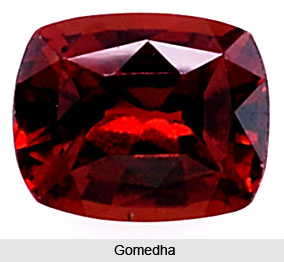
 Lord Agni in one of the adhyayas of Agni Purana has described the characteristics of different classes of gems worn by the twice-born ones. He has described the characteristics of gems like pearl, Turquoise, ire, vaidurja, moon-stone, sun-crystal, the Pushparaga (topaz), the Jyotirasa, the Raja, patta (a diamond of inferior quality) and Rajamaya respectively bring prosperity to a person using them. The Fire God has said that sulphur, conch-shell, Gomedha, Rudhiraksha, and Vallataka, nitrate of copper, lead, Pilu, coral, the Dindibha, the Bhramara, and the Utpala seeds, as well as gems found on the hoods of snakes, mounted on gold and worn by a man on his person, grant him success in life.
It has been stated in the Agni Purana that a gem well mounted, free from all impurities and shedding its characteristic lustre from its inside, should be looked upon as an escort of good luck. A gem any way cracked, fissured or shorn of its lustre or presenting a rough or a sandy aspect, should not be used at all.
Agni Purana says that a diamond of the first water, cut into the shape of a crescent or a hexagon, and possessing brilliance like that of the noon-day sun and not at all breakable, is only commended for use. Similarly an emerald, pure, cool and lustrous, and possessing the hue of the plumes of a parrot and containing crystals of golden grains in its inside, should be considered as of the right sort. The gem known as the Padmaraga is found in. the mines of crystal, and is marked by its extreme brilliancy and red colour. Tin (Vanga) is found in the country of Kuruvinda and also in the mines of sulphur.
Similarly pearls found in shells are marked by a red colour, while those found in conch-shells become pure white, and are regarded as better than the former species. Pearls found in the knots of bamboos or in the temple of an elephant or a boar, or in the brains of a fish, as well as those which owe their origin to rain clouds, should be deemed as pearls of the best species. Whiteness, rotundity, transparency and weight are the valuable traits in a pearl. An Indranila (Sapphire), dipped in a basin of milk and found to tinge its contents with its own peculiar blue, should be deemed as belonging to the best sort, while beads of Vaiduryas, both red and blue, should be used in a necklace.
Hence it is evident that various gems have different characteristics and only when the gems are obtained in their proper characteristics can they come to the right use.