Arab-Sarai
Arab-Sarai is a monument in Delhi lying in compound of Humayun’s Tomb. It was built by Haji Begum, Emperor Humayun’s widow.

Share this Article:

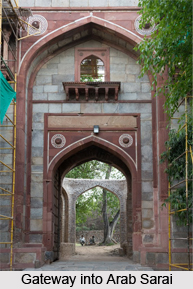
Arab-Sarai, DelhiArab Sarai was constructed by Haji Begum, Emperor Humayun`s widow. It was built in1560-61 to house the three hundred Arab mullas (priests), she is said to have brought with her from her pilgrimage to Mecca.

It is a big sarai (rest-house) with arched cells against its enclosure-walls. Almost all the cells are now in a dilapidated condition. The only structure worthy of notice is the northern gate, which is seen by the visitors on their right while proceeding to the emperor`s mausoleum after crossing Bu Halima`s Garden. The gate stands 12.2 metres high from its plinth and is built of local quartzite with red sandstone dressings and marble inlay. The main gate-chamber is hexagonal and was covered with a dome, now collapsed, with plastered interlace. Above the main arch of the gateway is a balcony window supported by six carved brackets, and on each side at the same level are more balcony windows with pyramidal domes enriched by yellow and blue tiles.

Arab-Sarai has two other gateways from the east and the west respectively. According to an inscription on the eastern gateway, that is close to the south-west corner of Humayun`s mausoleum, it was actually the entrance to a mandi (market), added to it by one Mihr Banu during the reign of Jahangir. The market consisted of a series of arched rooms, now in ruins.

As one approaches Humayun`s Tomb from Marhura Road, one passes through a rectangular enclosure with a tomb in its northern half and a gateway on its east. This is the entrance of Bu Halima`s Garden. Nothing is known about Bu Halima and the origin of the garden locally named after the lady but architecturally the enclosure-walls and the gateway of the garden belong to the early Mughal period (16th century). It was certainly built earlier than the Arab-Sarai, the northern wall of which abuts on the plastered exterior of the eastern garden-enclosure.

The garden is enclosed by rubble walls of local quartzite. Its eastern gateway is a simple structure consisting of an oblong main gate-chamber with octagonal wings. The central portion of the eastern gateway of Bu Halima`s Garden contains an ornamental arched recess, enclosing an arched doorway and a superimposed balcony-window supported by four brackets.

The facade was once decorated with brilliant coloured tiles, very little of which are still extant. As in other monuments in the Humayun`s Tomb complex, very little of the tile inlay work has survived the ravages of time and mankind. At the north-east and north-west corners of the enclosure-walls are octagonal bastions, surmounted by small domed chhattris with glazed tile work. The dilapidated structure in the north corner of the garden enclosure is said locally to contain the grave of Bu Halima.
Share this Article:

Related Articles

More Articles in Indian Monuments


Monuments of Punjab
Monuments of Punjab are the founding stones of the state. Punjab has numerous historical monuments and religious monuments scattered throughout its different cities.throughout its different cities.
Monuments of Lakshwadeep
Monuments of Lakshwadeep are famous for their ancient religious feel and historical value.
Monuments of Jharkhand
Monuments of Jharkhand are well maintained by the state government as these are popular tourist destinations. These monuments are remnants of the history of the region, narrating significant incidents from the past.
Monuments of Haryana
Monuments of Haryana represent the glorious culture and history dating back to thousands of years. These monuments are popular for their historical, religious, or political significance.
Monuments of West Bengal
Monuments of West Bengal, mainly from the British era, are considered as priceless heritage of the state and attracts many tourists to the state.
Monuments of Andaman And Nicobar Island
Monuments of Andaman and Nicobar Island loaded with their rich past unveils the history of India. Most of the monuments here are reminiscence of dark and brutal rule of the British Empire in India.
Monuments of Andhra Pradesh
Monuments of Andhra Pradesh represents several wonderful and glorious sagas of various ruling dynasties of the past. Most of these monuments are protected by the government for their architectural excellence and historical significance.
Monuments of Chhattisgarh
Monuments of Chhattisgarh have a significant role to play in the state`s tourism. The land has a rich cultural and political history that is reminiscent in the historical forts, palaces and temples of Chhattisgarh and are great tourist attractions.
Monuments of Telangana
Monuments of Telangana covers the ancient, medieval and modern historical structures illustrating the architectural grandeur and attracting thousands of tourists throughout the year.
Monuments of South India
Monuments of South India show strong Dravidian traditions and are located in Tamil Nadu, Kerala, Andhra Pradesh and Karnataka.
Tombs in India
Tombs in India are famous all over the world for their architectural beauty and most of these tombs have been built in the medieval period. Travellers from all across the globe throng these historical sites.
Daulat Khana
Daulat Khana complex belongs to the early phase of Nawabi construction in Lucknow. It was commissioned to be built by Nawab Asaf ud Daulah. The Daulat Khana Complex consists of the Shish Mahal, the Shish Mahal Ka Talab and the Baradari Shish Mahal.
Mahesh Vilas Palace
Mahesh Vilas Palace is located in the state of Uttar Pradesh amidst 35 acres of Lush Green Lawns, Fountains and Orchards.
Architecture Of Andhra Pradesh
Architecture of Andhra Pradesh is an illustration of diverse types of Hindu, Buddhist and Islamic architectural styles.
Architecture Of West Bengal
Architecture of West Bengal comprises Hindu temples, Muslim, Buddhist and Colonial monuments and the unique terracotta style.
Architecture of Lucknow
Architecture of Lucknow is mostly Islamic in nature. It is representative of 18th and 19th century Indian architecture. The architecture is broadly divided into religious architecture, such as that of Imambaras and secular architecture, such as that of Baradaris and Kothis.
Cheena Kottaram
Also known as the China Palace, the Cheena Kottaram used to be a rest house for the then King of Travancore.
History of British Architecture in India
History of British architecture in India had begun with a solemn promise, keeping no stones unturned. This line of architecture invaded in India from the early colonial times in the states like Delhi, Kolkata, Mushidabad and Pune.
Monuments of Assam
Monuments of Assam are timeless remnants of historical masterpieces which reflect the architecture of ancient Assam. these monuments are remnants of the glorious history of the region under different rulers.
Bharhut Stupa
Bharhut Stupa is situated between Jabalpur and Allahabad in the erstwhile Nagod state of Madhya Pradesh. In 1873, the place was discovered by Sir Alexander Cunningham.