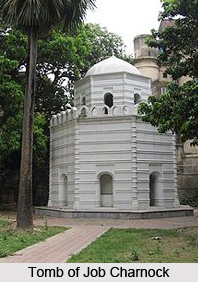
 Kalikata was one of the three villages in Bengal. The medieval era shows that Kalikata, Gobindapur and Sutanati as the three villages. After the Battle of Plassey in 1757 where Robert Clive on behalf of British East India Company defeated Siraj Ud Daullah, British East India Company in India with the basis of the lottery service from the rich Bengali people like Sethias and Basaks and from the compensation received after Battle of Plassey from Mir Zafar, established Calcutta as the capital and the main administrative unit in Bengal and India as well. Job Charnock, an administrator with the British East India Company is traditionally credited with the honour of founding the city. He settled in the village of Sutanuti.
Reference of Kalikata
Kalikata was much less important than Sutanuti and Gobindapur, and this, along with the consequent abundance of space, afforded the British room to settle there. While both Sutanati and Gobindapur appear on old maps of 1687 and George Herron"s of 1690, Kalikata situated between the two is not depicted.
Development of Sutanati
Job Charnock landed at Sutanuti on 24th August 1690 with the objective of establishing the Bengal Headquarter of British East India Company. As Kalikata did not have any settled native population, it was easy for the British to occupy the site. In 1696, construction of old Fort William began where now General Post Office established, without legal title to the land. Legal title was eventually secured on 10th November 1698 when Charles Eyre, Job Charnock"s son-in-law and ultimate successor, acquired the zamindari rights from the Sabarna Roy Choudhury family, the zamindars of the area.
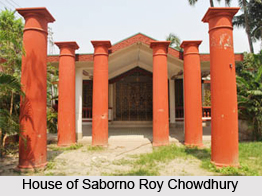 It is from this date that Kolkata came legally under British control. Sabarna Roy Choudhury family acquired the village of Kalikata, but they acquired a vast acreage by grant allegedly in 1608 from Raja Man Singh, a maternal cousin of the reigning Mughal emperor Jahangir. However, other sources state that a founder only impressed Man Singh in 1612.
Kalikata and Saborna Roy Chowdhury
The tenure of zamindari system of Saborno Roy Chowdhury was Kalikata, Sutanuti, and Gobindapur. Although in 1698, they were certainly the zemindars, or landlords, with their lands acquired by some sort of grant or lease from the Mughal emperors. They were apparently reluctant to transfer their rights as landlords but were forced to do so under pressure from the Mughal court.
From Kalikata to Calcutta
Kalikata was called "Calcutta" by the officers of British East India Company and the development took place with the hands of the officers of British East India Company and later the British Government of India after 1857.