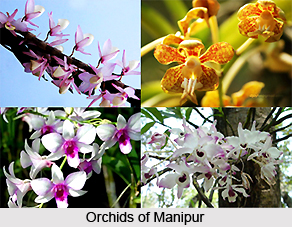
 Butterflies have captured the maximum interest of human beings among all interests. This is mainly due to its large size, beautiful colour patterns and universal occurrence in most parts of the world where man himself lives. Butterflies usually fly during the daytime unlike the moths which fly at night. Similarly they are different from the moths because butterflies have clubbed antennae.
Tropical forests, with their wealth of plant life and abundant sunshine, are a natural haven for most species of butterflies. But even temperate regions of the earth possess a diversity of butterfly species. The Indian subcontinent, with its rich diversity of habitats, from the ice-capped Himalaya Mountains to the parched Thar Desert in India, and from the lush, steamy tropical forests in Assam to the mangrove-lined sea coasts in peninsular India, is the home of around 1000 species of butterflies.
Butterflies have four life-stages-the egg, the larva, the pupa and the adult butterfly. The length of the life-cycle of a butterfly species usually takes three to four weeks: the egg and pupal stages occupying about a week each, while the larval stage may vary from a week to two weeks. The adult life-span is fairly long and may even exceed a year. Due to unfavourable climatic conditions or food scarcity, many butterflies undergo hibernation in any of their four stages. Since a life-cycle takes a month or so, theoretically there can be 12 generations in a year for most tropical butterflies. But certain optimum breeding requirements of temperature and food prevent most butterflies from producing so many broods; some may have just one brood a year and others may produce four or five.
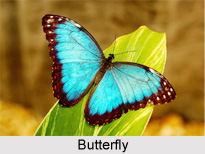 Most butterflies feed on the foliage of plants, especially fresh shoots, while some may bore fruit or pods or even are carnivorous and feed on other insects. The adult butterfly`s diet usually consists of flower nectar and free water. Besides this, some butterflies are also fond of animal dung and urine, fallen rotting fruit, tree sap, or even wood ash. Among their enemies are small parasitic wasps and flies that feed on the eggs, larvae or pupae, and the adults and larvae are prey for birds and many other insects and higher animals. For this reason, the larvae of many species of butterflies have protected themselves by warning or protective mimetic coloration or by developing "hairs` that carry poisonous chemicals.
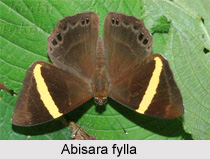
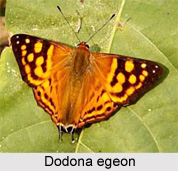
The Indian Butterflies are categorized into two families namely the Papilionoidea and the Hesperioidea. The Papilionidae includes some of the largest and most beautiful of all butterflies. Many possess `tails` on their rounded or elongate hind wings and their fore wings are generally dark brown or black with a variety of colourful markings on these somewhat broad pointed wings. The familiar Indian species are: Dodona egeon (Orange Punch), Abisara fylla (Dark Judy) and Taxila hurquinus (Harlequin).
The Blues, Coppers and Hairstreaks belong to the large family Lycaenidae which are mostly small butterflies with many species having tails on their hind wings. Their forelegs are perfect or slightly reduced and the male has a single claw.
 Their pupae are usually attached to leaves with a girdle and their larvae are smooth-bodied without long hairs and of a generally flattened shape. Like their names, these butterflies are usually blue or coppery above with brilliant metallic reflections and their wings are cryptically coloured on the lower surfaces. The colours of the upper and lower wings being so radically different, perhaps it helps to confuse the predator when the butterfly settles and closes its wings, and becomes very differently coloured from what it is in flight, with the showy upper surfaces of its wings in full view. These butterflies are very fond of the sun and will not fly on cloudy days. Some peculiar species feed on other insects like mealybugs and many species are tended by ants. A few lycaenids are known to cause damage to legume plants as they bore into the young pods. Another common `pest` is the species that bores into guava and pomegranate fruits.
Butterflies bear economic importance because they serve as agents of pollination and at the same time sometimes butterflies in their larval stage damage domestic crops and trees. Thus it can be said that butterflies are a delight for the onlookers with its vibrant hues.