
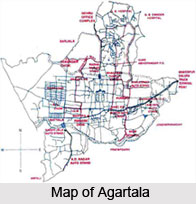
 Agartala is the capital of Indian state Tripura. Agartala is denoted as the second largest capital city in North east India. Agartala is rich in flora and fauna. The legendary state of Tripura is a fascinating world in itself. Agartala gained prominence when Maharaja Krishna Manikya shifted his capital here in the 19th century.
Agartala
Agartala is one of the busiest capital cities in North Eastern part of India. It is the capital city of Tripura covers many tourist spots of natural, archaeological and pilgrimage importance.
Introduction
Agartala is the capital of Indian state Tripura. Agartala is denoted as the second largest capital city in North east India. Agartala is rich in flora and fauna. The legendary state of Tripura is a fascinating world in itself. Agartala gained prominence when Maharaja Krishna Manikya shifted his capital here in the 19th century.Location of Agartala
History of Agartala
 History of Agartala is closely associated with the ancient, medieval and the modern history of Tripura. The ancient history covers the pre historic times to the rock arts of Unakoti, while the medieval era defines the glorious rule of Manikya kings of Tripura and later the British Government in India. Agartala is perched on the banks of Howrah River, the low-key capital city of Tripura-Agartala- attracts a large number of tourists for its past splendour.
Early History of Agartala : The name of the capital city of Tripura "Agartala" is derived from the words "Agar" and "tala" consisting of heavy density of "Agaru" trees. The term "Agar" was referred in the context of great king Raghu who tied up his Elephant feet with Agar tree on the banks of Lauhitya River in the mythological era. Then Agartala is also named in Indian epic Mahabharata. One of the earliest kings of Agartala was Patardan, who reigned the pre historic Agartala in 1900 BC. Chitrarath, Drikpati, Dharmapha, Loknath Jivandharan were the important kings during the time of ancient kingdoms in Agartala. It was the time long before the Manikya Dynasties of Tripura who were evolved in medieval era.
Medieval History of Agartala : Medieval History of Agartala shows the glorious rule of Maharaja Bir Bikram Kishore Manikya Bahadur, who was one of the most ambitious kings of Tripura. Under his reign, Tripura flourished as an independent North Eastern state in India. Maharaja Bir Bikram Kishore Manikya Bahadur is called the creator of the planned city of Agartala. He had gone for a tour in the United Kingdom and after returning to his kingdom he decided that he would make Agartala a mini United Kingdom that was during the 1940s when the town area was re-organised in a planned manner with new roads and a market building making a good comfort for the people of Agartala. In the medieval era, the land was formerly ruled by as many as 179 Hindu rulers, starting from mythological King Druhya to the last king of Tripura, Kirit Bikram Kishore Manikya. Apart from the great Hindu rule, Tripura also witnessed the glorious rule of the Mughal Empire in India. In 1760, Rangamati was shifted by the Maharaja Krishna Chandra Manikya Bahadur of Manikya Dynasty to present old capital of Tripura, Agartala by the bank of the river Haora-Saidra and was named `Haveli`.
 Modern History of Agartala : With the rise of British colonial power in India, the state of Tripura came under the governance of English Government in the year 1808. The ancient capital of the then Princely State `Swadhin Tripura` was at Rangamati which is now called Udaipur of South Tripura by the bank of the Gomati River. Due to frequent invasion of the Kukis and also to keep easy communication with the British Government in Bengal, the Maharaja Krishna Chandra Manikya started the process of shifting the capital from Old Haveli to New Haveli, which is known presently as Agartala in 1849. After the end of the reign of British East India Company, The British Government of India communicated with the Raja of Tripura. At that time, Agartala was the capital of the erstwhile `Hill Tippera` state, it became a municipality in 1874 to 1975, and in the year 1901 had the population of 9,513. The Princely state of Tripura has always remained as cake piece to the British and many other invaders, such happened when the Arakan soldiers attacked in the old capital of the state following which the king of Tripura responded to them in a tricky way by defeating the entire troop.
Agartala with the Independence of India : When India became independent in the year 1947, the people of Tripura started Ganamukti Parishad movement to include the state as the kingdom of India. The then queen of Tripura Maharani Kanchanprava Devi signed the agreement on 15th October 1949 permitting the government to merge the province with independent India. On 1st July 1963, Tripura became a centrally administered Union Territory and attained the status of full-fledged state on 21st January 1972. Agartala was named as the capital of Tripura. The Agartala Municipality was established during the reign of Maharaja Bir Chandra Manikya (1862-1896) within an area of 3 square miles.
Geography of Agartala
Agartala is situated in a plain along the Haora River, though the city also extends to the low lying hills on its northern parts.
Demography of Agartala
 According to the Population Census in the year 2001, the total literates in Agartala city are 343,633 of which 174,524 are males while 169,109 are females. The average literacy rate of Agartala city is 93.88 percent of which male and female literacy was 95.75 and 92.02 percent respectively. The sex ratio of Agartala city is 1002 per 1000 males. The child sex ratio of girls is 940 per 1000 boys.
Tourism in Agartala
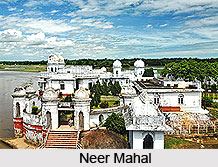 Tourism in Agartala defines the nature tourism sites, leisure tourism sites and the pilgrimage tourism sites. The history of Agartala also defines its tourism sectors. Some of the tourist important sites in Agartala are Ujjayanta Palace, Maharaja Bir Bikram College, Jagannath temple, Umamaheswar temple, Rose Valley Amusement Park and many other places, which are the centre of attraction of this place in North eastern part of India.
Maharaja Bir Bikram College : Maharaja Bir Bikram College of Tripura University is a prime tourist importance as this college has the bird sanctuary within. In this college, there exists a football ground, international cricket stadium and the picturesque lush landscapes and serene natural lakes.
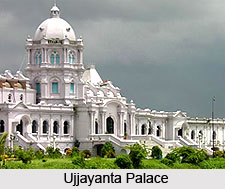
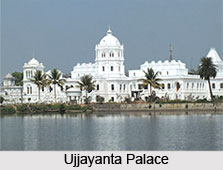
Ujjayanta Palace : Ujjayanta Palace is one of the most important tourist attractions in Tripura. Ujjayanta Palace was converted to state legislative assembly and now into a museum. This palace is situated in the area of Palace Compound which is one of the eye catching attractions in the state. It is a former royal palace in Agartala, the capital of the Indian state of Tripura, and also served as the meeting place of the Tripura Legislative Assembly until 2011. The area has decoded from the ruling landmark of the kings to the citizens of Tripura. The name Ujjayanta Palace was given by the Noble Laureate Rabindranath Tagore, who visited the state of Tripura quite a certain amount of times. Maharaja Bir Bikram was the last king of Tripura who ruled the state and was also the last king who stayed in his house in the palace.
Jagannath Temple : Jagannath temple is one of the Hindu temple of Vaishnava schools of thought in Agartala. This temple is dedicated to the Hindu Gods Lord Jagannath, Balabhadra and Subhadra. Jagannath temple was built in the 19th century by then Maharaja of Tripura, Maharaja Radha Kishore Manikya.
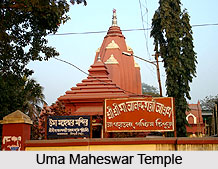
Umamaheswar Temple : Umamaheswar Temple is the Hindu temple of Shaiva and Shakti principles of Hinduism.
Venuban Buddha Vihar : Venuban Buddha Vihar is located at a distance of around 2 kilometres inside the city of Agartala. From the City centre is located the Venuban Vihar where a Buddha shrine houses a metal idol of Lord Buddha. The idol was primitively created in Burma now called Myanmar and was later transported to Venuban Vihar for installation into this shrine.
Other important places in Agartala are Krishna Mandir, Puratan Agartala (Old Agartala), Malancha Niwas, which was the house of Rabindranath Tagore, Rose Valley Amusement Park at Amtali, Agartala City Centre and many other places.
Recently updated articles in Cities of India
Places of Interest in Deogarh Uttar Pradesh
A place of historical and archaeological significance, Deogarh is a site with few popular places of interest.
Deoghar in Jharkhand
Deoghar is the divisional headquarters of Santhal Parganas located in Jharkhand and is popular for the famous Baidyanath temple and Shiva Temples.
The Asiatic Society of Mumbai
Asiatic Society in Mumbai is the temple of Asian Studies from the time of British rule in India.
Vasco da Gama / Vasco City
Vasco da Gama / Vasco is the biggest city of Goa and is one of the most visited for its perfect amalgamation of business as well as leisure options.
Agriculture of Ladakh
Agriculture in Ladakh is primarily practiced in the short summer season due to its cold desert climate. Farmers grow hardy crops like barley, wheat, p...
Related articles in Cities of India
Holy Cities of North India
Holy Cities of North India are having the rich history of Hinduism and the entire civilization was grown up with the hands of beliefs, rituals and the...
Holy Cities of South India
Holy Cities of South India gives the detailed cultural formation of Dravidians from the early era, which later developed to the world by the Pallavas...
Holy Cities of West India
Holy Cities in West India were established by the rulers of Rajputs and the Satvahana Dynasty and the medieval rulers of Junagadh.
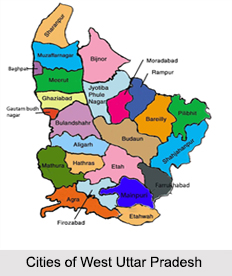
Cities of West Uttar Pradesh
Cities of West Uttar Pradesh include Meerut, Bulandshahr, Ghaziabad, Saharanpur, Muzaffarnagar, Bijnor, Bareilly, Rampur, Agra, Aligarh, Mathura and m...
Port Cities of South India
Port Cities of South India are developed from the early phase of colonial era when the Portuguese and the French traders came to India