 Thookkam dance is a traditional dance form practiced in the Kerala state of India. There are basically two types of Thookkam dances that are practiced in the South India namely Mayilpeeli Thookkam and Garudan Thookkam.
Mayilpeeli Thookkam
Mayilpeeli Thookkam also called "Arjuna Nritham" is a ritual art practiced in the Kerala state of India. It is performed by men of Ezhava community. The performance of this dance form is usually presented solo or in pairs. The various dance movements of Mayilpeeli Thookkam are similar to Kalarippayattu techniques.
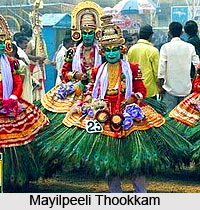
The costume of Mayilpeeli Thookkam comprise of a characteristic garment made of mayilppeeli which means "peacock feathers". Due to this costume, it is called "Mayilpeeli Thookkam". Also the performers paint their faces in green colour and wear unique headgears.
 The subjects of this dance deal with various themes of the Puranas. Before each song, the performers narrate the intricacies of the particular rhythm about to be employed and how this rhythm is translated into dance movements. The percussion instruments that accompany this dance form comprise of chenda, maddalam, talachenda and ilathalam (cymbal). Mayilpeeli Thookkam is prevalent in the Bhagavathy temples of south Kerala, mainly in the districts of Kollam, Alappuzha and Kottayam.
Garudan Thookkam
Garudan Thookkam (Eagle Hanging) is a ritual art form performed in the Kerala state of India. It is generally performed in the Kali temples of south India. A mythological story is associated with Garudan Thookkam. According to legends, even after slaying Darika, Goddess Kali remained thirsty. In order to quench Kali"s thirst Vishnu sent Garuda. A dancing but bleeding Garuda was taken to the goddess. Only after getting some drops of blood from Garuda, Kali was pacified. Garudan Thookkam is practiced based on this belief.
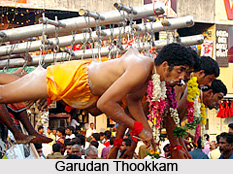
The performers dress up like Garuda. Once the dance performance is over, the hang-designate dangle from a shaft hooking the skin on his back. The ritual is more popular in the areas of Travancore and Kochi. During the time of Aswathi, Bharani days of Meenam Month, over forty to fifty numbers of Garudan can be seen performing. Adorned and floated in thoni vallams (big country-boats), they travel behind the Attuvela. Attuvela is basically a wooden structure constructed in the form of a three storied building. It is considered as the floating temple of the Goddess Kali in the Moovattupuzha River. After the night long performance, the Garudans - bleeding after the piercing of the skin on their back with a sharp metal hook is hung on a tall pedestal-like structure and taken thrice around the temple by the devotees. This can be seen at the Pazhaveedu temple at Alappuzha district.