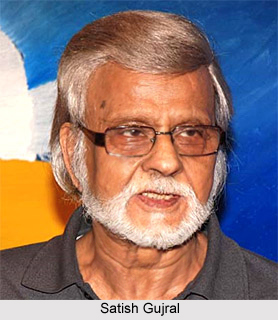
 Satish Gujral was born in Jhelum in 1925 in pre-partition West Punjab. He has won international recognition for diverse creativity which is evident in his painting, graphics, mural, sculpture, architecture and interior design. In 1939 he joined the Mayo School of Art in Lahore to study Applied Arts. Satish Gujral joined Sir J.J. School of Art in Mumbai in 1944 three years before the partition of India to study painting. During 1944-47 he came into contact with the Progressive Artists Group in Mumbai.
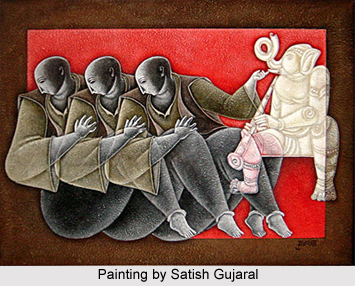
He had to discontinue studies in 1947 due to recurring illness. In 1952 he left for Mexico on a scholarship for an apprenticeship with Diego Rivera and David Sequeiros. Social content dominated his paintings and graphics. The anguish of the nations who lost their homes and families during the partition of the country came out in sweeping brushwork in his paintings. He diversified his sculptural materials with machined industrial objects in steel, copper, glass, often painted in strong enamel colors.
Since the late `80s up to the recent years, Satish Gujral`s paintings and sculptures have diversified both in terms of materials and content. He has also executed commissions to make large murals in mosaic and ceramic tiles and later in machined steel elements.
From 1952 to 1974 Satish Gujral had numerous solo exhibitions of his sculptures, paintings and graphics in Mexico City, New York, New Delhi, Mumbai, Kolkata, Montreal, Rome, Berlin, Tokyo, Buenos Aires and Stockholm. Since the late `80s up to the recent years, Satish Gujral`s paintings and sculptures further diversified both in terms of materials and content. His sculptures with burnt wood have a kind of slimily with the visceral forms of human and otherwise. Satish Gujral formed committees to make large murals, mostly in mosaic and ceramic tiles and later he took interest in machined steel elements as immediate architectural context.
 By 1977 Satish Gujral had made many murals for Punjab University, Chandigarh, Odeon Cinema, New Delhi (1962), World Trade Fair, New York (1963), Oberoi Hotel, New Delhi (1964), Northern Railway, New Delhi (1966), Ministry of Education, Shastri Bhavan, New Delhi (1968), Agricultural University, Hissar (1970, `73, `86), Oberoi Towers, Bombay (1971-72), The Palace of the Sultan of Muscat (1975), Delhi High Court (1976), Gandhi Institute, Mauritius (1977) and World Trade Centre, New York (1980). The year 1977 is important because in this year Satish Gujral started exploring the elusive vocabulary of International Style in modem architecture.
He designed the Daryani House, New Delhi (1977), Modi House (1978), Gandhi Institute (1978-79), Datwani House (1979- 90), Modi House (1980-82), Belgian Embassy, New Delhi (1980-83), and Dass House, New Delhi (1983-85). In 1986 Satish Gujral designed the Goa University and the CMC, Hyderabad, Palace AI-Bwordy, Dubai, and the Indian Ambassador`s house in Jakarta, Indonesia.
Since the early days of his career Satish Gujral has won several honors and recognition. Some of them can be named as The National Award for Painting (1956, 1957), National Award for Sculpture (1972), State Honour from the Government of Punjab (1979), and the Order of the Crown, Belgium, for Architecture (1983). Citizens of Delhi had honoured Gujral as one of its twenty-five most honourable citizens. In the year 1999 he was awarded by the highest accolade of Indian Government, the `Padma Vibhushan`.