


 Kazi Nazrul Islam also known as Quazi Nazrul Islam was the totem for revolution through his poetry and music had its crescendo in his able hands. Nazrul Islam was known for his fiery poems and moving songs; his greatness is incommensurate as is Tagore's. Though many of his poems are revolutionary in nature, he had also composed poems for children and in other genres. Kazi Nazrul Islam also known as Quazi Nazrul Islam was the totem for revolution through his poetry and music had its crescendo in his able hands. Nazrul Islam was known for his fiery poems and moving songs; his greatness is incommensurate as is Tagore's. Though many of his poems are revolutionary in nature, he had also composed poems for children and in other genres.
After India (Partition of India) was divided in 1947, Bangladesh recognised him their National Poet. He was one of the most versatile poets that Bengal ever witnessed. The poet conquered the home and the world with songs and compositions that were the result of a particular age but he himself quoted, "Even though I was born in this country (Bengal), in this society, I don't belong to just this country, this society. I belong to the world." The poet is alive still today. Resonances fill up the air with perpetual shouts of rebellion that he had implanted in every heart. So does the hope of seeing "One Great Union of Humanity". Early Life of Kazi Nazrul Islam Kazi Nazrul Islam was born on May 24, 1899 in Churulia village of Burdwan district, West Bengal. His father was an Imam of local mosque. His mother's name was Zaheda Khatun. He had two brothers and a sister. His father passed away when he was just 9 years old and hence he took up his father's job to support the family. He was often referred to as 'Dukhu Mian' or the Sad Man. From a tender age, Nazrul visited mosques and mausoleums and learnt Quran and Islamic theology. In 1910, he joined a 'leto' or travelling theatrical group which was run by his uncle. Nazrul wrote a number of folk plays for his group, which included Chasar San, Shakunibadh, Raja Yudhisthirer San, Data Karna, Akbar Badshah, Kavi Kalidas, Vidyabhutum, Rajputrer San, Buda Saliker Ghade Ron and Meghnad Badh. In 1912-13, he joined the Kabi troupe of Basudeva and then served as the cook to a railway guard and was an apprentice with a baker's shop. In 1914, he went to Mymensingh District (Bangladesh) and got admission in Shiarsol Raj School in class VII. During his school life Nazrul studied Bengali, Sanskrit, Arabic, Persian literature and classical music. From there he escaped Lahore to join the army to the Bengali Regiment before taking the Matriculation examination. Career of Kazi Nazrul Islam For a man as prolific as the poet laureate Nazrul, the ebbs and tides of fame touched him but only after his intimate association with aphasia and amnesia, his never failing friends. The lore of the followers still echo with the belief of slow poisoning by the British as the cause of deterioration of the poets health. His retreat to Calcutta in 1920 marked the writing of poetry, short stories essays, novels and songs. He joined the staff of the "Bangiya Mussalman Sahitya Samiti". He also worked as a newspaper editor, a film actor, a freedom fighter and a political worker. His first collection of poems "Bodhan", "Shat-il-Arab", "Kheya-parer Tarani" and "Badal Prater Sharab" got lots of critical accolades. In October 1921, Nazrul went to Santiniketan to meet Rabindranath Tagore. Despite many differences, Nazrul looked to Tagore as a mentor and the two were pretty close to each other. He also wrote a memorable poem on Rabindranath Tagore's death. Works of Kazi Nazrul Islam His first anthology of poems was "Agniveena" in 1922, which got outstanding success. In this year his famous poem collection 'Bidrohi' was published. He also published his first volume of short stories, the "Byather Dan" and "Yugbani", an anthology of essays in this year. 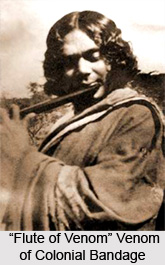
He received the title of 'Bidrohi Kabi' for his revolutionary writings. Fire oozed through his writings as he penned down: "I am the eternal rebel/ I raise my head beyond the world/ High ever erect and alone". 1922 witnessed the Rebel Poet's publication of 'Bidrohi' which manufactured a fierce insurmountable spree of hard-nosed nationalism in the hearts of the young Indians, and bred abysmal fear in the minds of the British. Kazi Nazrul Islam and the sobriquet that he is best known by today, is a remnant of that very cult that the poet had given birth to with his poem 'Bidrohi'. Till date, it is lauded as his most famous work, and till date he remains best known as Bidrohi Kobi (The Rebel Poet). Nazrul started a bi-weekly magazine, "Dhumketu" on August 12, 1922 where he used to write revolutionary poems, articles etc. His passionate activism in the Indian independence movement through those writings often led to his imprisonment several times by British government. While in prison, Nazrul wrote the "Rajbandir Jabanbandi" and condemned Islamic fundamentalism, orthodox traditions and bigotry in society. Upholding the life and abysmal conditions of the downtrodden masses of India, Nazrul advocated for their emancipation. An epitome of a rebel with a cause who nursed a binary hatred for oppression and fascism, a spiritual visionary who hardly down in front of his detractors, an idealist Nazrul was a man who was the genius incarnate who emblazoned the consciousness of the unconscious mind. Nazrul's visionary philosophy, a deep-seated love for equality of men and women makes him one of the first vocal feminists that the country has ever known. As he writes:" I don't see any difference/Between a man and woman/Whatever great or benevolent achievements/That are in this world/Half of that was by woman,/The other half by man." At a time when women were thought to have been born either to aid men in their way or to spend all their lives trying to rise to the expectations of men! He wrote over 2600 songs. To bring variations in his songs not only he used 200 ragas of classical music but also adapted different forms like- Dhrupad, Khayal, Tappa, Thumri, Dadra, Kajri, Chaiti, Rasia, Ghazal, Kirtan, Baul, Jhumur, Santhali Folksongs, Jhanpan Or The Folk Songs Of Snake Charmers, Bhatiali, Bhaoaia And Even Western Music. He retrieved some lost ragas and created few ragas and talas. His songs on communal harmony, socialistic inspiration and economic freedom are worth a special mention. Despite being a Muslim by birth, he composed several devotional songs like Bhajans, Shyamasangeets, Agamanis, Kirtans and also a large number of religious songs on invocation to Lord Shiva, Goddess Lakshmi and Goddess Swaraswati and on the theme of love of Radha and Krishna. Nazrul's emancipated thoughts made him what he is. His works have been banned innumerable times only to forecast the fact that he was much, much ahead of his times. Achievements of Kazi Nazrul Islam His biggest contribution was that he increased the horizon of Bengali literature. Nazrul was awarded the Jagattarini Gold Medal in 1945 - the highest honour for work in Bengali literature by the University of Calcutta. He was awarded the Padma Bhushan in 1960. He received Ekushey Padak by the Government of Bangladesh and was given the Honorary D.Litt. by the University of Dhaka. 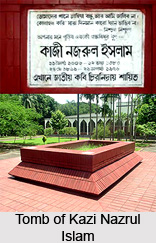 Personal Life of Kazi Nazrul Islam
In 1921 he was engaged to have marriage with Nargis, the daughter of a well known Bangladeshi publisher Ali Akbar Khan. On 18th June 1921, Nazrul walked away from the marriage ceremony. Later he married Pramila on 25 April 1924. Pramila belonged to the Brahmo Samaj, which criticised her marriage to a Muslim. His personal life was fraught with depressing realities and venomous pangs of pain. Losing both his sons to then-incurable illnesses, the dejected father sought shelter in music and poetry. He combined devotional music from Hinduism and Islam gave rise to a beautiful amalgam. Himself born a Muslim, Nazrul never believed in religious fanaticism. His works bear undying testimony to his absolutely secular loyalties, and he never left a stone unturned in his yet-unachieved goal of harmony between the two religions. After a sudden attack of paralysis on July 10, 1942, he was completely bedridden. He breathed his last on August 29, 1976 at the age of 77. When a flame burns progressively lighting a soul and the unquenched thirst for the right pulsates in a heart, poetry dons a fierce mantle. Nazrul continues to burn bright amidst the darkness of the night of human civilization like a tempest that traversed the heaven and earth and the world beyond. |
| |||



Home > Reference > Indian Literature > Regional Indian Literature > Bengali Literature > Kazi Nazrul Islam
Kazi Nazrul Islam
| The rebellious poet and literary genius, Kazi Nazrul Islam structured the Bengali literature most eloquently. |
| ||||||||||||||||||||||||||||

