Introduction
Costumes of Sikkim reflect the social and cultural lifestyle of the major communities namely Lepchas, Bhutias and Nepalis. All the three communities that are the Lepchas, Bhutias and Nepalis wear different costumes which further add to the variety that is found in the state. However, in the cities and urbanised sectors of the state, Marwaris, Biharis, Bengalis, South Indians and Punjabis, have settled to conduct business and serve in government services. The original inhabitants of Sikkim, the Lepchas, flaunt themselves in costumes, furnished with resplendent colours.
Male Costume of Sikkim
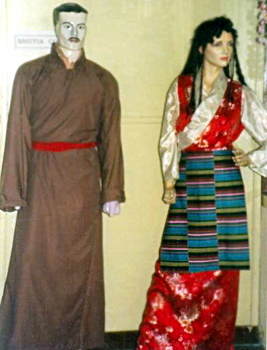
The traditional costume of the Lepcha male is Thokro-Dum which involves a white pajama, stretching only to the calves, Yenthatse, a Lepcha shirt and Shambo, the cap. The texture of the male dress is rough, and long-lasting, suitable for the hardy toil in the field and forest. The traditional costume of Bhutia males comprises Kho, also known as Bakhu. It is a loose mantle which is tied at the neck on one side, and at the waist region with a silk or cotton belt. Added to this basic garment, a Bhutia man dons Jya Jya, a waist coat, the shirt, called, Yenthatse, shirt, Kera, a cloth-belt and Shambo, the cap. Nepali, another predominant group of Sikkim, has sustained the ethnicity of their own culture in their costume. The Nepalese men dress themselves in Shurval, a Churidar Pajama, topped off by a shirt, known as Daura. It is associated with Aaskot, wrist coat and their belt, called Patuki.
Bakhu Dress of Sikkim
Sikkimese men don traditional attire that includes the bakhu, tohr, dotho, and tharo. The bakhu, a woolen robe with vibrant borders, represents the warrior spirit and serves as the focal point of the ensemble. Beneath the bakhu, they wear the tohr, a shirt that adds comfort and structure. Completing the outfit is the dotho, a wraparound skirt tied at the waist, adding a distinctive touch to their cultural dress.
Thokro-Dum Dress of Sikkim
The Thokro-Dum is the traditional attire of the Lepcha community, often worn by male bread makers. This outfit features a white, calf-length pajama that closely resembles the attire of a karate practitioner. It is paired with the Yenthatse, a Lepcha shirt, and the Shambo, an embroidered cap. A vibrant, hand-woven cloth called the Dumpra is draped over one shoulder and secured with a waistband, adding a splash of color to the ensemble.
The short pajama length reflects the community’s origins in marshy areas, designed for practicality. Made from rough, durable fabric, the outfit is ideal for enduring the rigors of fieldwork. Additionally, traditional cone-shaped hats crafted from bamboo and rattan are often worn, enhancing both functionality and cultural identity.
Female Costume of Sikkim

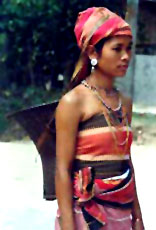
The hereditary costume of Lepcha women is Dumvum or Dumdyam, a kind of smooth and cosy ankle-long dress, draped like a saree, Tago a loose-fitting comfortable blouse, Nyamrek, a belt and Taro, a cap. The magnificent ornaments exhibited by the Lepcha women, entail, earrings, called Namchok, Lyak a necklace, Gyar, a bracelet, and so on. The Bhutia community, hailing from the adjacent country of Tibet, has over years become rooted in the culture and social norms of Sikkim. A Bhutia woman`s general costume consists of Kho or Bakhu, Hanju, a silky full-sleeve loose blouse, Kushen, a jacket, a different pattern of the cap, Shambo and Shabchu, the shoe. Pangden, the stripy apron, the signifier of marital status is a symbol of married Bhutia females. The ornaments enhancing the appearance of the Bhutia women are Yencho, the earring, Khao, the necklace, Phiru, the pearl ornament, Diu, the Gold bangle, and Joko, the ring. Bhutia people are obsessed with the pure form of gold, i.e., 24 carats, and have most of their ornaments crafted from pure gold.
The traditional costume of the Nepali women of Sikkim is endowed with fabulous hues. Pharia, the saree, gorgeous in vibrant shades, definitely augments the grace of the Nepali women. The dressing gets the right finish with a long loose blouse, is fastened from four sides and hence is called Chaubandi Cholo. Another variety in blouse is the Tharo Cholo. The upper portion of the body is daintily enveloped with a piece of cloth with wonderful prints. It is called Hembari.
The dance costume of the Nepali women is amazing. Pachauri, a colourful piece of cloth, suspended from the head to the waist, is utilised as adornment during dance performances. The ornaments that give a gaudy appearance to the Nepalese women are Sir-Bandi or tiara, i.e., a jewelled head-ornament, Kantha, a necklace, Naugeri, a pearl-necklace, Charanihari, again a necklace, Tilhari, a green bead with an elongated gold pendant, attired mainly by married women, Bulaki, a nose-ring, Dungri, a nose-pin, Tik-mala, Chandrahar, Chepti son, an ear ring, Gadwari, an ear ring, a silver Chura, a bracelet, and Kalli, a thick, substantial, silver anklet.
Kho Dress of Sikkim
The Kho is a loose, cloak-like garment fastened at the neck and secured at the waist with a silk or cotton belt. Traditionally worn by women of the Bhutia tribe in Sikkim, it is a variation of the bakhu. Over time, the bakhu has evolved, with modern women often styling it with jeans, adding a contemporary, Western flair to the traditional attire.
Dumvum Saree of Sikkim
Lepcha women traditionally wear the Dumvum or Dumyam, an ankle-length, sari-like garment known for its silky texture, blending comfort with cultural elegance. Underneath, they pair it with a loose-fitting blouse called the Tago, often in a contrasting color. The look is completed with the Nyamrek, a belt, and the Taro, a cap. A scarf known as Gorey is also commonly used to cover the head.
A fascinating distinction exists between the attire of Lepcha men and women. The men wear the Thokro-Dum, a calf-length bottom designed for marshy terrains, reflecting their connection to the land. In contrast, the flowing Dumvum suggests the women’s association with dry-land areas. Men’s clothing is coarse and durable, suited to their labor-intensive work in fields and forests, while women’s attire is crafted from lighter, softer fabrics, emphasizing grace and femininity.
Dresses of Other Communities in Sikkim
The other Marwari, Bihari, Bengali or Punjabi communities cater to their traditional costumes of salwar-kameez dupatta, saree, woolen textiles, and even to Western outfit, like jeans, T-shirts, trousers, anything which suits their taste and preferences.
Costumes of Sikkim, reflects in the resplendence of the dress and ornaments of the people, their love for beauty and inventive finesse.