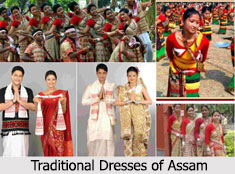
 The traditional dresses of Assam consist of the Muga or the golden silk fibre which has a huge demand in the global market. Besides the `Muga` variety there is the `Eri` and the `Paat` that are being used mostly in the making of traditional clothes in Assam. The former is used to make winter garments especially shawls called `Eri Chadar` and the latter is used for the making of `Mekhela Chadar.`
The `Muga` is the most important and the most preferred wild silk all over India and is the main cause behind the exquisiteness and elegance of the Assam Silk saris. The delicate designs, finely woven on the saris cater to patterns in nature, for example, the flora and fauna. Embroideries also incorporate, acquainted and culture-related things, such as architecture and stone sculptures on the Madan Kamdev Temple in Assam.
Traditional Garments for Assamese Men and Women
The fabric might be the same but men and women have different sets and styles of traditional attire in Assam. Following are the traditional dresses of Assam described in detail.
Mekhela Chador
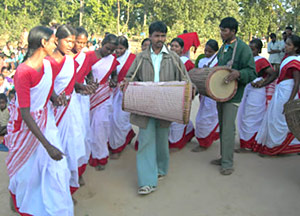
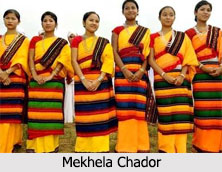
The Mekhela Chador is the traditional dress for the women of Assam. It is worn by women of all ages except children. This two piece garment has a long piece of cloth that is draped from the waist downwards and is then folded into pleats and tucked in. This piece is called the Mekhela. The upper part of the dress is the Chador that is also a long piece of cloth whose one end is tucked into the Mekhela, and then the rest is wrapped around the body. This Chador is worn with triangular folds, the art of which can be mastered only by sheer practice.
Dhoti and Gamosa
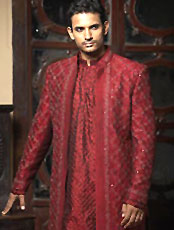
The traditional dress for men in Assam is the Dhoti and Gamosa. The Dhoti is used to cover the lower half of the body and the Gamosa is a rectangular piece of cloth that is an important and significant part of the Assamese culture. Gamosa means `A cloth to wipe one`s body` and is a white cloth with a beautiful red border on three sides and woven motifs on the remaining one. It is a piece of clothing that has some great significance in this state hence it is also used to felicitate and honour people who achieve some great feat. The Gamosa can be used as a cloth to wipe or can be transformed into a waistcoat which is commonly known as the Tongali. It can also be used as a Loincloth by a Bihu dancer.
Tongali
Tongali is a form of gamosa worn in a different way. People who wear Gamosa take the cloth in two ways. Either they wear it as it is, or create a waistcoat of it which is known as Tongali. Nowadays, people have created a number of options in terms of style and material.
Aronai
Initially was worn by saints, Aronai has been passed on to the people of Assam as a traditional dress. It is said that Aronai is deeply rooted in their culture right from the very beginning. This dress is popular among the Bodo tribe. It is originally a piece of cloth which is presently used to felicitate people publicly
Sgaopha and Phagri
Sgaopha and Phagri is a popular dress of the Dimasa tribe of Assam and are close to their tradition. It is a two-piece cloth that usually symbolizes pride and identity in the society.
 Rigdo
Rigdo
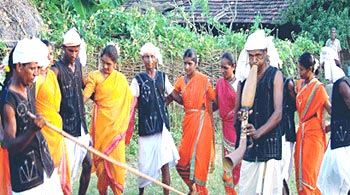
Rigdo is a kind of muffler worn by Dimasa tribe with any traditional attire. This beautiful woven muffler has gorgeous patterns and can be paired with any dress.
Risha and Gainthao
This traditional attire is mainly worn in the form of dhoti by Dimasa tribe. Risha and Gainthao are similar in designs and style with the only difference in size. Risha is a dhoti that reaches only the knee whereas Gainthao goes all the way to the ankle.
Rigu
Rigu is a traditional cloth worn by tribal women in Assam. This piece of cloth is worn down the waist line and it is quite a long cloth. Originally, Rigu is an ankle-length cloth made of Muga silk material.
Experiment of the Muga Artists on the Traditional Dresses of Assam
Nowadays, Muga artisans, indulge in experimentation. They offer contrast creations of pinkish red or greenish blue and other innovative as well as traditional colours of red, blue, yellow and green, against the inherent golden colour of the fabric. The Assam silk saris are bridal wears which are designed with gold and silver threads that add an elegant touch to the bride"s entire ensemble on her special occasion. This high quality textile of Assam, Muga silk, serves as the material-base, even for Mekhela Chador, which is another one of the traditional dresses of Assam.
Hub of Traditional Dresses of Assam
Sualkuchi is the place where the world famous Assam silk is grown. Various varieties, such as, Golden Muga, the White Pat and the warm Eri are grown here. It is situated at a distance of 32 km from Guwahati. This village is often called the "Manchester of the East". Amongst all varieties of silk that are grown here, the best is Muga. The golden silk of Assam is exceptional to this state.
Traditional Dresses of the Assamese Tribes
The tribes of Assam have inhabited the area for ages. They are often recognised as the first inhabitants of the land who belong to various tribal groups. The tribes show the indigenous side of the state. Listed below are some of the tribes and their traditional dresses:
Bodo Tribe
The Bodo Tribe of Assam resides amidst the lush greenery of the region. The Bodo tribal womenfolk acknowledge Mekhela as their prevalent costume. Along with the Chador, an upper-wrap called Riha is also a part of the traditional attire. In fact, this happens to be the usual costume of the rustic people of Assam. The men of the Bodo tribe, dresses themselves in Dhoti and Chador, which is made from Endi.
Dimasa Tribe
The dressing style of Dimasa Tribe in Assam is very similar to the Bodo tribe. The men and women of Dimasa wear clothes made in looms of household. The women of this tribe wear Rigu which is skirt-like attire. It is usually made of silk or Endi. On top they wear a vest-like cloth, called Rijamphai. The women folk also wear attire called Rikhaosa while dancing. The Dimasa men wear costumes called Rica or Dhuni. They also sport beautifully designed scarf known as Rinsaso. He also attaches on his head, a turban woven from pure cotton or Endi, which is 19 meters in length.
Thai Phake Tribe
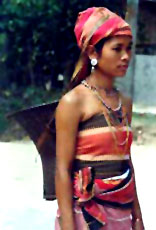
A Thai Phake woman uses a striped girdle, called Chin which stretches from the waist down to the ankles. There exists a cloth belt encircling her waist, it is called Chairchin. It has a width of about 6 cm and a length of 1.5 m. Young girls wear a similar upper-cloth structure, with the only difference being in size and is known as Fafek. The Thai Phake women pair their attires with multi-coloured blouse, called Chekhamchum.
The costume of the Thai Phake man is to some extent same. The men wear a chequered green loin cloth, invested with black stripes and red, yellow or white lining, called Fatong. Upwards, he matches his Fatong, with a shirt called Sho. He also bears a white turban called Fa ho ho. While venturing out, the Thai Phake men, adorns themselves in a white shirt with long sleeves, enriched with a plain bordered white shawl called Fa fek mai. Jewellery is a fundamental aspect of costume of any place. The remarkable feature of Assamese jewellery is Khopo Phool, an earring which appears like an orchid.
Gaam Kharu is a large-sized silver bangle with shimmering gold polish. Another fashionable earring is Lokaporo, wherein two gold or ruby or mina or enamel-plated, bird figures are conjoined together, back to back. Assamese costume has cast an enchanting spell on not only India, but on foreign nations also, because of their mind-blowing perfection.
Mech Kachcharis Tribe
Mech Kachcharis wear ordinary dresses that are hand spun and hand woven. The men wear dhoti, turban and endi shawl or chaddar while the women wear dress like Assamese Mekhela Chador.
Radhas Tribe
The people belonging to Rabha tribe in Assam wear typical costumes known as koum kontong that are woven by women on the back-strap loom. These costumes are usually very elegant and colourful costume that is wrapped around as a skirt around their waists. A kambang covers the upper part of the body in the nature of a stole. Rabha women also adorn themselves with colourful blouses that they make themselves. The women also wear a delicate belt made of several, small conch shells or pearl balls around their abdomen that is known as labok.
Mishing Tribe
The women of the Mishing tribe wear simplistic traditional dresses. Additional piece of cloths are worn by the married women around the hip. The upper portion of the body remains covered by Galuk. The women also adorn themselves with headdress known as Hura. Women wear a self-woven loin cloth, which is known as Gaseng Kebbung, is the upper garment covered round just below the shoulders. Beautiful shawls or Ribi Gaseng is used mainly during the winter season and during festivals.
The males dress themselves in white dhoti as the lower garment and wear a white bush shirt or kurta as the upper garment. They also wear a turban on the head. The men also wear a cover coat with parallel and stripe design known as Mibu.