The `official language` of the Republic of India is Hindi, with English serving as its auxiliary official language. In this context, substantial information that is noticed is that Indian states can `legislate` their own official languages, because neither the Constitution of India, nor any Indian law determines the status of `national language`. States designate their own official languages by the process of legislation. The part of the Constitution of India dealing with official languages assimilates detailed provisos, which are related not only with the languages employed for official purposes of the Union, but also with the languages that are to be utilised for official purposes of each state and union territory in the country. The section of the Constitution also deals with the languages that are to be employed for communication between the union and the states or amongst themselves.
During the time the Indian Constitution came into force, English was employed for most official purposes, both at the central and various state levels. The Constitution makers meanwhile, had envisioned about the gradual introduction of local languages, predominantly Hindi, to replace English over a fifteen-year period. The status of `Indian official languages` was then, hanging in mid-air, awaiting its enforcement into a law. However, the Constitution vested powers upon the Parliament, by law, to furnish for the continued usage of English even thereafter. In accordance, English continues to be employed still in present times, in combination with Hindi (at the central level and in some states) and other languages (at the state level). One sole reason behind English language being used to this date as a prominent Indian language, rests absolutely upon the British Empire domination and reigning for 200 years. The legal framework leading the utilisation of languages for official purposes currently includes the Constitution, the Official Languages Act, 1963, Official Languages (Use for Official Purpose of the Union) Rules, 1976, and several state laws, in addition to rules and regulations created by the central government and states.
 In addition to the languages to be employed by the Union government, the Constitution of India conceives of a situation of having each state its own official language. After Indian Independence the government decided that the official language of India would be Hindi language, belonging to the family of Indo-Aryan languages. But the speakers of other languages, more specifically the Dravidian languages, stood in direct opposition. Basically they were affrighted of loosing their language culture. There however stood a valid reason why Hindi should be chosen as the official language in India; the question was not just that it was the most-commonly spoken language, but it was intrinsically linked with Indian history long before its Independence.
The different states of India posses their different official languages, some of which are not recognised by the Central government. Some states have more then one official language. For instance, Bihar in east India has three official languages, namely Hindi, Urdu and Bengali, all recognised by the Central government. But in Sikkim there exists four official languages, out of which only Nepali is recognised by the Central administration. Besides the languages officially recognised by union or state governments, there also exists other languages also which do not have this recognition.
Now as decided by the Union Government, every state in India has its own official language. In this manner, Punjabi, Bengali, Hindi, Oriya, Chhattisgarhi, etc. are presently counted as official languages, whereas Sadri, Nimadi, Sindhi, etc. are not included in the list.
Official languages of India Apart from Hindi and English, a total of 21 other languages are recognized as official languages by the Constitution of India:
| Bengali | Nepali |
| Bodo | Oriya |
| Dogri | Punjabi |
| Gujarati | Sanskrit |
| Kannada | Santhali |
| Kashmiri | Sindhi |
| Konkani | Tamil |
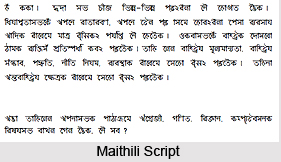
| Maithili | Telugu |
| Malayalam | Urdu |
| Manupuri |