Introduction
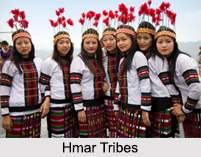 Hmar Tribes is one of the tribes of North East India who are settled in Manipur since 1872. They are a distinct community as far as their traditions, culture and social customs are concerned. The Hmars belong to the Chin-Kuki-Mizo group of tribes, and are recognised as Scheduled Tribe under the Constitution of India.
Origin of Hmar Tribes
Hmar Tribes claim their origin from the Singlung which is located in central or south-west China. Ancestors of Hmar belong to the Chinese dynasty. They are found in Rippaimukh area, Jiribam and Khuga areas and Churachandpur area of Manipur. Hmar tribes mostly reside in the southern area of Manipur, especially in the districts of Churachandpur and its neighbouring regions. This area comprises Tuthaphai, and mighty rivers like Tuiruong (Barak), Tuivai and Tuithapui (Khuga) also flow through this area, thus making the place quite ideal for the tribes to settle down in large numbers.
Clans of Hmar Tribes
The Hmar society is based on clan system. They are Biete, Changsan, Chawrai, Darngawn, Faihrien, Hmarlusei Hrangchal, Hrangkhawlh, Khawbung, Khawlun, Khawlhing, Klielth, Leiri, Lungtace, Ngente, Ngurte, Pakhuong, Sakechek, Sakum, Thiek, Vatigsie and Zote. Each clan had a dialect of its own though now-a-days a common dialect used by the Hmar People was developed by Christian missionaries. The chief of the village council is called "Lal". He is selected from amongst the youngest son except Leiri and Faihrien Clans. Everybody follows his leadership and directive.
Society of Hmar Tribes
The society is patrilineal and patriarchal in nature. Father is the head of the family. Joint family is common among them. The clan is not exogamous in Hmar society. They practice both inter-clean and intra-clan marriage. Ultimo geniture is the law of inheritance in Hmar society. 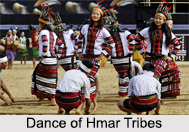
Among the Hmar, the dormitory for the unmarried boys is called "Buomzolor" or "Zawlbuk" and "Numghakleng" for the dormitory of the girls. Training is provided to all members of dormitories. Tribal war, hunting, wrestling, village self government, obedience, art of singing and dancing, codes and conduct of the society, customary behaviour are the main aspects of training.
House of Hmar Tribes
The villages of Hmar tribe are usually set on top of hills. The house constructed by them has four chambers - Sawangka, Sussphuk, Hall and Namlhlak. Sawangka is meant for entertaining the visitors, Sussphuk is meant for winnowing of the grain, spinning, pounding and husking. Hall serves the purpose of bed room, living room and dining room. Namthlak serves the purpose of waiting room for guests.
Economic Life of Hmar Tribes
The Hmar tribes depend on forest products. Their economy can be classified dually -traditional and subsidiary occupations. Shifting cultivation is the main and traditional occupation and blacksmith, carpentry, poultry, basketry, priesthood, herbal medicine are subsidiary occupation. They are economically backward. Paddy, maize, millet, chilli, potatoes, mash melon, beans, cucumber, watermelon are the main crops of shifting cultivation.
Religious Life of Hmar Tribes
Hmars worship supernatural beings. "Pathien" is the supreme God. They do not worship any celestial bodies like the sun, the moon and stars. They worship the mountains, rocks, big trees, rivers and water springs. There is the concept of life after death. They believe that the soul of brave and noble men go to the heavenly place called Pielral. The souls of pious and holy persons go to the heavenly abode.
Festivals of Hmar Tribes
The traditional festivals of Hmar tribe include Siel-sun, In-ching, Buinei, Khongchoi, Butukhonglom, Lomjii and Chavang Kut. Siel-sun is a sacrificial festival of the wild animals a man had killed in hunting and war.
Dance and Music of Hmar Tribes
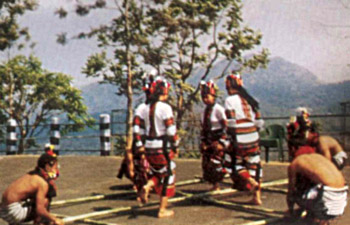 Expertise is shown in the representation of adventure, battle, love, victory and other experiences throughout history in the folk dances of Hmar tribe. Dance is closely related with the expression of joy after a good harvest, on the success of hunting expedition, to ward off grief on the death of an important person, expression of joy in festivals and to speed up work progress in the fields.
Without the co ordination of the people dance and songs cannot be performed. Chawn-lam or festive dance, Dar-lam or funeral dance, Pheipheet-lam or war dance, Hrang-lam or head hunting dance, Tinna-Hla-lam or parting dance are common dances of the Hmar community. Dances are based on the rhythmic tunes of musical instruments. Various folksongs are sung along with the dances.
Chawn-lam
This is the main dance of the Hmar tribes. Chawn-lam is a dance that is performed during the harvesting festival. It is performed both by male and female. The boys and girls are arranged systematically outside the dancing place. Each row is headed by leader of each gender. Then they enter the dancing ground. Each row jumps face to face according to the sounds of drums. Each dance has its specific style of drumming. Gong string, bell bangles are the additional musical instrument which make the dancing more pleasing. The boys are expert in beating the drums according to the need of the rhythmic tunes. Jumping, stepping and other activities pertaining to dance are done according to the line of song and rhythmic tunes of musical instruments.
Dar-lam dance
This is a funeral dance which is performed when a chief person dies in the village. It is done to pay their last respect to the departed soul. The person of sixty to seventy years is considered important if he has served the society for the well being of the community. The procession is accompanied by musicians and dancers who perform this dance up to the graveyard. When the dead body is ultimately buried at funeral ground the procession comes back singing and dancing to the house of the family where in death had taken place.
Pheipheet-lam
This dance is to celebrate the victory of raid or head hunting. This is a symbol of a mark of bravery and honour of the warriors. The hunted heads are hung in the courtyard of one of the warrior`s house. The warriors wear their best clothes which has specific designs, put on headgear which is made up of red and black cotton, hold a gun in their hand and go around the post on the top of which the hunted heads are hung. Friends holding bamboo pipes accompany them. At the same time musicians are standing in a group in a corner and beating on drum, gong and bangles.
Hrang-lam
This dance is performed jointly by both men and women. Women occupy places in between men. While dancing the warrior enters the ground, chanting the hunter`s cry and fire gun shots. The other dancers go round the head thrice before taking a break. In this dance people erect a long bamboo over which the hunted head is hung. Dancing and singing continues day and night. During the dance the warrior enters in the middle, pulling the hand of his wife that appears to show like the flying of birds. It is followed by a scene where of weeping by the wife and her husband dries her tears.