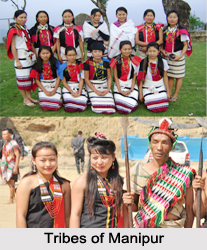
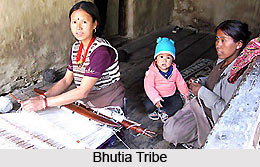
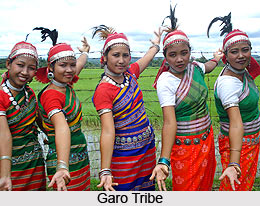
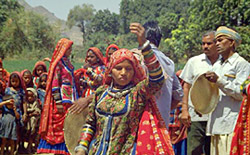
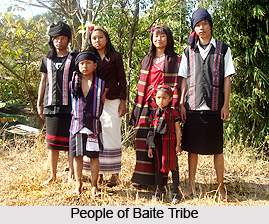
 Baite tribe has gained prominence as one of the important tribes of north-eastern province of Indian subcontinent. The etymological significance of the term Baite suggests `one who cannot walk properly due to injury`. Mainly located in the hilly regions of Indian state of Manipur, Baite tribes are quite attractive to look at with their curly darkish hair and medium body stature. The famous scholar G.A. Grierson claims that the Baite tribal community is closely linked with `Rangkhol`, and due to their close association with the Rangkhol tribes, Baite tribes were being thrown out of the Lushai Hills by the Thadous.
Origin of Baite Tribe
The origin and birth of the Baite tribal community has an interesting story behind it. The Baite tribe believes that they came down from `Khul`, which means cave. There is a myth related to their arrival from the cave. Songza and Zahong, the ancient tribes, once resided together in the sub-terranian world. It was their ancestor Zahong who made up their minds to come to the Chungkha. The story adds that when a huge serpent called Gulheopi tried to close the door of the cave, Zahong cut the serpent into three pieces with his sword. After that he came out of the cave and others too followed him.
Distribution of Baite Tribe
Presently, Baite tribes have comfortably settled down in sixty seven villages. Out of these villages, fifty are found in Manipur state while the rest seventeen are being situated in the beautiful state of Assam. As per the recent demographic report, amongst the total population of ten thousand of Baite tribes, three thousand and five hundred have already settled in the Assam and its adjoining region. Amongst various districts where Baite tribes can be located in Manipur state Ukhrul, Senapati, Churachandpur, Chandel and Thoubal deserve special mentioning.
Society of Baite Tribe
The whole of the Baite society has a proper structure in order to ensure that they can run a good system of administration. Generally, the whole of the society has been consisted of twelve clans. Quite a number of a sub-clans and lineages too are found with in the societal structure of the Baite tribes. The well-formatted society of Baiga tribes has delineated standard social rituals and practices. The society of this tribal community is matrilineal. Marriages, just like any other matrilineal society, have a preference for cross cousin marriage lines. Ideal for a normal Baite is to get married to the daughter of his maternal uncle. Both the parents of the bride and groom gives consent and also fixes this kind of marriage and is popular amongst the locales as the `Chongmou`. Often due to premarital pregnancy, a man gets married to the woman and this marriage is acclaimed as `Jolgai`. Main occupation of the Baite tribes is Lou Jhum or shifting cultivation. Rice is the staple food, appended by various cash crops. Some of the Baite tribes are even involved in trade and commercial activities.
There is also another type of marriage practiced by the Baite where the couple gets married by eloping. It is locally known as `Kijammang`. No marriage is thought to be complete without the payment of price by the family members of the bride. A bride price of a Baite girl is 8 `mithuns`, 1 `Dak (gong)`, 1 necklace, locally known as `Khi`, 1 `Lutom` (a fine cloth for her father), and one `Laisui` (a conventional cloth for her mother). On several occasions, both the parents of the groom and bride as well as their household council fix the cost of a mithun or even the whole of the amount that the family of bride needs to pay.
Beliefs of Baite Tribe
Baite tribes have got lots of belief and faiths on various taboos. Especially certain taboos are closely related to childbirth and pregnancy of woman. For example, after conceiving, the woman is being prevented to eat certain culinary items like bear meat crabs, meat of guinea pig, locally known as `Vui`. Banana is also a complete no for the pregnant woman. Certain taboos are also being followed by the husband. He is prohibited for doing certain tasks like killing snakes, making ropes, cutting `Sukto`. All these taboos are being followed otherwise according to the Baite tribes, the foetus would melt into liquid or it would become deformed.
Festival of Baite Tribe
Festivals, joyful occasions are integrated to the culture of Baite tribe. Various ceremonies are feted like birth ceremony, name giving ceremony etc. To celebrate the birth of a child, a temporary name is given so that, the evil spirits (thilha) may not hurt the child. Before that also, when a woman is about to give birth, another Baite middle aged woman of her village prepares cloths for bringing out the child The man also prepares a sharp bamboo blade for cutting umbilical cord of the new born child. Nowadays, a steel blade is often used with antiseptic lotion to avoid any harm. The name giving ceremony is being revered with equal importance.