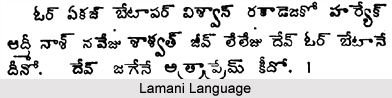
 Lamani or Lambadi language is counted essentially as an Indian tribal language, widely spoken by the scheduled tribes residing in the heartland of Orissa state. In addition, almost all the states of East India and also other states comprising the people of Andhra Pradesh, Madhya Pradesh, Himachal Pradesh, Gujarat, Tamil Nadu, Maharashtra, Karnataka etc. speak in Lamani or Lambadi language. Indo-Aryan is the name of the language family to which this category of Indian tribal language belongs. In effect, umpteen names have been bestowed upon Lamani or Lambadi as alternatives and this list comprises: Lamani, Lamadi, Lambani, Labhani, Lambara, Lavani, Lemadi, Lumadale, Labhani Muka, Banjara, Banjari, Bangala, Banjori, Banjuri, Brinjari, Gohar-Herkeri, Goola, Gypsy, Gurmarti, Gormati, Kora, Singali, Sugali, Sukali, Tanda, Vanjari, Wanji. "Gormati" is regarded as the `self-name` lent to Lamani.
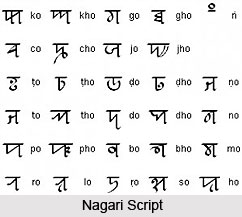
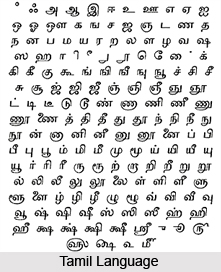
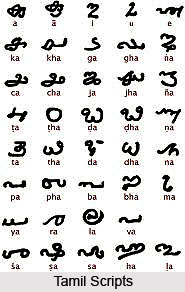
When specified by regions too, Lamani language possesses a wealth of dialectical kinds and forms. For instance, Maharashtra Lamani, Karnataka Lamani (Mysore Lamani), Andhra Pradesh Lamani (Telugu Lamani) are some of the categories which are spoken in a different manner. Each of the three dialects also calls for a different script: Maharashtra utilises the Devanagari script, Karnataka utilises the Kannada language and script, Andhra Pradesh Lamani utilises the Telugu script.
A unique survey had been carried out by the IMA in recent times, which had estimated 1,961,000 number of Lamani speakers in India. With time and modernisation, Lamani language has undergone significant metamorphosis; as such, its literacy rate as a second language has also increased over the years.
Lamani is however also looked at as a Rajasthani language, spoken by nomadic Banjara Tribe across India. Speakers of Lamani language are at times bilingual in Telugu, Kannada, or Marathi.
This article is a stub. You may enrich it by adding more information to it. You can send your write-up at content@indianetzone.com