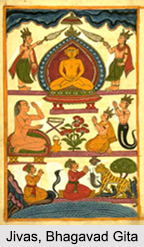
 Jiva in the Hindu book of Bhagavad Gita is the immortal essence of living being (human beings, animal, fish and even plants) described as immutable, ageless and indestructible because it is beyond physical death. Along with Hinduism, Jainism also advocates the basic doctrine of hylozoism; the belief that all livings including fire, water, wind and earth all have lives.
This infinite number of souls in Jainism is called the jivas (lives). In Hinduism it is believed that it is not a product of the material world but of a `higher spiritual nature`.At the point of death of a body the jiva takes a new physical body, which depends on karma of the individual. Souls carry themselves to the new body consistent with their karman.
 The goal of Jiva as described in the Hindu and the Jain scriptures are as follows. Liberation from the cycle of birth and death (moksha) obtaining pure love of God (bhakti) and while living becoming liberated from the happiness and distress of the world (jivanmukta). The concept of jivas is similar but not identical with the concept of soul.
In Jainism it is believed no one can destroy the jivas .The number of jivas remain the same throughout, although they move from one place to another and also they assume different forms in different things. In Jainism there are the following divisions of the Jiva-Nirtya Siddhas -the ever perfect souls; Mukta -the liberated souls who are free from the cycle of birth and death. Baddha-the bonded souls who have to undergo the cycle of birth and death and are also judged on the basis of their Karman. According to Jainism, karma is not only action of the soul but a kind of matter or energy that enters the body of the jiva making the liberation of the jiva increasingly difficult.