|
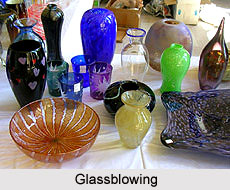 The exquisite Glass blowing involves a particular process where varied shapes are formed while the glass is in a molten, semi-liquid state. Inside a furnace, the change of raw materials like sand, limestone, soda ash, potash and other compounds into glass takes place, at a very high temperature of more than 2000øF (1100øC). Then the glass is transformed into a hot orange colour. Afterwards it is then left to "fine out" which means to allow the bubbles to emanate out of the mass. The temperature of the furnace is boiled down to around 2000øF (1100øC) where "Soda-lime" glass remains fairly 'plastic' and viable, and as low as 1000øF (550øC). The exquisite Glass blowing involves a particular process where varied shapes are formed while the glass is in a molten, semi-liquid state. Inside a furnace, the change of raw materials like sand, limestone, soda ash, potash and other compounds into glass takes place, at a very high temperature of more than 2000øF (1100øC). Then the glass is transformed into a hot orange colour. Afterwards it is then left to "fine out" which means to allow the bubbles to emanate out of the mass. The temperature of the furnace is boiled down to around 2000øF (1100øC) where "Soda-lime" glass remains fairly 'plastic' and viable, and as low as 1000øF (550øC).
Three furnaces are used for making glassblowing the first one is called simply a 'furnace', containing a melting pot of molten glass. The second one is the "Glory Hole", and is utilized to heat up a piece repeatedly in between steps of doing work with it. The final furnace is called the "lehr" or "annealer" which is used to cool down the glass slowly. It takes over a period of a few hours to a few days, mainly depending on the size of the pieces which finally holds the glass from breaking up due to thermal pressure.
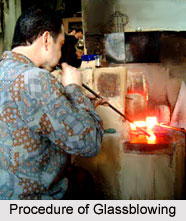
 The major tools that are used are the blowpipe, the punty (or pontil), bench, marver, blocks, jacks, paddles, tweezers, and a variety of shears. The extreme end of the blowpipe is first burnt repeatedly; then doused in the molten glass in the furnace. Then molten glass is 'gathered' on to the blowpipe and thus the blowing process continues. Bench is indeed the most important element of the glassblower's workstation and is comprised of a seat where the blower sits while blowing. Jack a particular kind of tool is used in this process for contouring the glass. While the paddles are used to create the flat bottom it is the usage of the tweezers that are used in order to offer that detailed shape. Straight shears and the diamond shears are used in cutting off the chunks of glass.
Once a piece blows up to its approximate final size, the bottom is settled. Then, the piece is changed to a 'punty', and the top is also settled down. There are a lot of ways to apply patterns and colour to the blown glass. These include flapping molten glass in powdered colour. Also there are larger pieces of coloured glass called frit. Complex patterns with great detail can be created through the use of the rods of coloured glass there are special rods, which can be cut in cross-sections to reveal patterns. These pieces of colour are then formatted in a pattern and 'picked up' by rolling a bubble of molten glass over them. One of the most complicated techniques of glass blowing, popularly known as cane working, is 'reticello'. It involves creation of two bubbles from cane and then each is twisted in a different direction, then uniting them and blowing out in to the final shape.
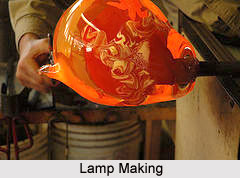
 A lamp work is a special type of craft made from blowing glass. On a smaller scale a lamp worker usually used alcohol lamps and breaths of air to make a hot flame to manipulate preformed glass rods and tubes. These stock materials took form as laboratory glass, beads, and durable scientific "specimens" amalgamated as 'miniature glass sculpture'. The craft became an art form in the late and is still practiced in the contemporary period. However the modern lamp worker incorporated new techniques. They use a flame of oxygen and propane or natural gas. The modern torch is used to a large extent. It actually permits working with both the soft glass from the furnace worker and also the 'borosilicate' glass of the scientific glassblower. The latter have got multiple headed torches and special lathes to create the glass or fused quartz and are used for special projects. The molten glass is then attached to a stainless steel or iron rod called a punty (or a punty rod, a pontil, or a mandrel) for shaping. It transfers a hollow piece from the blowpipe for an opening thus creating shape.
Historical records unfold the fact that the concept of glass blowing, as an art form once came into limelight in India as a result of the foreign invasion. The Indians whilst establishing it as a unique art form once duly embraced the Persian glassmakers who brought their artistry of Glass blown art in India. In India, the original form of glass blowing art then got rather an oriental shape. It was much later in the Mughal period; the very concept of the glass blowing art gained a distinct dimension and became quite a popular artistic expression. A contemporary tinge to this glass blowing art was however offered by the British during the British Rajin India.
In the modern days also this glass blowing art is practiced all over India especially in the rural areas. With the introduction of modern science in India the whole concept and artistry of glass blowing has further being revived. The ancient art with its modish gamut still murmurs the rich artistry of the Indians.
|





