


|
Guna in Samkhya Philosophy Sattva is associated with virtues and qualities such as wisdom, joy, altruism, and brightness. A person with more of sattva has a positive or even orderly state of mind. Such a person is psychologically kind, calm, alert and thoughtful. Rajas is associated with greed, ambition, activity, and anger. It leads one to activity and is explained by the term Yogakshem. Yoga in the present context is acquiring something that one does not have. Kshem means losing something that one already has. Tamas is associated with idleness, ignorance, and delusion. A tamas quality also can imply that a person has a self-destructive or entropic state of mind. That person is constantly pursuing destructive activities. The soul must strive to detach itself from all three gunas. Everything in the universe is involved with the three gunas, which form the basis of the qualities and values of life. In all human beings one of the three gunas has superior strength and this is reflected in all they do and think. Guna in Classical Literature 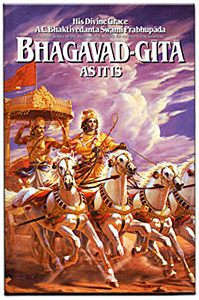 Guna in epics like Mahabharata and religious texts like Bhagavata Puranaand Bhagavad Gita is related to five senses, five elements and five body parts. Each guna is associated with an organ, ether has sound for its Guna (and the ear for its organ) and air has tangibility and touch for its Gunas (and the skin for its organ). Fire has shape or colour, tangibility, and sight for its Gunas (and the eye for its organ), water has flavour, shape, tangibility, and taste for its Gunas (and the tongue for its organ), earth has all preceding Gunas and its own peculiar Guna of smell (and the nose for its organ). According to the Bhagvad Gita those who can conquer the Gunas live in eternal happiness .At the same time conquering the Gunas frees one from birth old age, disease and death. Guna in epics like Mahabharata and religious texts like Bhagavata Puranaand Bhagavad Gita is related to five senses, five elements and five body parts. Each guna is associated with an organ, ether has sound for its Guna (and the ear for its organ) and air has tangibility and touch for its Gunas (and the skin for its organ). Fire has shape or colour, tangibility, and sight for its Gunas (and the eye for its organ), water has flavour, shape, tangibility, and taste for its Gunas (and the tongue for its organ), earth has all preceding Gunas and its own peculiar Guna of smell (and the nose for its organ). According to the Bhagvad Gita those who can conquer the Gunas live in eternal happiness .At the same time conquering the Gunas frees one from birth old age, disease and death.
In Nyaya philosophy the twenty-four Gunas are shape, colour , rasa (savour), gandha(odour), sparsa(tangibility), samkhya (number), parimana (dimension), prthaktva(severalty), samyoga(conjunction), aparatva(proximity), gurutva(weight), vibhaga(disjunction), paratva(remoteness), dravatva(fluidity), sneha(viscidity), prayatna(effort), shabda(sound), buddhi or jnana(understanding or knowledge), sukha(pleasure), dukkha(pain), iccha(desire), dvesa(aversion),dharma( merit or virtue), adharma(demerit), samskara(the self-reproductive quality). Guna in Ayurveda According to the Ayurveda medicines and foods are sattivic ,rajasic or tamasic or a combination of these gunas. Sattvic foods are fresh juicy, light, nourishing, sweet and tasty and give necessary energy to the body without taxing it. For example fresh fruits and vegetables that are easily digestible. Rajasic foods are bitter, sour, salty, pungent, hot and dry. They over stimulate the body and excite the passions. For example sattvic foods those have been fried in oil, cooked too much or eaten in excess are Rajasic. This includes coffee and tea, fish, eggs salt and chocolate. Tamasic foods are dry, old, decaying and consume a large amount of energy while being digested. The body's resistance to disease is destroyed and the mind filled with dark emotions, such as anger and greed. For example foods those have been strongly processed, canned or frozen and are old, stale or incompatible with each other. Meat, vinegar, liquor are especially tamasic. Overeating is also regarded as tamasic. The Gods and the Three Qualities 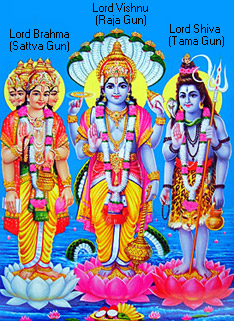 The three basic gunas are formed by the union of prakrti and Purusha. In Brahma, the creator, three guns are present and in balance too. In other beings, one or the other guna prevails. Gods are largely considered as sattvagun. Brahmans are sattvagun. Kshatriyas are rajogun and the Shudras are tamogun. Demons and animals are rajogun and plants and minerals are tamogun. The three basic gunas are formed by the union of prakrti and Purusha. In Brahma, the creator, three guns are present and in balance too. In other beings, one or the other guna prevails. Gods are largely considered as sattvagun. Brahmans are sattvagun. Kshatriyas are rajogun and the Shudras are tamogun. Demons and animals are rajogun and plants and minerals are tamogun.
According to a legend, there are three forms of the goddess that corresponds to the three gunas: Goddess Kali, or tama gun, Goddess Lakshmi, or raja gun, and Goddess Sarasvati, or sattva gun. These three forms form the basis of the social order and of the people's participation in the pujas. There are different approaches to the gods that varies from one gun to the other. The sattvik mat is the way of Vaisnavas, The rajasik mat is a worship that insists on power, the ego and Tamasik mat is the worship of the householder who wants everything that is from the deities that is required to carry out everyday duties. Sattva, raja, and tama also correspond to the three major deities Lord Brahma, Lord Vishnu, and Lord Shiva. The first is truth, the second is power and the third is the way of everyday life, the householder pressed by social burden. Sattva leads to Moksha; dharma is the responsibility of rule; Kama and artha are the units of everyday life tama. |
| |||



Home > Reference > Indian Philosophy > Schools of Indian Philosophy > Samkhya Philosophy > Gunas - Hindu Philosophy
Gunas - Hindu Philosophy
| Guna in Hindu Philosophy in its philosophical sense refers to the constituent quality. The whole universe is guided by the three gunas, which are basically attitudes, qualities found in human being. |
| ||||||||||||||||||||||||||||

