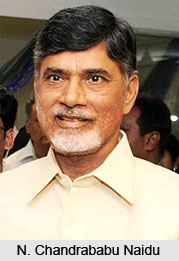
The instrumental role player in making Hyderabad one of the IT hubs in India, Nara Chandrababu Naidu was intended to make Andhra Pradesh the key destination in biotechnology. The Chief Minister with a modern outlook to administration, his style of functioning is more alike to that of a CEO rather than a traditional politician. The Chief Minister has a firm conviction that modern technology should be used in the service of the common man. He ushered into modernisation of the administrative setup by computerizing a number of Government Operations. Consequently, he lays great emphasis on the use of modern information technology in Government. He would like the State to be run professionally as an efficient organization rather than as a bureaucracy. This visionary`s vision for the future includes multidimensional development for all the citizens of the state.

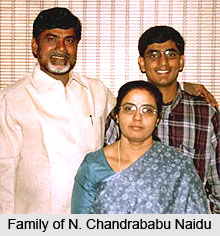
The Visionary Leader Chandrababu Naidu was born on 20th April 1950 in the Naravaripally village of Chittor district Andhra Pradesh, India. In a modest home, an average household like any other, farmer N K Naidu`s lady, a tremendously hard working rural Indian housewife, Ammanamma, gave birth to a little boy. She named him Chandra, the moon. He was already conscious of the life`s biggest enemy. The enemy had to stamp out, forever. The enemy was the poverty of the Indian village. His life`s mission was set, his goal etched on his heart and soul. The mother would tell stories of heroes; he would listen, and think. " Why can`t I be a hero? And try to do as much good to everyone?" he would think. Always thinking, always planning "One day, one day I shall...." The road ahead was clear. Thus began the story of Chandra, the son of Ammanamma, and Andhra too. Mr. Naidu had his school education in Chandragiri and his college education at the Sri Venkateswara Arts College, Tirupati. He earned a Masters degree in Economics from the Sri Venkateswara University, Tirupati. While pursuing his Ph.D. at the same university he ventured into politics. The Chief Minister is married to Mrs. Bhuvaneswari and has a son Lokesh. His father-in-law, the late Mr. N.T. Rama Rao, was one of the most accomplished film actors of Telugu cinema, who later founded the Telugu Desam Party and was also the Chief Minister of Andhra Pradesh.
Chandrababu Naidu organized a number of social activities and also held various positions of office in his college. Following the 1977 cyclone, which devastated Diviseema taluk of Krishna district, he actively organized donations and relief material from Chittoor district for the cyclone victims. Mr. Naidu has been evincing a keen interest in rural development activities in general and, the upliftment of the poor and downtrodden sections of society in particular.
When the great call of life to act and use one`s already acquired knowledge comes, most men withdraw. They hesitate. And remain in the safe boundaries of the mediocre. Great men see their opportunity. And act. Chandrababu did. In 1978 Naidu was elected to the Andhra Pradesh Legislative Assembly from the Chandragiri constituency in Chittoor district on a Indian National Congress ticket. He became a Cabinet minister of Tanguturi Anjaiah and held various portfolios like Archives, Cinematography, Technical Education, Animal Husbandry, Dairy Development, Public Libraries, and Minor Irrigation between 1980 to 1983. He also served as the Chairman of the State Karshak Parishad, constituted for the first time to look after the welfare of the farming community. But he lost the elections from Chandragiri in 1983. Again he was elected to the State legislature from Kuppam constituency of Chittor district in 1989. As a Coordinator of the Telugu Desam Party, he effectively handled the party`s role of being the primary opposition party in the State Assembly. This won him wide appreciation from both his party cadre and the public. His role during this phase both inside and outside the Legislative Assembly was said to be a critical factor for the subsequent success of the party at the hustings. He was re-elected in 1994, to the Assembly from Kuppam constituency with one of the largest margins of 57,000 votes and went on to hold some important portfolios like Finance and Revenue. During this tenure Naidu systematically introduced transparency in Government, breaking the tradition of inordinate secrecy in the Finance department.
The mantle of leadership fell on the shoulders of Mr. Naidu at a most critical juncture in the State`s politics. Chandrababu Naidu succeeded N.T.Rama Rao, the founder of Telugu Desam Party and the chief minister of Andhra Pradesh, with the support of Rao`s family members and the majority of the members of the legislative assembly. Naidu was sworn in as the Chief Minister of Andhra Pradesh on 1 September 1995. NTR died a few months later. Naidu led TDP to victory in the following State Assembly elections, and on 11 October 1999 he was sworn in as the Chief Minister of Andhra Pradesh for the second term.
During his tenure ship Microsoft chose to set up a development center in Hyderabad. A Biotech park was also established in the City. This all was made possible because of Chandrababu`s instrumental role and intension to make Andhra Pradesh the number-one destination in the field of biotechnology. His attempt for the betterment of the government- public interface also reflected as he streamlined the process of payment of all the utility bills and taxes, which could now be processed at a single counter. There was also a great emphasis on infrastructure and the state saw a sudden increase in the road network. He was also instrumental in the development of the new Hyderabad international airport. During his tenure many ports and IT parks were developed with private-public partnership.
He is keen to develop the full potential of all citizens based on a strong moral foundation. The Chief Minister has been propagating a return to ethical and value-based precepts in day-to-day life. In keeping with this commitment, he has launched new initiatives, like the `Janmabhoomi` program, a project that encourages people to be part of developing the state, which aims at achieving excellence in all walks of life and focuses on community-building through team work. He also was instrumental in creating DWACRA groups whose mission is to provide social and economic infrastructure to the women of Andhra Pradesh.
In order to achieve greater involvement of the people in the implementation of Government programs, Chandrababu Naidu has been encouraging the concept of social audit, which involves making information available to all citizens about the works being taken up with public funds in their area. The initiative for setting up self-help groups like water users` associations, for involving farmers in the management of irrigation systems was also taken by The Chief Minister. Other self-help groups like Watershed Development Committees, Women`s groups, Youth groups, Village Education Committees and Village Health Committees have also been set up. These self-help groups have significantly contributed to removing intermediaries and have been widely acknowledged for improving the condition of the poor.
Naidu had initiated an exercise to define "Vision 2020" for the state of Andhra Pradesh. According to him, "Our vision of Andhra Pradesh is a State where poverty is totally eradicated; where every man, woman and child has access to not just the basic minimum needs, but to all opportunities for leading a happy and fulfilling life; a knowledge and learning society built on the values of hard work, honesty, discipline and a collective sense of purpose." With this Naidu`s perspective on the state`s development reflects, and the details of the vision are proposed to be fine-tuned in consultation with the people on a continuing basis.
His approach was said to be effective in overcoming the routine bureaucratic delays in the course of responding to issues of immediate public concern. A video conferencing unit was set up which enabled him to simultaneously address all District Collectors on a regular basis, or consult the Cabinet ministers on various issues like the electric power situation in various districts, the Clean and Green program, rythu (farmer) bazaars, monitoring of commodity prices, implementation of road works, public health & sanitation, and law and order. Naidu expedited decision making within the government by making effective use of communication.
A lot of emphasis was laid on water conservation and water harvesting during Naidu`s reign. Chandrababu Naidu took up a campaign for sensitizing the people of the State and the administration for better water management to prevent drought. Launching of an innovative program called Neeru Meeru, formation of Watershed Committees, promotion of Water Shed development were taken up in the State for better water management. These programmes have been inspired a voluntary participatory movement amongst the citizens of the state towards water conservation. Due to this campaign a number of households built rain water-harvesting structures.
A new way of looking at Center-State finance relations was also suggested by Naidu. He sharpened the campaign for fiscal federalism in the wake of the recommendations of the Eleventh Finance Commission. He emphasized on equity and efficiency in the devolution of Central revenues and sharing of resources between the Center and the States.
Early in 1999, Y.S. Rajasekhara Reddy had launched a campaign on the issues of rural neglect symbolized by farmer suicides and promised to provide free electricity to the farmers. This move however backfired and TDP`s alliance with the BJP which was riding high over the victory of kargil war won the elections. The state had also witnessed high economic growth in all sectors, and the improvement in the quality of life during the period between 1995-1999.The Congress party under the leadership of Reddy defeated Telugu Desam Party in the elections of 2004. The defeat to Congress party was attributed to the persistent drought that crippled the rural agriculture economy. Some also believe that his prime focus on IT resulted in him ignoring the traditional economic drivers like agriculture. Many news papers and opposition leaders criticized him for his obsession with technology, and the lack of touch with problem of the poor. He was also criticized for patronizing the World Bank. During his tenure many non-performing government industries were shut down resulting in the loss of large number of jobs.The movement for a separate Telangana state is also said to have played a major role for the party`s loss in the telangana districts.Factors like anti-incumbency factors, farmers committing suicides,drought in many areas,naxalite problems and neglecting rural areas in favour of urban areas are also said to have contributed towards the defeat of TDP in 2004 state assembly elections.
The Chief Minister has won numerous awards including " IT Indian of the Millennium` (India Today) Business Person of the Year (Economic Times) member of the World Economic Forum`s Dream Cabinet and South Asian of the Year (Time Asia). The Chief Minister was chosen as one of 50 leaders at the forefront of change in the year 2000 by the Business Week magazine for being an unflinching proponent of technology and for his drive to transform the State.
The politician turned author, wrote a book on governance. Naidu penned down his ideas on the challenge of governance in the new millennium. Titled "Plain Speaking", co-authored by Ninan Sevanti, focuses on changing strategies of governance, hurdles in pursuing reforms and the need to break free from the politics of populism.
On October 1, 2003, Naidu as the Chief Minister escaped a land mine blast which was part of an assassination attempt planned by a naxal outfit Peoples War Group, now known as CPI Maoist.
Chandrababu, a strict disciplinarian with definite objectives and goals, is the guiding force behind his party and holds a firm grip over his council of ministers. Chandrababu Naidu played an important and decisive role by helping N.T.Rama Rao in keeping his party`s MLAs together is also a good organizer and an excellent strategist. He is currently the leader of the opposition in the Andhra Pradesh state assembly, and the president of Telugu Desam Party, the second largest legislative party in Andhra Pradesh. Many of Naidu`s initiatives like e-Seva (an eGovernance initiative) are still continuing to improve the transparency and accountability in administration. Several institutions established during Naidu`s tenure like International Institute of Information Technology, Hyderabad, Indian School of Business, Center For Good Governance and HITEC city (which houses several IT companies) along with a modern administration can be construed to be Naidu`s Legacy and his contribution to Andhra Pradesh.
His Political Philosophy is "History cannot afford a political vice, or civilization a holiday". He knew too well that opportunity comes only once, and if missed, we go right back, or worse. To him All power lies with people, we don`t rule them, we provide them with governance, and we owe them a good government. A SMART government, one of his several coinages, reflects his inner political clarity and sense of accountability. History according to him is too full of wasted chance, and could no longer afford leader`s vice. No dinners for ministers, no garlands at public functions, no personal paraphernalia, no showbiz or sycophancy. Simple and moral are the fundamentals to watch. Civilization cannot afford to go to sleep, he repeats, and adds, we need to work incessantly. His leaders and party cadre, and the government setup too, took lessons from his own 18-hours-a-day schedule, and followed suit. His popularity rose, not because of publicity but performance. Accountability was another factor he introduced. He went to the people, surprised as they were, to find a government at their doorstep. His surprise checks to ensure work was done, and pulling-up slack officials and rewarding merit, won the people`s hearts. Above all a transparent government. Long preached but always elusive, it was achieved. People were made partners in the development process, and equally responsible. Everyone must work and achieve. Only then the goal could be reached, but the goal now had a name: Swarnandhra Pradesh.