|
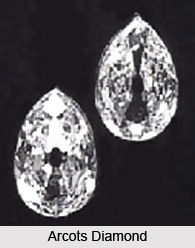 During the colonial rules of the British, they mysteriously become the owners of countless Indian treasures that they have recorded in their journals as a 'nazrana'. 'Nazrana' is a gift offered to a ruler as an expression of loyalty. The gems presented by Azim-ud-Daula, the Nawab of Arcot, to Queen Charlotte, the consort of King George III of Great Britain, in Mil, were possibly also a nazrana. The nawab gifted several diamonds to the queen Charlotte; of which two were pear-shaped drops weighing 33.71 and 23.65 carats are known as the Arcot diamonds. During the colonial rules of the British, they mysteriously become the owners of countless Indian treasures that they have recorded in their journals as a 'nazrana'. 'Nazrana' is a gift offered to a ruler as an expression of loyalty. The gems presented by Azim-ud-Daula, the Nawab of Arcot, to Queen Charlotte, the consort of King George III of Great Britain, in Mil, were possibly also a nazrana. The nawab gifted several diamonds to the queen Charlotte; of which two were pear-shaped drops weighing 33.71 and 23.65 carats are known as the Arcot diamonds.
The Arcots were discovered from the famous diamond mines in Golconda. These two diamonds were particularly well received by the queen as she had a passion for jewels, which was widely known. But they were not considered as a part of the crown jewels as they had been a personal gift. Queen Charlotte ordered in her will that the diamonds be sold after her death and the earnings be divided among her four daughters or their survivors who were to "share and share alike".
Conversely, after her death in 1818, her eldest son disregarded her last wishes. Following his father's death in 1820, he conquered the family property, money and all his mother's jewellery and ascended the throne as King George IV, and had the Arcot diamonds set in his crown. John Bridge of Rundell & Bridge & Co, the crown jewellers, bought the Arcots, after George IV died. They were mounted in a gorgeous crown made for Queen Adelaide in 1831, as she wanted to wear at the coronation of her husband William IV, the successor of George IV. It was not unusual in that time about this loan as it was regular for the royal family to scrounge expensive jewels from the crown jewellers for state occasions.
 The Arcots were offered for sale on July 20, 1837, at an auction held at Willis's Rooms in London. The first Marquess of Westminster who also purchased the Nassak diamond, he bought the Arcots for £11,000 as a birthday present for his wife. Afterward, the two incredible drops were set in a variety of jewels for almost a century. The second Marquess of Westminster in 1930 had them set in a splendid tiara designed by the Parisian jeweler Lacloche. The Westminster Tiara, fashioned to fit on the head like an upright hair band, apart from the Arcots was set with, a round brilliant weighing 32.30 carats in the center and 1,421 smaller diamonds. The beautiful ornament that encircled delicate diamond nibs, was made up of baguette, marquise and round diamonds set in 'pave-style' arches and it was set amid a cluster of large round stones with the Arcots. The centerpiece could be standing apart and also worn as a brooch. The Arcots were intended to double as earrings. Cecil Beaton, the celebrated photographer, photographed Duchess Loelia wearing this tiara in 1931, who has been the duke's third wife, and later his fourth wife was also often seen wearing it.
Sotheby's in London auctioned the tiara on June 25, 1959, after the death of the second Marquess of Westminster. For £\ 10,000, Harry Winston bought the tiara which was then a world record price for a piece of jewellery. For greater brilliance, he had the Arcots recut to 30.99 carats and 18.85 carats. The stones were sold as solitaire rings to two private clients as a result of split up. The larger diamond was the Arcot I while the smaller one was referred as Arcot II. The tiara, could be worn without the removable diamonds and which was actually not broken up, was sold, again by Sotheby's, to a client in Texas.
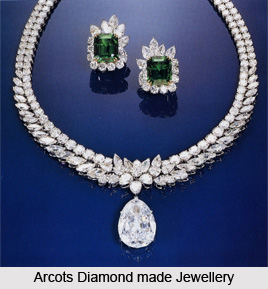
Van Cleef & Arpels, Paris created a pendant floating from a ravishing necklace with Arcot I. The recent owner of the Arcot I was a lady. She offered the bewitching stone and the necklace for sale at an auction on November 17, 1993 by Christie's at Geneva. The predictable price was 2 million Swiss francs. Both the Arcot and the necklace were sold to Sheikh Ahmed Hassan Fitaihi of Saudi Arabia at the event, for an amazing sum of £918,243.
|





