


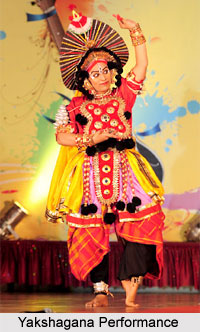
 Performance of Yakshagana, in its final form, takes place in open air. On the evening of the performance Chande is beaten to convey the news and to invite the neighbouring villages. The sound of Chande, sharp and penetrating, easily reaches a village of even six to eight miles away if the wind is favourable. On the evening people assemble near and about the platform, generally in front of the village temple. The platform is about 16 feet square with bamboo poles fixed at the four corners. The top is covered by a mat made of palm leaves and the entire arena is decorated with flowers, mango leaves and also young plantain-trees tied to the poles on either side in the traditional way. On the three sides of the platform sit the audience spreading their own mats, while to the rear of the platform the Bhagavata (in plain clothes) with cymbals or gong in hand takes his place with his accompanists: the players of Maddale or Mridanga, Chande and Pungi or Mukha Veena - the drone. With this, the stage is set for the show. Performance of Yakshagana, in its final form, takes place in open air. On the evening of the performance Chande is beaten to convey the news and to invite the neighbouring villages. The sound of Chande, sharp and penetrating, easily reaches a village of even six to eight miles away if the wind is favourable. On the evening people assemble near and about the platform, generally in front of the village temple. The platform is about 16 feet square with bamboo poles fixed at the four corners. The top is covered by a mat made of palm leaves and the entire arena is decorated with flowers, mango leaves and also young plantain-trees tied to the poles on either side in the traditional way. On the three sides of the platform sit the audience spreading their own mats, while to the rear of the platform the Bhagavata (in plain clothes) with cymbals or gong in hand takes his place with his accompanists: the players of Maddale or Mridanga, Chande and Pungi or Mukha Veena - the drone. With this, the stage is set for the show.
Elements of Yakshagana The Yakshagana performance of the coastal tract opens with prayers (Nandi) to Gods Ganapati and Subrahmanya, sung by the Bhagavata. The jester Kodangi then enters the stage in a queer costume doing an odd dance and singing a song. Two players in female attire called Nitya Vesha then appear on the stage to sing and dance. This long series of several songs, dances and humorous talk provided by the minor roles, called Tundu Vesha, engages and amuses the audience and alerts their attention to the main show. Bhagavata sings again to signal the entrance of the chief characters of the performance. From behind the curtain held at the ends by two persons, gradually emerge the dressed up participants one by one until at last the most important character called Pundu Vesha or Bannada Vesha appears. Then in a row, they stand together to make a bow to the audience. It is a sight of real splendour and this completes Poorvaranga (preliminary formalities). Then the characters recede out of sight, leaving the Bhagavata and his accompanists on the platform. The Bhagavata then sings Prastavane or the prologue to the play chosen for the evening. As the tempo of his song rises accompanied by the fast beat of the cymbals, mridanga and chande, relevant characters enter to start the play proper. Every character dances into the stage, the pattern of dancing itself differing from one to the other in accordance with the spirit and sentiment for which the role stands. Music of Yakshagana After the end of the short dancing to the accompaniment of cymbals, mridanga and sometimes chande the character is interrogated by the Bhagavata who introduces him to the audience. In recent times however, the tradition is changed and the character himself - be it the king Rishi, Danava or Deva, at his first entrance introduces himself in dry prose, and then in a short speech acquaints the audience with the dramatic situation that has prompted him to appear. It is then the character assumes the role fully by interpreting in prose, dance and gesture, the various verses recited by the Bhagavata. When the verse refers to a particular character on the stage, that particular character alone keeps dancing in consonance with the mood of the verse. The climax is reached when the inevitable battle ensues between the hero and his foe. Accompanied by the severe beating of chande and mridanga at varying rhythms, the characters perform the war dance with all rustic vigour and grandeur, until the enemy is overpowered. Thus goes on the performance before the spell bound audience throughout the night and no one will be aware of the passing time. It was the custom, though now extinct, to see the Sun in the East and end the play after invoking his blessings. Colours Used in Yakshagana 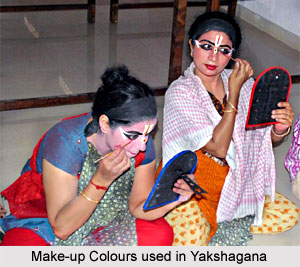 Yakshagana does not present two similarly made up and dressed characters unless warranted by a situation requiring two roles with identical innate qualities. Colours used for painting the face will be chosen with care. Gods are usually painted in reddish soft white, while roles like Yama, Bali and even Harischandra are painted in black. Lord Krishna is painted in a pleasant blue and the leading opposite role, the Bannada Vesha in black or pink. Originally, all the basic paints were made with the help of different indigenous colours called; Aradala, lngaleeka, Kadige and Balapa. It is over this foundation painting that careful working of the features of the character is made in red and white. The most imposing achievement of the Yakshagana artist could be seen in the make up of mythological characters like Narasimha, Ravana, Chandi and Yama. These characters will be able to create an illusion that they are wearing masks on their faces. It is so because the nose is uplifted with a lump of cotton, eyes are made to look three times their natural size, and a string of bordering white dots provides a decorated frame work (called Chutti) to the face and then, artificial canine teeth are fixed up. Yakshagana does not present two similarly made up and dressed characters unless warranted by a situation requiring two roles with identical innate qualities. Colours used for painting the face will be chosen with care. Gods are usually painted in reddish soft white, while roles like Yama, Bali and even Harischandra are painted in black. Lord Krishna is painted in a pleasant blue and the leading opposite role, the Bannada Vesha in black or pink. Originally, all the basic paints were made with the help of different indigenous colours called; Aradala, lngaleeka, Kadige and Balapa. It is over this foundation painting that careful working of the features of the character is made in red and white. The most imposing achievement of the Yakshagana artist could be seen in the make up of mythological characters like Narasimha, Ravana, Chandi and Yama. These characters will be able to create an illusion that they are wearing masks on their faces. It is so because the nose is uplifted with a lump of cotton, eyes are made to look three times their natural size, and a string of bordering white dots provides a decorated frame work (called Chutti) to the face and then, artificial canine teeth are fixed up.
Actors of Yakshagana The Yakshagana artist can make marvels on the human face just with the help of white, red and black colours and cotton. He steals a march over the Greek and Javanese masks, which though grotesque, wear but a single static expression. What the mask denies, the make-up of the Yakshagana provides in abundance a scope to work the eye and the mouth. Some of the typical make-up patterns will be provided by great demon characters like Chandi and goddess Kali. These odd roles, which stand on the stage in glaring contrast, often shatter the illusion of a wonderland created by the magnificent make-up of the main characters. This neglect can be accounted for, as the main sentiments of Yakshagana, Veera and Adbhuta could be roused only by dominant mythological heroes and not by secondary roles like the jester and the rashi. Still, for the sake of theatrical harmony, it should be necessary to pay some attention to these minor roles, their make-up and costumes. |
| |||



Home > Art & Culture > Indian Dances > Folk Dances of Indian States > Folk Dances of Karnataka > Yakshagana Dance > Performance of Yakshagana
Performance of Yakshagana
| Performance of Yakshagana occurs in the open air accompanied by music and dance. |
| ||||||||||||||||||||||||||||

