Sabha in Ancient India - Informative & researched article on Sabha in Ancient India
 Indianetzone: Largest Free Encyclopedia of India with thousand of articlesIndian Administration


in  
 Art & Culture|Entertainment|Health|Reference|Sports|Society|Travel
Forum  | Free E-magazine  | RSS Feeds  
Indian Administration : Constitution of India |Government of India |State Governments in India |Indian Judiciary |Indian Economy |Constitutional Bodies in India |Indian Civil Awards |Local Self Governments |Indian Political Parties |Foreign Relation of India |Indian Government Departments |National Symbols of India |Indian Media |Indian Armed Forces |Council of Ministers of India |Indian Coins |Indian Political Culture |History of Indian Administrative System |District Administration in India |Regional Administration in India |Distribution of Power between Centre and States
Home > Reference > Indian Administration > History of Indian Administrative System > Indian Administrative System in Ancient Period > Sabha in Ancient India
Sabha in Ancient India
Sabha in ancient India was a separate body that was apart of the village. In some states the sabha was associated with the king.

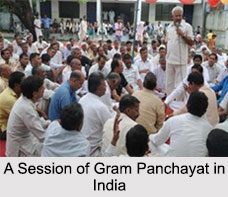
 Sabha was a village assembly where the members would meet and discuss social and political issues. It was an important political unit. It was generally attended by noble people. It was considered as the national tribunal. This term has been mentioned in Rig Veda. Members of the sabha performed all the functions. A sabha eventually assumed a patriarchal and an aristocratic nature. Earlier women also attended sabhas. However it stopped in the later Vedic age. The village head called Gramini attended the meetings of the Samiti. The sabha was attended by priests. However the Vedic literature does not have much information regarding the clan character of sabha. It reflects the presence of people who belonged to a higher social rank.

Original clan nature of sabha was determined in the Rig Vedic age. Dispossessed and impoverished people could not be a part of sabha. Power belonged to those who owned horses and chariots. Sabha was the advisory body of King and was dependent on their advice and counsel. According to Rig Veda Sabha is a gambling assembly. Sabha was also used for amusements like dance, music. It was also associated with witchcraft and magic practices. It also discussed pastoral affairs. Religious activities were also talked about in the sabha. It is considered that its members invoked Lord Indra to protect the sabha. Whenever they had a meeting they performed a sacrifice.

Political and administrative functions were also exercised by the Sabha. There are evidences that indicate that the sabha also executed judicial functions. It has been asserted that the judicial functions were not exercised by the entire sabha but instead by the standing committee of the sabha. The judicial nature of the sabha existed later too as it has been mentioned in the Jataka too. There are also references to the royal presence in the sabha. There are evidences that the king attended sabha. As per Chandogya Upanishad the King maintained his own sabha. The king considered sabha`s advice to be supreme. Sabha was a permanent body that comprised of selected men.

This article is a stub. You can enrich by adding more information to it. Send your Write Up to content@indianetzone.com


(Last Updated on : 22/11/2011)
 
 
Absolute Monarchy in India Panchayat System in India Types of States in Ancient India
Functions of Ancient Indian States Influence of Religion Ancient Indian States Role of King in Ancient India
Influence of Philosophy on Ancient Indian States Saptanga Theory of State Town Administration in Ancient India
Village Administration in Ancient India Land System in Ancient India Ministers of Ancient India
Paura Janapada Assembly in Ancient India Laws of Ancient State Sabha in Ancient India
Samiti in Ancient India    
Recently Updated Articles in Indian Administration
Ronen Sen
Ronen Sen was the diplomat of India, the ambassador to the United States of America from August 2004 to March 2009.
National Institute of Public Cooperation and Child Development
National Institute of Public Cooperation and Child Development was set up to promote and advance the cause of women and child development by means of research and training activities. It is an autonomous body functioning under the guidance of the Ministry of Women and Child Development.
National Institute of Agricultural Marketing
National Institute of Agricultural Marketing (NIAM) is a premier National level Institute set up by the Government of India in August 1988 to offer specialized Training, Research, Consultancy and Education in Agricultural Marketing.
National Institute for Empowerment of Persons with Multiple Disabilities
National Institute for Empowerment of Persons with Multiple Disabilities is an autonomous body of the Union government functioning under the Ministry of Social Justice & Empowerment. It works towards the empowerment of persons with multiple disabilities.
International Center for Alternate Dispute Resolution
International Center for Alternate Dispute Resolution undertakes studies and research in the field of alternative dispute resolution. The center is an autonomous body functioning under the Government of India.
E-mail this Article | Post a Comment
Forum
Forum on Indian Administration
Free E-magazine
Subscribe to Free E-Magazine on Reference
 
 
Sabha in Ancient India - Informative & researched article on Sabha in Ancient India
Sitemap
Contact Us   |   RSS Feeds
Copyright © 2008 Jupiter Infomedia Ltd. All rights reserved including the right to reproduce the contents in whole or in part in any form or medium without the express written permission of
Jupiter Infomedia Ltd.