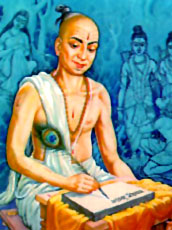
 Magha was a Sanskrit poet who was a master of technique in the strict Sanskrit sense of luscious descriptions. He was the poet at King Varmalata`s court at Srimala, the then-capital of Gujarat. His main work is "Shishupalavadha". He has borrowed the theme of this epic from Mahabharata. He was born in a Shrimali Brahmin family and was son of Dattaka Sarvacharya and grandson of Suprabhadeva.
Works of Magha
Magha`s recognition rests completely on an influential "mahakavya" that consists of uneven number of relatively short cantos, the "Shishupalavadha". In this epic Shishupala`s head is cut off by Lord Krishna. Lord Krishna encourages Yudhisthira to perform royal devotion. The ritual proceeds and Bhishma`s advice results Lord Krishna getting the award. Shishupala, King of Chedi becomes angry and leaves the hall. Yudhisthira tries to appease him. However, Bhishma praises Lord Krishna and restrains him. Shishupala revolts and seeks to devastate the sacrifice. Yudhisthira seeks out for Bhishma`s guidance. He is advised to have trust on Krishna and challenge the king. The latter insults Bhishma. Shishupala then abuses Krishna. Magha has treated the theme with originality. In Canto one, there is a new motif as the sage Narada appears in the house of Vasudeva where Krishna lives. Magha`s skill in politics is also shown. In Cantos four to nine Magha imitates Bharavi. Thereafter through a series of descriptions he exhibits his skill.
The changes made in the epic narrative are not minor. The rival speeches have been shortened. Bharavi`s procedure is imitated as far as making a struggle between rival armies preceding the contest is concerned. These stories have high qualities of poetry and the plot and characterization is not that great. However he lacks the conciseness, the serenity and dignity of Bharavi. His poem has luxuriance of expression and imagination. He admits his indebtedness to Kamasutra and exhibits intimate knowledge. He imitates good sense and simplicity of Bharavi. Magha is capable of effective strength and simplicity that is visible in the speeches of his heroes.
His use of figures is free and his alliterations have point and effect. He is adept in language as well as gives an abundant illustration of grammatical rules which is probably under Bhatti`s influence. He has borrowed certain techniques from Panini. Magha`s chief accomplishment is in Canto IV when he manages to use 22 metres. The sloka is the most common; Upajati of Vancastha type; Indra Vajra type; the Udgata; the Aupacchandasika; the Drutavilambita; the Puspitagra and many more metres have been used. He has used one Vipula in every three or four verses. Magha allows the usage of weak caesura.
Magha in the Prasasti gives some autobiographical details which is a rarity among Indian poets. Magha belonged to the state of Gujarat. Magha, in the concluding five verses of the work gives some autobiographical details, which is rare for Indian poets. According to one legend, he died in poverty.