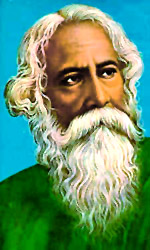
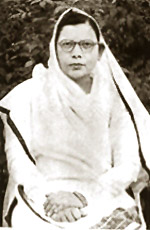
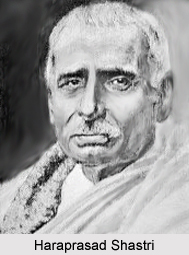
 Haraprasad Shastri or Bhattacharya (6 December 1853-17 November 1931) is known for discovering the Charyapada, one of the earliest known instances of Bengali literature. Haraprasad Shastri, an antiquarian, archivist and a Sanskritist survived from the late 19th -early 20th century. An antiquarian Shastri stands bare among those whose historical claims had gone awry, and hailed as a genius whose work is an eclectic conglomeration of historiography as well as literary productions. This was an experience relating to the axiomatic of history that was being delineated by the early colonial scholars, necessitating a search for and a projection of what could be called a transcendental historical subjectivity. He was born in Kumira village in Khulna, Bengal. The family name was Bhattacharya, a common Bengali surname.
He completed his college from Sanskrit College and Presidency College in Kolkata. He was conferred the title of Shastri when he received an MA degree. Thereafter he joined Hare School as a teacher in 1878. He also served as a professor at the Sanskrit College in 1883. He worked as an Assistant Translator with the government of Bengal. He also served as the Librarian of the Bengal Library. He was the Head of the department in 1895 of the Sanskrit department at Presidency College.
In 1900 he was the principal of the Sanskrit College. He has also served as the president of Asiatic Society for two years. He was the President of Vangiya Sahitya Parishad for twelve years as well as an honorary member of the Royal Asiatic Society in London.
Works of Haraprasad Shastri : The 1925 essay titled `Aamader Itihas`, makes it possible to get a proper measure of Shastri`s well aimed concern for salvaging an archive that has been stigmatised in terms of its inability to stand as the `sources` of Indian History. And this archive houses the possible `literary sources` whose validity would dwindle when seen in contrast to the `epigraphic sources` that came to prominence somewhat later, at a time when the `literary` materials were discredited as possible `sources` lacking any provision of a certain chronology. What Shastri did was to lay bare a solid proof of cultural technologies of the language travelling through paradigm shifts and create a niche for the colonised national entities. His aim was thoroughly fulfilled. The history of India was refurbished not through the tinted colonial eyes but the third world history through the third world eye.
His first research article was "Bharat mahila" which was published in the periodical Bangadarshan. He regularly contributed to the periodical. He translated the Buddhist Puranas that was included in the book The Sanskrit Buddhist Literature of Nepal. Depiction of confrontation with the `colonial experience` in historiography, engrossed in the attempt to find a `historical chronology`, also awaits us in one of Shastri`s early essays referring back in its introductory paragraphs to the early colonial attempts to chart a chronology for history. The essay having the title "Aamaader Gauraber Dui Samay" came out in 1877 and was one of Shastri`s first encounters with history. It attempted to mark out the `glorious times` that the colonized could call their own; but none of the two signifiers, `glory` or `time`, bring any promise of transparency regarding their value unless one probes further.
He played a major role in preparing the Catalogue of the Asiatic Society`s ten thousand manuscripts with the help of few others. He gradually became interested in collecting old Bengali manuscripts and ended up visiting Nepal. In 1907, he discovered the Charyageeti or Charyapada manuscripts. This research led to the establishment of Charyapada which became the earliest known evidence of Bengali language.
He was the collector and publisher of many old works, author of several research articles and a noted historiographer. His notable works were: Balmikir jai, Meghdoot byakshya, Beneyer Meye, Kancanmala, Sachitra Ramayan, Prachin Banglar Gourab, and Bouddha dharma. The English works include: Magadhan Literature, Sanskrit Culture in Modern India and Discovery of Living Buddhism in Bengal.
In the novel Beneyer Meye (1920) is written in a style that is close to colloquial. It reconstructs the domestic and social atmosphere in West Bengal in the eleventh century. Kancanmala is also a well-written fictional tale. He remains one of the best Bengali prose writers as well as one of the greatest scholars of modern India. He wrote several antiquarian, historical and literary treatises, essays and two historical tales. For Haraprashad Shastri, culture meant the self cultivation of the finer qualities lurked within the faculties of mind and heart through the study of literature. His works aptly reflect such.