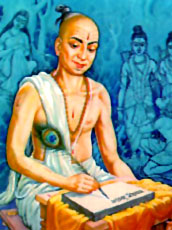
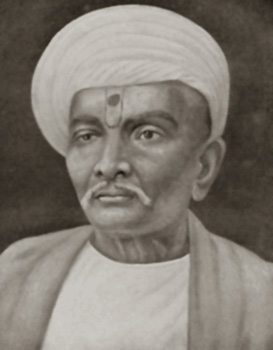
 Dalpatram was a Gujarati writer of the 19th century. When Dalpatram came to Ahmedabad in 1848, he already had grounding in Gujarati, Vraj and Sanskrit poetry. Born in a poor Brahmin family in a backward native state of Vadhwan in Kathiawar in 1820, with little formal knowledge of English, he was attained by his father to be a vedic priest. But Dalpatram was inclined towards poetry early in life. He joined the reformist Swaminarayan sect and aspired to be a court poet in the native states. In 1848, he met Alexander Kinloch Forbes. Forbes was a British judge in Ahmedabad, a connoisseur of poetry who was looking for a native scholar with knowledge of Vraj and Chaarani the languages used by poets and chroniclers in native courts. He needed someone, moreover, who could assist him in collecting scattered material on the history on Gujarat, and Dalpatram was the person best equipped for the job. Dalpatram`s first `literary` assignment was to travel in Gujarat and collect manuscripts from private libraries, Jain Bhandars, individuals, as well as to chronicle histories of small dynasties through oral rendition by individuals; later to collate this material, which Forbes finally translated into English and published as Rasmala. The Gujarat Vernacular Society was founded by Forbes in 1848 in Ahmedabad, for the development of Gujarati language and literature, in which Dalpatram played an important role. He helped in the running of the society and was the editor of Buddhiprakash, the journal run by the Society since 1854. In the hands of Dalpatram, the journal became a powerful medium for shaping the life of the city.
The debates on literature in Buddhiprakash focused primarily on Gujarati literature. In the first decade of his editorship Dalpatram undertook systematically to reorganise Gujarati literature, Gujarat language and Gujarati prosody. He regularly published his own poems in the journal, which were written in the traditional Hindi and Gujarati verse forms over which he had remarkable mastery. Only the content of these poems now comprised largely of issues of reform. Even descriptive poems such as poems on months, based on the earlier Barahmasa, contained some reference to current affairs. A poem on Margshish, for instance, described the cold which had set in during Kartika beginning to grow, just as the practice of education which was introduced and growing among the natives.
Dalpatram continued to recite these poems and entertain his listeners even though they were published. He continued the old tradition of oral recitation of poetry throughout the nineteenth century, not only in the courts of the native kings, but also before the Mahajans of Ahmedabad, to British officials including the governor of Mumbai, Mountstuart Elphinstone at large public meetings, and in the private audiences of seths in Mumbai. The transition to print which he hailed as a symbol of the new age had little effect either on his mode of writing or transmission of poetry. While his contemporaries were addressing the upper caste, middle class, urban Hindu readership, Dalpatram was more accessible to all upper strata of society that included, besides Hindus, Jains, Parsis, Rajputs and of course the British. A local poet with an ambition to be a state poet in a native court, Dalpatram by the end of the century had become known as the Raaj Kavi of the new age.
It was for this larger readership, and with their patronage, that he was reorganising Gujarati literature. He was appointed teacher of poetry in the Ahmedabad high school in 1859 where he trained a whole generation of poets in the old Vraj and Gujarati verse forms. He wrote the first Pingal (a book on prosody) in Gujarati, which incorporated not only the traditional Gujarati metres but also, the Hindi and Sanskrit metres. It was serially published in Buddhiprakash. The journal also published from December 1856 a series of his essays on the history of Gujarati poets. Prose was another form of writing that was introduced in Buddhiprakash in the form of essays, which were commissioned by the Society. Dalpatram was the first to write an essay on `Ghosts` (Bhoot Nibandh) and one on `Superstition` (Vahem) and win prizes. But the entire body of early Gujarati literature existed in the verse form, including the Akhyans or narratives.
Dalpatram remained the reigning literary figure of Ahmedabad. In 1862 he published Kavyadohan, a collection of Gujarati poetry that was commissioned by the Director of Public Instruction, Mr Howard. Unmindful of what his contemporaries thought, Dalpatram was engaged in a slow but solid consolidation and institutionalisation of Gujarati literature in Ahmedabad.