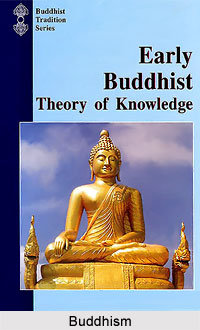
 Theory of knowledge in Buddhism unlike the materialist theory admits the validity of inference in addition to perception. However, there is a difference between the Buddhist theory of inference and the Naiyayika`s. The Buddhist maintains that connexions could be established between causes and effects, while the Naiyayika admits other forms of invariable coincidence as well. According to Buddhist philosophy, though inductive generalisations based on inseparability may not be always valid, they are valid with regard to causal successions. Buddhist theory of knowledge also includes inference to fire from smoke is concerned, it cannot be denied, for denying it, it is impossible to live.
Regarding establishing causal relations between two phenomena, the early Buddhist theory of knowledge says that if A precedes B, and the disappearance of A means the disappearance of B, other things remaining the same, then A is the cause of B. This is the method of difference. Later Buddhists developed this doctrine by emphasising the immediate antecedents of the cause. They also insist that one should be careful that no other circumstances are altered. So they state the full doctrine of causal inference in five steps, whence it is called Panchakarani. Firstly, in the stage of perceiving neither the cause nor the effect, in the second stage the cause appears, in the third stage the effect appears, in the fourth stage the cause disappears and finally in the last and fifth stage the effect disappears. According to the Buddhist theory of knowledge, relations of co-existence such as those of genus and species can also be established, though in a different manner.
Lord Buddha says that he has nothing to do with theories. His system is not a Darshana, or a philosophy, but a vehicle, a practical method leading to liberation. Buddha analyses experience, discerns its true nature. Since they adopt the method of analysis, the Buddhists are sometimes called as analytic thinkers or Vibhajyavadins. Buddha does not like the idea of basing the reality of Vedic authority. Buddhist philosophy states that there is nothing beyond experience. The real and the experienced are identical. The relative is the absolute. A true metaphysic must be a theory of experience, and not a guess work as to what is at the back of it hiding itself under a veil. Some believers of Buddhism tried to round off Buddha`s deliverances on the nature of this world by their own schemes of metaphysics.