
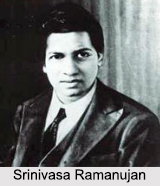
 Srinivasa Iyengar Ramanujan, popularly known as S. Ramanujan, was amongst the most renowned and respected mathematicians in India. He is credited with making numerous significant contributions to various fields of mathematics. This great mathematician was a self-taught learner and had no formal education in pure mathematics. He had made astonishing contributions to number theory, continued fractions, mathematical analysis and infinite series. Ramanujan is generally considered as one of the soaring geniuses in mathematics.
Srinivasa Iyengar Ramanujan
Srinivasa Iyengar Ramanujan was an Indian mathematical genius. He added a new dimension to the whole world of mathematics.
Introduction
Srinivasa Iyengar Ramanujan, popularly known as S. Ramanujan, was amongst the most renowned and respected mathematicians in India. He is credited with making numerous significant contributions to various fields of mathematics. This great mathematician was a self-taught learner and had no formal education in pure mathematics. He had made astonishing contributions to number theory, continued fractions, mathematical analysis and infinite series. Ramanujan is generally considered as one of the soaring geniuses in mathematics.Early Life of S. Ramanujan
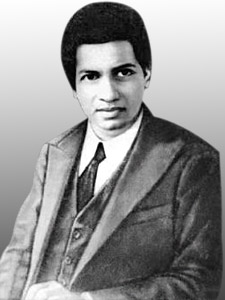 Srinavasa Ramanujan Iyengar, popularly known as S. Ramanujan is considered to be one of the best mathematicians of all time in India. S. Ramanujan was born in a little town, named Erode on 22nd December, 1887. Erode is located about 500 kilometers southwest of Madras, in the state of Tamil Nadu. His father`s name was Srinavasa and mother`s name, Komalatammal. His mother was a great devotee of the Goddess Namagiri of Namakkal and it is believed that he was born after his mother prayed to the Goddess for long days. Out of the several children Komalatammal had, S. Ramanujan was only the third son. His other two brothers were junior to him by ten and seventeen years, respectively. He had a lot of resemblance with his mother and his mother lovingly called him as `Chinnaswami` that represents the little Lord Krishna in Tamil.
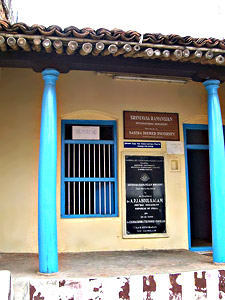
S. Ramanujan`s father, Srinavasa was a petty clerk in a saree shop in Kumbhakonam that is about 320 kilometers southwest of Madras. The inhabitants of the Kumbhakonam were mainly craftsmen and metal-workers. S. Ramanujan was brought up in a small hut-like house on the Sarangapani Sannidhi Street of this little known town. The highly religious nature, faith in astrology, psychic powers and superstitions of his mother, Komalatammal, had a strong hold on S. Ramanujan from his childhood. While growing up, Ramanujan also became a firm practitioner of religious customs, a believer in astrology and palmistry. He attributed his entire mathematical prowess to the blessings of the Goddess Namagiri, as well.
S. Ramanujan was unlike most of the other children of his age, during his childhood. He was never that much naughty, rather he was quiet, meditative and also had an extraordinary memory. He was a self-willed child and always did what and when he liked doing. The most unique thing about Ramanujan was that he was very fond of mathematics and curious about the world, right from his childhood. He always had the habit of questioning his mother about the world. His love for mathematics started with an incidence, when he came home crying, as one of his classmates scored more marks than him in mathematics. Though, Ramanujan paid attention to all the subjects in the early years of his schooling, he started to show his precocity in mathematics, while growing up. He would often mentally solve a mathematical question before the teacher could do that on the blackboard. Sometimes, he would also offer an alternative method of solving the same question or give an easier or quicker way of doing the same, to the teacher. He also used to finish his mathematics paper within half the time, during examinations.
Because of this strange nature and his extraordinary talent, the teachers of S. Ramanujan`s school liked him very much and they also praised him openly in class. Ramanujan was bothered about several questions like `What is the highest truth in mathematics?` right from his early age. He would often quiz his mathematics teachers on the same. Ramanujan got admitted in the Town High School in Kumbhakonam in January 1898. Ramanujan`s genius was revealed for the first time during a mathematics class in the Town High School, where the students were being taught the simple sums of division. It was in this class, where Ramanujan started to develop a life-long fascination for zero and infinity, as anything that is divided by zero is infinite. He could also often rattle off the value of pi (n), e, square root of two etc., up to any places of decimals, at any time. Apart from his love for mathematics, Ramanujan was also well educated in the ancient Indian philosophical books like Vedas, Upanishads and Hindu scriptures. He could also recite shlokas from those books, along with a running commentary on their meaning.
 S. Ramanujan received the prestigious K. Ranganatha Rao Prize for standing first in Mathematics in a school examination, during his childhood. After that, he also became successful to win the Junior Subrahmanyam Scholarship in a school competitive examination for standing first in Mathematics and English. While winning those prizes, S. Ramanujan was also introduced to S. L. Loney`s book Trigonometry, through one of the college boarders in his house. The book was recommended as a textbook in colleges at that time. Though Ramanujan was only thirteen years old then, he did not take much time to master the subject. However, he faced some problems while studying the other subjects like English, Greek and Roman History, and Physiology, in the higher classes. He could not pay due attention to those subjects for his great love for Mathematics and hence, he started to score badly in those subjects.
The difficulties of S. Ramanujan increased once he passed the Matriculation and entered into the F.A. (First Arts) in the Government College, Kumbhakonam. He was overwhelmed by Mathematics and mathematics stated to come in a flood to him by that time and that caused a huge loss for Ramanujan`s study of the other subjects. Ramanujan became more and more interested in Mathematics after he came across George Shoobridge Carr`s book titled "A Synopsis of Elementary Results in Pure and Applied Mathematics", published in 1886. The book contained about 6,000 problems in algebra, trigonometry, calculus and analytical geometry and it did not discuss any of the problems adequately or give step-by-step proofs. Rather on some occasions it simply gave hints to solve the problems. The book had a huge effect on Ramanujan and it actually changed his outlook and life forever. He made every problem mentioned in the book, a research project for him. It was this book that led Ramanujan to such a condition, where he could not think of anything else but mathematics, whether he was sleeping or awake.
As S. Ramanujan did not have the proper training and guidance in higher mathematics, he used to look at every problem given in the book Synopsis, with `fresh` eyes. Though the problems described in Carr`s book had already been solved more than 150 years ago in Europe, Ramanujan started to solve them in his own ingenious way. As a result, though sometimes he solved them just in the way they were solved earlier by European mathematicians, he occasionally solved them through altogether novel methods. He also often used to go far beyond into new realms of mathematics, where no European mathematician had gone before, in seeking solutions of the problems. He also made wonderful discoveries in mathematics, during the course of time, almost unknowingly. He also had the habit of hiding some of the mathematical calculations, when he came to know that what he had discovered was already a part of a higher mathematics text-book.
S. Ramanujan used to sit on the pial (steps) of his house during leisure period, with a slate and a notebook and think about mathematics and also play with numbers. Whenever he solved a problem or he felt he had reached an important result, he would immediately write down in his ledger-like notebook. He had also sometimes re-made the brilliant discoveries of European mathematicians and sometimes made original contributions to mathematics, while playing with numbers. However, as Ramanujan neglected the other subjects due to this mathematical outpouring, he failed miserably in his F.A. examination. Although he did very well in mathematics, he could hardly obtain 20 to 30 per cent marks in all the other subjects. He got a huge shock from this failure and in shame, he ran away from home. However, his father travelled from here to there to search Ramanujan and eventually became successful to get Ramanujan back at home.
After finding him out, S. Ramanujan`s father sent him to Madras, where he impressed the Principal of the Pachaiappa College and got admission in F.A. class again in 1903. However, he once again failed miserably in the examinations and that was the end of formal education for Ramanujan. S. Ramanujan`s mother did not like this at all and she soon arranged for his marriage, with an intention to get Ramanujan back into normal life. She came across the nine-year-old Janaki during a visit to a neighbouring town and talked with Janaki`s parents for getting her as daughter-in-law. Ramanujan got married on 14 July 1909. The marriage changed Ramanujan almost completely, as he became more responsible and actively started to look for a job to meet the needs of the family. That was the time; when Ramanujan started to get less time for playing with numbers and fulfilling his desires of solving mathematical problems. The situation also eventually led him get his first job in the Madras Port Trust.
Career of Srinivasa Ramanujan
While pursuing for job, Srinivasa Iyengar Ramanujan travelled extensively to Chennai and the neighbouring towns and during this course; he met several mathematicians who became his friends. As a result of which he got a chance to meet R. Ramchandra Rao, the Collector of Nellore. He soon granted S. Ramanujan a good scholarship of Rs 25 per month from his personal funds so that Ramanujan could pursue his passion for mathematics without even having a job. He also arranged a job for him and Ramanujan soon joined in a clerical post in the Madras Port Trust. He was a Class III Grade-IV Clerk. Apart from studying mathematics, Ramanujan also started contributing research papers in the newly started Journal of the Indian Mathematical Society.
 The turning point in Ramanujan"s life occurred when he got the chance to go to England and pursue systematic studies in higher mathematics. He spent almost five years over there to collaborate with Hardy and Littlewood in Cambridge and to publish the parts of his findings. Apart from that, Srinivasa Iyengar Ramanujan also got a fellowship in the University of Madras for pursuing research in mathematics, in spite of lacking formal education.
The turning point in Ramanujan"s life occurred when he got the chance to go to England and pursue systematic studies in higher mathematics. He spent almost five years over there to collaborate with Hardy and Littlewood in Cambridge and to publish the parts of his findings. Apart from that, Srinivasa Iyengar Ramanujan also got a fellowship in the University of Madras for pursuing research in mathematics, in spite of lacking formal education.Contributions of S. Ramanujan
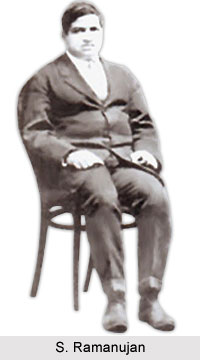 Contribution of S. Ramanujan is widespread in fields of Algebra, Geometry, Trigonometry, Calculus, Number theory etc. He has also made some extraordinary contributions to the fields like Hyper-geometric series, Elliptic functions, Prime numbers, Bernoulli`s numbers, Divergent series, Continued fractions, Elliptic Modular equations, Highly Composite numbers, Riemann Zeta functions, Partition of numbers, Mock-Theta functions etc. In reality, apart from a few elementary ones, most of the contributions of S.
Ramanujan belong to a higher realm of mathematics that is often referred to as Higher Mathematics. But the most significant contributions are Ramanujan Prime, Ramanujan Theta function, Ramanujan-Soldner constant, Ramanujan`s sum etc.
Contribution of S. Ramanujan is widespread in fields of Algebra, Geometry, Trigonometry, Calculus, Number theory etc. He has also made some extraordinary contributions to the fields like Hyper-geometric series, Elliptic functions, Prime numbers, Bernoulli`s numbers, Divergent series, Continued fractions, Elliptic Modular equations, Highly Composite numbers, Riemann Zeta functions, Partition of numbers, Mock-Theta functions etc. In reality, apart from a few elementary ones, most of the contributions of S.
Ramanujan belong to a higher realm of mathematics that is often referred to as Higher Mathematics. But the most significant contributions are Ramanujan Prime, Ramanujan Theta function, Ramanujan-Soldner constant, Ramanujan`s sum etc.
Mathematical and Scientific Contributions of S. Ramanujan : According to an eminent mathematicians, all the numbers were actually the intimate friends of S. Ramanujan. In order to calculate the value of `pi` up to 17 million places using a computer, the present day mathematicians actually use S. Ramanujan`s method. Ramanujan was close to the numbers that he made the number 1729 as the `Ramanujan number`, as the other mathematicians call it so in his honour. The main reason behind this is that S. Ramanujan gave its fine characteristics in an anecdote involving G. H. Hardy, who had visited him in a sanatorium by hiring a taxi having this number. The mathematical contributions of S. Ramanujan have also been widely used in solving various problems in higher scientific fields of specialisation. The diverse specialised higher scientific fields include the likes of particle physics, statistical mechanics, computer science, space science, cryptology, polymer chemistry and medical science.
Apart from the above fields, S. Ramanujan`s mathematical methods are being used in designing better furnaces for smelting metals and splicing telephone cables for communications, as well. Ramanujan was shown how to solve cubic equations in 1902 and he went on to find his own method to solve the quadratics. The following year, not knowing that the quadratics could not be solved by radicals, he tried to solve the quadratics. It was in the Town High School that Ramanujan came across a mathematics book by G S Carr called Synopsis of elementary results in pure mathematics. This book, with its very brief style, allowed Ramanujan to tutor himself mathematics, but the method of the book was to have a rather unfortunate result on the way Ramanujan was later to write down mathematics since it provided the only model that he had of written mathematical arguments. The book contained theorems, formulae and short proofs. It also contained an index to papers on pure mathematics which had been published in the "European Journals of Learned Societies" during the first half of the 19th century. The book, published in 1856, was of course well out of date by the time Ramanujan used it.
By 1904, Ramanujan had begun to undertake deep research. He investigated the series ä(1/n) and calculated Euler`s constant to 15 decimal places. He began to study the Bernoulli numbers, although this was entirely his own independent discovery.
Ramanujan, on the strength of his good school work, was given a scholarship to the Government College in Kumbakonam which he entered in 1904. However the following year his scholarship was not renewed because Ramanujan devoted more and more of his time to mathematics and neglected his other subjects. Without money he was soon in difficulties and, without telling his parents, he ran away to the town of Vishakhapatnam, about 650 km north of Chennai. He continued his mathematical work, however, and at this time he worked on hypergeometric series and investigated relations between integrals and series. He was to discover later that he had been studying elliptic functions.
S. Ramanujan essentially belonged to the Formalist School of Mathematics. It is true that Ramanujan had not given much attention to the deeper meaning of mathematics but he had given the subject a concrete form with the help of formulas, theorems, identities etc. He also searched for forms or patterns in mathematics and he actually worked more by intuition and induction and showed relationships between numbers, something that nobody could even imagine at that time. He had found results that were both original and very different in nature. Some of his famous discoveries were the Ramanujan prime and the Ramanujan theta function.
Notebook of S. Ramanujan : S. Ramanujan wrote down all his mathematical findings, in ledger-like notebooks that lately became famous as Ramanujan`s Frayed Notebooks. The Cambridge University Press brought out his Collected Papers in 1927 and after this, the mathematicians all over the world became fascinated by his work and personality. In 1929, two British mathematicians, G. N. Watson of the University of Birmingham and B. M. Wilson of Liverpool University, started to study and edit the notebooks with an intention to unearth the mathematical gems lying undiscovered in them. The Notebooks contained numerous formulas most of which were related to mock theta functions and q-series and around a third are about modular equations and singular module and other formulas of congruencies, integrals, asymptotic series.
Eventually, the Tata Institute of Fundamental Research, Mumbai published the facsimile editions of the two volumes of Ramanujan`s notebooks in 1957. The books were published at the initiative of the Indian nuclear physicist Dr. Homi Jehangir Bhabha and the publication once again, renewed the mathematicians` interest in Ramanujan`s notebooks. S. Ramanujan surmise has remained a bench mark in Mathematics. The most outstanding contribution of Ramanujan was his formula for p (n), the number of partitions of "n". For all these reasons, he is hailed as an all time great mathematician like Euler, Gauss or Jacobi for his natural intellect.
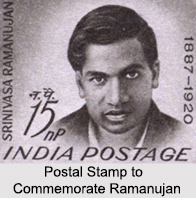
To commemorate Ramanujan, Indian Government issued postage stamps to celebrate his 75th birthday.
Achievements of Srinivasa Ramanujan
Srinivasa Iyengar Ramanujan was awarded PhD Degree in London in March 1916 for his work on highly composite numbers. The first part of this work was published in the Proceedings of the London Mathematical Society. He was elected to the London Mathematical Society on 6th December 1917. He was also elected as a Fellow of the Royal Society in 1918 for his investigation in Elliptic Functions and the Theory of Numbers. He was the second Indian to become a Fellow and also one of the youngest Fellows in the entire history of the Royal Society. Ramanujan also became the first Indian to be elected as a Fellow of Trinity College, Cambridge for his contribution in developing the Number Theory, on 13th of October, 1918.
Death of Srinivasa Ramanujan
Ramanujan was diagnosed with tuberculosis and a severe vitamin deficiency and was confined to a hospital. After suffering from various diseases for some months, Srinivasa Iyengar Ramanujan eventually came back to India from England but unfortunately, he died at the young age of 32 years on 26th of April, 1920.
Honours to Srinivasa Ramanujan
 The Government of India issued a commemorative stamp to pay tribute and honour the 75th Birth Anniversary of Srinivasa Iyengar Ramanujan in 1962.
Tamil Nadu celebrates his birthday as the "State IT Day".
The Ramanujan Journal was launched as an international publication, which included his work in areas of mathematics.
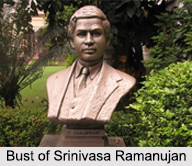
A bust of Srinivasa Ramanujan has been built inside the Birla Industrial and Technological Museum.
After his death, "Nature" listed Ramanujan among the other genius scientists and Mathematicians on a "Calendar of Scientific Pioneers".
Ramanujan"s birthday 22nd December is celebrated as Ramanujan Day in Government Arts College, Kumbakonam, where he studied and in IIT in Chennai.
In 2011, Indian Government declared his birthday 22 December as the National Mathematics Day to commemorate his 125th birthday.
Recently updated articles in Personalities in India

Governors of Mizoram
The Governor of Mizoram is the constitutional head of the state and is appointed by the President of India. The Governor performs various constitution...

Governors of Jharkhand
Governors of Jharkhand have served as the constitutional heads of the state since its formation on 15 November 2000. Appointed by the President of Ind...

Agnimitra Paul
Agnimitra Paul is an Indian fashion designer and politician serving as a Member of the West Bengal Legislative Assembly from Asansol Dakshin. A senior...
Governors of Uttarakhand
Governor of Uttarakhand is the nominal head of the state. The Governor is also the representative of the President of India in the state of Uttarakhan...
Nibaran Chandra Dasgupta
Nibaran Chandra Dasgupta was a distinct personality of Bengal who became famous for the establishment of ‘Shilpashram,’ a rural industry within the ma...
Related articles in Personalities in India

Sanskrit Theatre Personalities
Sanskrit Theatre Personalities was the main elements of Indian theatre with culture, customs and ethnicity.
Indian Social Reformers
The Indian Social Reformers are responsible for liberating the nation of several social and religious evils.
Raja Ram Mohan Roy
Raja Ram Mohan Roy is a great Indian social reformer who is celebrated all over the country. He has done many operations for the liberation of women....