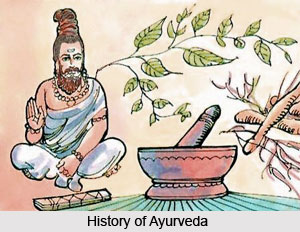
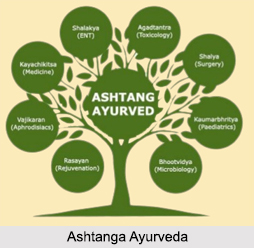
 Ayurveda is the knowledge of life that deals in detail with conditions favourable to life, and factors contributing to the happiness, or responsible for the misery or sorrow of human beings. Ayurveda also suggests measures for a healthy living and a long life. It is the most ancient form of Indian medicine, whose origin can be traced to more than 5000 years.
The physiology of Ayurveda is based on the panchmahabhoota philosophy. This philosophy holds that every living being belonging to either the plant or the animal kingdom is made up of a living material, which has five fundamental components. Thus every living thing is an exclusive creation effected through these five basic elements- Earth (Prithvi), Water (aap), Divine Fire (tej), Air (vayu) and Universal Space (aakash). These five basic elements are known as the panchmahabhoota. These panchmahabhootas cumulatively lead to the formation of Tridoshas (tree = three, doshas = basic components or organizations), which constitute our body. The basics of the physiology of Ayurved can be found in a few ancient texts, the chiefest of which is the Charaka Samhita.
The tridosha concept in the physiology of Ayurved has been linked to the fundamental Buddhist notion of the three poisons. This view holds that, the human being exists because of the influence exerted on the uniform and undisturbed universal spirit, as it moves through the world, by the three disrupting forces: attraction (desire), aversion (hatred), and confusion (conception and misconception ). It is the eventual task of a human being to break free from these influences (poisons) and attain the ultimate objective of pure undifferentiated consciousness (nirvana). Although not visible, the doshas are an integral part of the human body and hence are studied in great details under the scope of the physiology of Ayurveda.
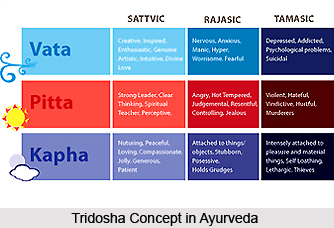
There are three types of doshas like the kapha, pitta and vata. Kapha is connected with confusion. It is the transporter of fluids and is the controller of the phlegm humor. Its function is associated with building up of the body tissues and stored substances as well as cooling or restraining, including keeping the mind calm. Pitta, connected with aversion, is the transporter of substances involved in metabolism and transformation and controls the fire or bile humor. Pitta is concerned with the digestive processes, keeping the body warm, and regulating mental and physical activity. Vata, which initiates desire, is the transporter of air and energy, and is also the controller of the wind humor. The function of vata ranges from the breaking down of the body tissues to the elimination of stored substances.
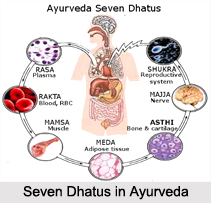
The physiology of Ayurved is also based upon the seven dhatus ( rasa, rakta, mansa, med, asthi, majja, shukra ) and the three malas ( mutra, purish, sweda). Each dhatu is nourished, in turn, from another, until the processes of refinement and transformation of the nutrients derived from food produce the life-sustaining ojas ( the essence of energy of all the tissues ) that permeate the whole body. Each refinement process yields a pure substance and a waste product (mala). The mala is something that the body needs to eliminate. The physiology of Ayurved therefore deals not only with the doshas, dhatus and malas but also with the diseases related to them. Ayurved believes that the most important means of attaining a healthy body is to maintain the doshas and dhatus in proper balance by in taking a nutritious and balanced diet.