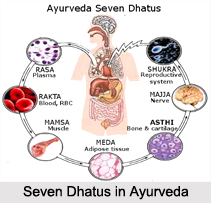
 One unique feature of Ayurvedic physiology is Majja, is that each human tissue is derived from the previous tissue in ascending order of complexity. From rasa (life sap) the body builds up rakta (blood), from rakta it develops mansa (muscles), from mansa originates med (fat), from med is developed asthi (bones) and from this asthi the body generates majja (bone marrow tissue), which in turn produces shukra (semen).
Majja or bone marrow tissue occupies certain inner cavities of the body, specially the hollow cavities of long bones. Active bone marrow in an adult human being is estimated to form 3.5 to 6 percent of body weight. The volume of the marrow is 70 ml at birth and about 4000 ml in the adult. In the adult, only about 50 percent of the total bone marrow is in an active state, known as the red bone marrow, while the rest is inactive, and is called the yellow bone marrow.
In spite of being inactive, the yellow bone marrow has the potential to resume its activity of producing blood cells when the body is in urgent need. Under such emergency conditions, a certain fraction of the yellow bone marrow gets transformed into the red bone marrow. Although only half the bone marrow is active in the adults, yet it has tremendous functional ability and ample space for expansion.
In the red bone marrow part of majja, red cells are actively manufactured. In foetal stage, most of the bones contain red bone marrow. But with the advancement of age, the red bone marrow becomes concentrated only in the upper ends of bones like humerous and femur, the bones of the skull, thorax and vertebrae and the bones of the pelvis. The yellow bone marrow is made up of fat and blood vessels. In adult human beings, they occupy the spaces where red bone marrow is absent.
From birth upto the fourth year all the bones contain red marrow. By seven years the marrow becomes less active and is pale red in colour. Between ten to fourteen years a patch of yellow marrow appears in the corner portions of the long bones, which gradually extends to both sides. At the age of twenty, the entire red bone marrow of the long bones is replaced by yellow bone marrow excluding the upper ends of femur and humeropus. Throughout adult life, this distribution persists. By seventy years more than half the ribs and half the sternum (breast bone) contains yellow marrow.
Red bone marrow of majja is active and has the capacity of producing red cells as well as other blood cells. Under certain urgent need and in case of anemia, mature and even immature cells may be released in the circulation. In the bone marrow, not only are the blood cells formed but the abnormal, imperfect, damaged and aged red blood cells are also destroyed. Moreover, bone marrow is an important site for storage of iron coming from food as well as from the destruction of red blood cells. This stored iron is readily utilized for the synthesis of haemoglobin. Majja plays an important role in neutralizing toxins that enter the body. The cellular elements that take part in the formation of bone are produced in the bone marrow. Since it contains connective tissue elements, it also performs several functions associated with connective tissues.
Thus majja dhatu is of prime importance because it is the birthplace of the blood cells, especially the red blood cells. The abnormality of this dhatu may cause a wide range of disorders like pain in the joints, fear, unconsciousness, collapsing, and seeing darkness in day light and extra hard root like formation in the joints.