 Khalsa are a special group of initiated Sikh warriors which have undergone the sacred Amrit Ceremony initiated by the 10th Sikh Guru, Guru Gobind Singh. The word "Khalsa" means pure and it forms an important custom for the Sikhs. Khalsa was instituted by Guru Gobind Singh in response to the tyrannical rule of Aurangzeb, corruption of masands and caste practices among Sikhs. The foundation day of Khalsa is celebrated as Vaisakhi by the Sikhs today.
Foundation of Khalsa
On the day of Vaisakhi in1699,Guru Gobind Singh summoned a large gathering of Sikhs. He got up from his throne with his sword and addressed to the Sikh congregation and asked if anyone is willing to sacrifice their head. Nobody responded in the beginning and he repeated three times.
A Sikh named "Bhai Daya Ram", a Khatri of Lahore stood up and was ready to offer his head. He took him inside a tent and repeated his call four more times, in response to which, a second Sikh, "Bhai Dharm Das", a Jat from Delhi became ready. Thereafter, a third Sikh who came forward was "Bhai Mohkarm Chand", a washerman and the fourth Sikh was "Bhai Chand" of Bider was a barber. The fifth Sikh was "Bhai Himmat" who was a water-carrier by caste. 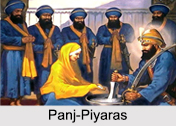
Guru Gobind Singh later on called his "5 Beloved Ones" as "Panj-Piyaras". After this he addressed them. After that he baptized the 5 Beloved Ones by administering them amrit or sugar water, stirred with a double-edged sword out of the same bowl. After that he declared the 5 Beloved Ones as the "Khalsa". This meant pure ones and gave them new names with the suffix "Singh" for the males and "Kaur" for the female.
Five K"s in Khalsa
Then the Guruji made them to take an oath to observe and wear the Five K"s. The five K`s borne by the Khalsa Sikhs are not just outward symbols but they signify the commitment which the Khalsa Sikh has towards the Sikh community. They should abstain from smoking, consuming alcohol, from eating slaughtered meat in the halal manner but eat only jhatka meat and should not resort to extramarital relationship.The following are the Five K"s:
•Kesh (hair),
•Kangha (comb),
•Kara (bracelet),
•Kachha (pair of shorts), and
•Kirpan (sword).
Khalsa Panth
Khalsa Panth is the most important custom for the Sikhs. The Khalsa Panth is a way of life which every Sikh should follow in order to uphold the virtues of Sikhism. Almost, all the adult members of the Sikh community get initiated into the Khalsa Panth through a ceremony of baptism known as "Amrit Sanchar". The Khalsa Panth is also an embodiment of brotherhood among the members of the Sikh community. Not only the Khalsa Panth dissipates the spirit of brotherhood but also gives the member the strength to protect the innocent and to punish the prosecutor. Hence it can be said that being closely associated with the Khalsa Panth is a way to adhere to the Sikh customs.