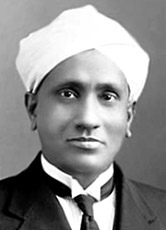
 Chandrasekhara Venkata Raman was an Indian scientist and Noble Laureate. C.V. Raman received the Nobel Prize for his work known as `Raman effect` that is named after his name. His theory goes like this - when light is spread from a molecule or an atom, most of the photons are elastically speckled. The scattered photons have the same energy and, therefore, wavelength, as the happening photons. However, a small portion of scattered light is spread from excitations with optical frequencies different from the rate of the incident photons. In a gas inelastic spreading of a photon can occur with a change in vibration or electronic energy of a molecule. This effect was first reported by C.V. Raman and K.S. Krishnan and independently by Grigory Lansberg and Leonid Mandelstam in 1928.
Early Life of Chandrasekhara Venkata Raman
Chandrasekhara Venkata Raman was born on 7th of November, 1888 at Trichinopoly. His father R. Chandrasekhara Iyer was a lecturer in physics and mathematics and so he grew up completely in an academic atmosphere. When he was very young, he shifted to Vizag in Andhra Pradesh. In the year 1902, C.V. Raman entered Presidency College in Chennai. He passed his graduation securing a gold medal in the year 1904. In 1907 he gained his masters degree with the highest distinctions.
Career of Chandrasekhara Venkata Raman
Chandrasekhara Venkata Raman joined the Indian Finance Department as an Assistant Accountant General in Kolkata. During his days in Kolkata, Raman found opportunities for carrying on experimental research in the laboratory of the Indian Association for the Cultivation of Science, of which he became Honorary Secretary in the year 1919. Further, in 1917 he resigned from his government job. He took up Professorship in Physics at the University of Calcutta. To him, this period was the golden era of his career. After 15 years at Kolkata in 1934 he became the director of the newly established `Indian Institute of Science` at Bangalore. Two years later he continued as a professor of Physics there. Raman along with Dr. Krishnamurthy in 1943 started a company called Travancore Chemical and Manufacturing Co. Ltd which during its 60 year history established 4 factories in Southern India. C.V. Raman was appointed as the first National professor in the year 1947 by the new government of Independent India. He retired from the Indian Institute in 1948 and a year later he established the Raman Research Institute in Bengaluru. Raman remained active with his institute until his death. He also founded the Indian Journal of Physics in 1926, of which he was the Editor. Raman sponsored the establishment of the Indian Academy of Sciences and endowed as the President since its origin. He also initiated the procedures of that academy, in which much of his work were published, and is President of the Current Science Association, Bengaluru, which publishes Current Science (India).
Discoveries of Chandrasekhara Venkata Raman
`Raman Spectroscopy` is a spectroscopic method used in reduced matter physics and chemistry for studying vibration, rotational, and other low-frequency modes in a system. He also worked on the sounds of several musical instruments. Raman worked out the concept of `transverse vibration` of bowed strings, based on `superposition velocities`. He was also the first to investigate the harmonic nature of the sound of the Indian drums such as the tabla and the mridanga.
Raman`s earliest researches in optics and acoustics, the two fields of investigation to which he has dedicated his entire career were carried out while he was a student. Some of Raman`s early memoirs appeared as Bulletins of the Indian Association for the Cultivation of Science dealing with the `Maintenance of Vibrations` and with the theory of the musical instruments of the violin family. In 1922 he published his work on the `Molecular Diffraction of Light`, the first of a series of investigations with his collaborators. This ultimately led to his discovery, on the 28th of February, 1928, of the radiation effect which bears his name and which gained him the 1930 Nobel Prize in Physics.
Other investigations carried out by Raman were his investigational and academic studies on the diffraction of light by aural waves of ultrasonic and hypersonic frequencies, and those on the effects produced by the X-rays on infrared vibrations in crystals exposed to ordinary light. In 1948 Raman, through studying the spectroscopic behaviour of crystals, approached in a new manner fundamental problems of crystal dynamics. His laboratory has been dealing with the configuration and properties of diamond, and optical behaviour of many shimmering substances. His other interests had been the optics of colloids, electrical and magnetic anisotropy, and the composition of human vision.
Awards for Chandrasekhara Venkata Raman
Chandrasekhara Venkata Raman also received worldwide acknowledgment for his work in optics and scattering of light. In 1924, he was also elected to the Royal Society of London and the British conferred him a knight of the British Empire in the year 1929. In the same year C.V. Raman was honoured with the president`s chair of the 16th session of the Indian Science Congress. The following year he was honoured with the prestigious Hughes medal from the Royal Society. His research work in the Indian Association for the Cultivation of Science culminated with his Nobel Prize winning work. In 1930, C.V. Raman won the Nobel Prize for his work on the scattering of light and discovery of `Raman Effect`. For the first time in its history, an Indian scholar has received the highest honour in science. He was awarded the Bharat Ratna in 1954 and with the Lenin Peace Prize in 1957.
To commemorate the memory of Raman`s discovery in 1928, Indian celebrates National Science Day on the 28th February of every year. Chandrasekhara Venkata Raman died on 21st November 1970.