
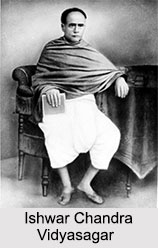
 Ishwar Chandra Vidyasagar was one of the foremost figures of the Bengal renaissance, whose scholarly contributions to Sanskrit and Bengali are equalled by the social reforms he affected on the milieu of his time. Though born impoverished, Vidyasagar grew up to be a highly influential polymath, an expert writer, philosopher, educator, publisher, reformer, philanthropist, academic, entrepreneur and activist, whose legacy is still honoured by Indians from all over the country. He is credited with the simplification and modernisation of Bengali prose, and the modernisation of the Bengali alphabet. His social reforms did much to rid the country of its rampant casteism, especially in the teaching of Sanskrit; and Ishwar Chandra Vidyasagar was one of the earliest proponents of women"s rights; campaigning for widow remarriage and establishing schools for women.
Ishwar Chandra Vidyasagar
Ishwar Chandra Vidyasagar was a great 19th century Bengali scholar, reformer, writer and philanthropist, whose ideas remain relevant even in modern India.
Introduction
Ishwar Chandra Vidyasagar was one of the foremost figures of the Bengal renaissance, whose scholarly contributions to Sanskrit and Bengali are equalled by the social reforms he affected on the milieu of his time. Though born impoverished, Vidyasagar grew up to be a highly influential polymath, an expert writer, philosopher, educator, publisher, reformer, philanthropist, academic, entrepreneur and activist, whose legacy is still honoured by Indians from all over the country. He is credited with the simplification and modernisation of Bengali prose, and the modernisation of the Bengali alphabet. His social reforms did much to rid the country of its rampant casteism, especially in the teaching of Sanskrit; and Ishwar Chandra Vidyasagar was one of the earliest proponents of women"s rights; campaigning for widow remarriage and establishing schools for women.Early Life of Ishwar Chandra Vidyasagar
Ishwar Chandra Bandopadhyay was born in a Kulin Brahmin family at Birsingha in Midnapore district in the state of West Bengal, on 26th September 1820. Vidyasagar spent his childhood in abject poverty. Vidyasagar commenced primary education at the village "Pathshaala" - an indigenous Indian school where language, grammar, arithmatic and other Shastras were taught to youngsters. His childhood was full of learning, as his father Thakurdas Bandopadhyay was a teacher of Sanskrit and wanted his son to follow his profession. Vidyasagar"s mother, Bhagabati Devi had a strong spiritual influence on him all his life. In the year 1839, Ishwar Chandra Vidyasagar graduated in the law examination conducted by the Hindu Law Committee.
Career of Ishwar Chandra Vidyasagar
 Career of Vidyasagar
Ishwar Chandra Vidhyasagar was a visionary whose only aspiration was to build a society of cultured young men and women who would be better qualified by their writings and teachings. He anticipated that the youth would disseminate sound information world-wide. For this reason he worked hard to educate young people. On 29th December 1841 Ishwar Chandra took a job as head pundit, the Principle lecturer (Sanskrit teacher) at Fort William College. G. T. Marshall who was the Secretary of the College at the time acted as the catalyst for gaining this prestigious position for him at the age of 21. Marshall had been thoroughly impressed by Ishwar`s scholastic achievements.
Career of Vidyasagar
Ishwar Chandra Vidhyasagar was a visionary whose only aspiration was to build a society of cultured young men and women who would be better qualified by their writings and teachings. He anticipated that the youth would disseminate sound information world-wide. For this reason he worked hard to educate young people. On 29th December 1841 Ishwar Chandra took a job as head pundit, the Principle lecturer (Sanskrit teacher) at Fort William College. G. T. Marshall who was the Secretary of the College at the time acted as the catalyst for gaining this prestigious position for him at the age of 21. Marshall had been thoroughly impressed by Ishwar`s scholastic achievements.
In 1846 he joined Sanskrit College as Assistant Secretary. Along with his Sanskrit College position, the government entrusted him in 1855 with the added responsibility of Special Inspector of Schools for the districts of Hughli, Burdwan, Midnapore and Nadia. He was also an honorary office bearer of several organisations including ASIATIC SOCIETY and BETHUNE SOCIETY. Vidyasagar traveled all over Bengal in the capacity of Inspector of Schools. This gave him the opportunity to witness the pervading darkness and superstition amongst the illiterate, uneducated masses of Bengal. He was so distressed by all the malpractices he saw and esp. the exploitation of women in the name of religion, that he hurriedly established 20 Model schools in a short period of only 2 months. He realised that unless women of the land were educated, it was impossible to emancipate and liberate them from the terrible burden of inequalities and injustice imposed on them by the oppressive Hindu society blinded by false beliefs and derelict customs. He worked relentlessly and opened 30 schools for girls in Bengal. In order to promote the education of girls, Vidyasagar made door to door calls, requesting parents to send their daughters to schools.
As Special Inspector of Schools, Vidyasagar also used his position to encourage landholders and other wealthy people to establish educational institutions. Within his inspection zone, he was instrumental in founding many schools, several of which were for girls. Some schools were established at his own initiative and with his financial support. Vidyasagar`s philanthropy was proverbial. It is said that half the money that he got from his salary and the royalties of his published books was kept reserved for helping the distressed.
His well documented protests against the then Education Department officials testify the degree of intensity with which he pursued the course of educational reforms. He favored English and Bengali as a medium of learning alongside Sanskrit and wanted to offer students a wide range of subjects. He wanted to broaden their horizons in studying and analyzing European and Indian conceptual practices so that they could judge for themselves and discover the ultimate truth.
He was not afraid of discarding erroneous beliefs of Indian shastras and preferring European science wherever appropriate. But he also did not blindly accept everything. He had an open mind for discovering the truth and truth alone, with an unshakable determination.
In 1858, he was made one of the first fellows of the Calcutta University. He received a certificate of Honour at the Imperial Assemblage in January 1877. A year later in1847 he and his friend Madan Mohan Tarkalankar set up the Sanskrit Press and Depository, a print shop and bookstore on Amherst Street in north Calcutta with a loan of six hundred rupees. His first titles were Bharatchandra Ray`s "Annadamangal Kavya" for which his copy-text was a rare manuscript owned by the Krishnanagar zamindars, and the "Betal Panchabingshati" (Twenty Five Tales of a Demon), traslated from the Sanskrit epic "Kathasaritsagar". In 1849 his partner Madan Mohan Tarkalankar began an illustrated series for children, "Shishu Shiksha".
The success of the Sanskrit Press was extremely important for Vidyasagar, since he lacked ancestral or personal wealth and had to support himself as well as find money for his campaigns. It also gave him an instrument through which he could speak to Bengal, and it magnified his words and distributed them cheaply to every child in the land. In 1859, the Calcutta Training School had been set up and in 1864 Vidyasagar became its director. It was renamed the Hindu Metropolitan Institute and in 1872 it was granted the status of a college. Today it is a university named after its greatest benefactor -- Vidyasagar University.
Achievements of Ishwar Chandra Vidyasagar
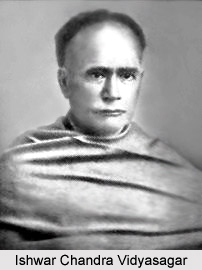 Ishwar Chandra Vidhyasagar was one of the pillars of Bengal Renaissance. An active social reformer, he was born in Birsingha in Midnapur on September 26, 1820. Widely known as Vidhyasagar, he is known to have championed several social causes. He spent is childhood days in abject poverty. His quest for knowledge helped him excel in various fields and win a number of scholarships. Revolutionary by nature, Vidhyasagar ushered in light in the educational system of Bengal. Poet Michael Madhusudan Dutt in one of his works wrote about him, "The genius and wisdom of an ancient sage, the energy of an Englishman and the heart of a Bengali mother".
During his graduation he gained mastery in many shastras or disciplines - kavya (poetry), alankar (rhetorics), Vedanta (Vedic literature and anthology), Smriti (philosophy of law), nyaya (logic, science and jurisprudence), and jyotish-vidya (astrology). He bagged prizes and scholarships for best performance. Evaluating his stupendous results in the above courses, the College Committee endowed Ishwar Chandra with the Honorific Title of `Vidyasagar` (Ocean of Knowledge) in 1839 when he became a Law Graduate. Vidyasagar`s greatest legacy is the result of his persistent campaign to better the situation of Indian women, specially in his native Bengal.
Many social reformers, such as, the celestial body of the Brahmo Samaj movement -- Raja Ram Mohan Roy, Keshab Chandra Sen, Debendranath Tagore and Christian missionaries like Alexander Duff, Krishna Mohan Banerjee and Lal Behari Dey, were attempting to reform Indian social practice. Vidyasagar endlessly worked for transformation of orthodox Hindu society from within.
During his tenure as the principal of the famous Sanskrit College, he encouraged scholars to study ancient sacred texts and also interpret them. His study of these texts convinced him that the contaminate status of women in nineteenth century Hindu society was not at all sanctioned by the scriptures. It had more to do with existing power relations in society. The bias in law against female inheritance, wealth and property, and the social prejudice against female autonomy and education, were in his eyes comparatively recent phenomena. He raised his voice fearlessly on behalf of widow re-marriage.
Apart from this another custom of the Kulin Brahmin polygamy allowed elderly men often on the verge of death to marry many teenage girls or even infants. The girls were usually abandoned soon after marriage and left behind in their parental homes, with their parents bearing the entire expense of their upkeep in addition to the financial burden of the wedding and dowry. The children would often be widowed within a few years and thereby condemned to live in abstinence, grief, torture, deprivation and discrimination. They were abstained from eating meat, fish, onions, garlic and (often) sugar and to take part in any social customs. Viewing this evil practice against women Vidhyasagar introduced widow remarriage to uplift the Hindu society.
Ishwar Chandra Vidyasagar`s pioneering work in Bengali prose certainly deserves the very best of appreciation. He mostly devoted his time writing reformist literature and textbooks. Vidyasagar cannot be judged as one of the best pure literary figures of Bengal but his simplification of idiomatic expressions and clarification of the writing style provided the sound base on which latter Bengali writers like Tekchand Thakur, Pyarichand Mitra and Bankim Chandra Chatterjee built their literary superstructures. Vidhyasagar also wrote biographical notes on numerous noteworthy personalities in the history of the world so that the young generation could be inspired by reading the great examples of their endurance, hard work, honesty, patience, perseverance, courage, determination and philosophy of life.
Betaal Panchavinsati - 25 tales of a Betaal (Demon) published in 1847 - a translation from the Sanskrit Kathasaritsagara on King Vikramaditya and his Betaal, is one of the most popular works of Vidyasagar in Bengali prose. Other notable literary contributions by him include
Banglar Itihaas (1848)
Jivancharita (1849)
Shakuntala (1854)
Mahabharata (1860)
Seetar Vanavas (1860)
Bhrantivilaas (1869)
Oti Alpa Hoilo (1873)
Aabaar Oti Alpa Hoilo (1873)
Brajavilaas (1884)
Ratnopariksha (1886)
Besides these he also penned down few social reform monologues such as:
* Bidhobabivah (whether widows should remarry) the first exposure (1855)
* Bidhobabivah - the Second Book (1855)
* Bahubivah - (whether polygamy should be banned) the first exposure (1871)
* Bahubivah - the Second Book (1873)
* Balyabivah (flaws of child marriage)
Vidyasagar is also eminently known for his contribution towards the educational book of "Barnoparichoy." It is the first book of the Bengali alphabet written with an aim to introduce kids to the Bengali alphabetical letters.
Ishwar Chandra Vidyasagar thus, with his outstanding contributions steered a revolution in the society. Blessed with intellect, he was also a man with a big heart so much so that people addressed him as "Dayar Sagar." A prolific writer, academician and scholar, he earned respect and love from all the sections of the society. After his death in 1891 Rabindranath Tagore wrote about him, "One wonders how God, in the process of producing forty million Bengalis, produced a man!"
Recently updated articles in Personalities in India
Governors of Jharkhand
Governors of Jharkhand have served as the constitutional heads of the state since its formation on 15 November 2000. Appointed by the President of Ind...
Agnimitra Paul
Agnimitra Paul is an Indian fashion designer and politician serving as a Member of the West Bengal Legislative Assembly from Asansol Dakshin. A senior...

Governors of Uttarakhand
Governor of Uttarakhand is the nominal head of the state. The Governor is also the representative of the President of India in the state of Uttarakhan...
Nibaran Chandra Dasgupta
Nibaran Chandra Dasgupta was a distinct personality of Bengal who became famous for the establishment of ‘Shilpashram,’ a rural industry within the ma...
Asha Devi Aryanayakam
Asha Devi Aryanayakam was an eminent Indian freedom fighter, educationist, and close associate of Mahatma Gandhi. Deeply influenced by his ideals, she...
Related articles in Personalities in India
Sanskrit Theatre Personalities
Sanskrit Theatre Personalities was the main elements of Indian theatre with culture, customs and ethnicity.
Indian Social Reformers
The Indian Social Reformers are responsible for liberating the nation of several social and religious evils.
Raja Ram Mohan Roy
Raja Ram Mohan Roy is a great Indian social reformer who is celebrated all over the country. He has done many operations for the liberation of women....