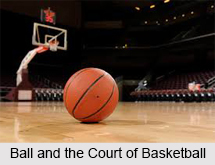
 Rules of Basketball in India are considered as those rules and regulations, which govern the play, equipment, officiating and other procedures associated with the game. The game of Basketball has several rules that the players obey and follow. The "Father of Basketball", Dr. James Naismith directed a set of 13 such rules of Basketball.
The winner of a basketball game is the team with the most points. The team gets points by throwing the basketball through the opponent`s hoop or basket. In regular play a basket made from within the three point line is worth 2 points and a basket shot from outside the three point line is worth three points. When shooting a free throw, each free throw is worth 1 point.
Players and team building in Basketball
Naismith`s original rules never specified the number of players on the court. In 1900, five players became standard, and players that were substituted were not allowed to re-enter the game. Since 1921, players were allowed to re-enter a game and it became twice from 1934. Such restrictions on substitutions were abolished in 1945 when substitutions became unlimited. Coaching was prohibited during the game but from 1949 coaches were allowed to address players during a time-out.
Basic Rules in Basketball
Some of the basic rules in Basketball are as follows:
1. Each team consists of five players. Substitutes are allowed up to five. A team can have maximum12 players in such tournaments where more than three games are played.
2. The game begins with a jump ball at the centre circle with the two opponents` feet the half circle.
3. The referee tosses the ball upward (vertically) between them to a height greater than the players can reach.
4. The jumpers are allowed two taps at the ball. Penalty for technical foul by a player is two free throws. Penalty for technical foul by a coach or substitute, or a team follower is two free throws and the ball shall be thrown in by any player of free throw shooter`s team from out of bounds at mid court of the side line opposite scorer`s table.
5. A basket is worth two points. If a basket is scored from beyond the 3-point line, then it will be three points and if it is scored from a free throw it is one point.
6. Free throw taker must remain behind the free throw line until the ball hits the ring or the backboard. No other player is allowed to enter the free throw line until the throw has been taken, i.e., the ball has left the free thrower`s hands.
7. Non-offending team may leave its right to free throws if it so desires.
8. All breaches of rules not considered fouls are known as violations. These include running with the ball, kicking or punching the ball, making illegal dribble or causing the ball to go out of court. In case of a violation or a foul, if free throw is not permitted then the ball is given to a member of the non-offending team at the sideline closer to the point at which the violation has occurred. That player must pass the ball into the court within five seconds.
 9. Following a basket or a successful second throw, the opposing team puts the ball back into play from any point behind the end line.
10. Each player is numbered on the front and back of his vest. In international competitions only the numbers 4 to 15, both inclusive, are used.
11. The ball may be played only with hands and players are not allowed to carry it more than a single step.
12. Every player in basketball must try to avoid personal contact at all times and if such a contact occurs, a "personal foul" is charged against the player responsible.
13. If the player who had been fouled was in the act of shooting for goal, and if the shot proved unsuccessful, that player is awarded two free throws.
14. A "technical foul" is charged for an offence not involving personal contact. This would also result in two free throws.
15. If a player commits five fouls either personal or technical during a match, he is barred from taking part in the game. A substitute may be introduced in place of that player.
16. After a team has committed seven player fouls either technical or personal in a half all-subsequent fouls shall be penalised by one and one Rule.
17. The team in possession of the ball must advance the ball into its front court within ten seconds of having gained possession of the playing court. Infringement of this rule is a violation
18. There is no limit to the number of substitutions that may be made during the game. Substitution can be made only when the ball is dead and the clock is stopped.
19. Time out: A team coach may request time out. He is allowed to have two time outs in each half and one in each extra period. Time out is granted when the ball is dead.
20. The basket is 3.05 m above the floor and the ball must enter it from the top.
21. A game consists of two periods of 20 minutes each with 10 minutes interval. Extra time is played for five minutes only.
22. In basketball there is no draw. At the end of 2.20 minutes period, if both the teams have equal points, five minutes extra period is given to break the tie. Even after five minutes extra time, the points are equal; a further five minutes extra time will be given. This process will continue, till the tie is broken.
Time Limits in Basketball
The first time restriction on possession of the ball was introduced in 1933. Since then teams were required to advance the ball over the center line within 10 seconds of gaining possession. Currently, this time has been reduced to 8 seconds in many countries.
Fouls and Violation
Dribbling was not part of the original game, but was introduced in 1901. At the time, a player could only bounce the ball once, and could not shoot after he had dribbled. The definition of dribbling became the "continuous passage of the ball" in 1909, allowing more than one bounce, and a player who had dribbled was then allowed to shoot. Running with the ball ceased to be considered a foul in 1922, and became a violation, meaning that the only penalty was loss of possession. Goaltending became a violation in 1944, and offensive goaltending in 1958.
Free throws were introduced shortly after basketball was invented. In 1895, the free throw line was officially placed 4.6 m from the backboard, prior to which most gymnasiums placed one 6.1 m from the backboard. From 1924, players that received a foul were required to shoot their own free throws.
Ball Used for Basketball in India
The ball of basketball in India is between 74.9 and 78 cm in circumference and weighs between 567-650 gm. It is so inflated that when dropped on a hard surface from a height of 1.80 m it re-bounces to a height of between 1.20 -1.40 m. The ball is normally bright orange coloured with black panel markings. The width of the seams and for channels of the ball not exceed 0.635 cm.
Officials for Basketball
The game is controlled by two officials (referee and umpire) aided by several assistants. The referee has the ultimate authority. The assistants are the time-keeper, the scorer and the 30-second operator. A technical commissioner may also be appointed.
Scorer
Scorer keeps chronological summary of the score sheet. Along with points scored, he also notes all fouls, free throws, time outs, substitutions, etc.
Time-Keeper
The time-keeper controls the game clock. When an official sounds his whistle, the timekeeper stops the clock which is not restarted till the bail is once again in play and retouched by a player. The clock is also stopped during free throws.
30-Second Operator
The 30-second operator operates the 30-second device or clock. He ensures that the team in possession attempts a shot within 30 seconds of having gained control of the ball. If they fail to do so, the operator sounds signal to indicate a violation.