 The showy plant that got its name from Dr. Allamond has now become one of the most popular of garden shrubs. The name of this shrub is the `Allamanda`. The botanists of the world know it as `Allamanda Cathartica`. The word `Cathartica` means "purgative". It derived from the family of `Apocynaceae`. In Bengali, the shrub is called as `Har-kakra` and it has got another name in English as the `Golden Trumpet`. The shrub is of deep green colour and it has a shining and evergreen foliage. The shrub originated from America and it has been planted so widely in India that at present you can find it in many parts of the country.
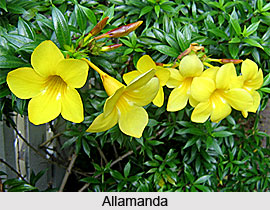
The flowers of the shrub are waxy and yellow in colour. They are a very attractive and although it is generally considered to be without scent, you can detect a faint but rich smell of spices in some special occasions. It is a straight and quite a large climbing plant. It can climb to a considerable height under suitable conditions. If you train it over a screen, it will form a marvelous hedge or you can prune it into a more compact formation. In a container, it makes a cheerful splash of colour on a veranda. The `Allamanda` is capable of producing flowers all through the year though there is a period when the flowers are small, imperfect and remain few in number. The young branches of the shrub are circular and silky. They are green in colour and often maroon on the upper side. By the course of time, they turn to ashy brown colour and become slightly scaly.
The leaves sometimes grow in pairs and sometimes in groups of fours. They are narrow and pointed. Practically they do not have any stem and they are of a rich, glossy green colour above. They are much paler below and about 10 cm in length. Their shining surfaces catch every light as they are slightly folded and curved. The flowers of the `Allamanda` do not grow from the ends of the branches. They grow from short-stemmed side shoots. One or two buds may bloom at the same time on the shoots. These buds have great charisma in themselves. They are twisted to a long point and are a lovely blend of bronze and lime green colour. Each of the flowers consists of a loose calyx. The calyx is smooth and slender. It divides into five red-tinged and green coloured sepals and also a funnel shaped corolla. The corolla tube emerges as a slim cylinder, bellies out and then opens into five broad petals. The petals are rounded at one side and sometimes have a short point at the other. The throat is penciled with deep orange coloured veins inside. The whole flower is about 8.8 cm in diameter. There are some varieties of this species that have minor differences in size and the throat markings of the flowers.