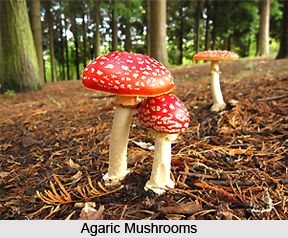
 The scientific name of the agaric mushroom is Amanita muscaria. It is commonly known as the `fly agaric`and is popular because of its hallucinogenic properties. It has a bright red cap covered with white scales. This variety of mushroom is found everywhere in the northern hemisphere and has been most unintentionally conveyed to many countries in the southern hemisphere and has become a truly cosmopolitan species in the recent era. . It is categorized as poisonous in many mycological documents and specifically by the FDA because the mushroom contains the toxic, psychoactive alkaloid .It is widely held that the mushrooms are so poisonous that they are often left open to kill flies. Although it was used traditionally by a number of cultures yet its use is not common because it`s effect can be sometimes unpleasant.
The written records of the human use of the mushroom dates back around 1600`s and the shamanic use of Amanita muscaria goes back 5000-7000 years. The most powerful mushrooms were picked in the middle of August when the season was beginning. In the mushrooms picked in September the narcotic and physical effects were predominant whereas in August the "visionary" and psychedelic effects were more highlighted. " -- As said in Disembodied Eyes. Lewin (1931) discovered that the native tribes of North East Asia used the `fly agaric`. It is witnessed that the different tribes did use Amanitas since the dawn of time. . However the effect of the mushroom varied from person to person and in the same person at different times .The mushroom varied in potency and sometimes one mushroom was effective and other times ineffective. Effects of the mushroom started occurring 1-2 hours after consumption. Subjects became calm and went in a trance, some became very jolly or sad while others jumped about danced, sang or gave way to great fright. Then the visions came on and the subjects spoke with their visionary people and discussed various matters with them. When consumed in large quantities more severe hallucinations and rages occurred and the initial excitation could become more and more severe leading to attacks of raving madness.
Amanita Muscaria is also used for religious purposes by several cultures .The religious use of `fly agaric` is common among the Indians. Indians call this mysterious mushroom "The Divine Soma".To the Aryans of the ancient Indian civilization Soma was a god and simultaneously a plant ,and the juice of the plant was consumed which inspired religious ecstasy. In recent times the images of the Amanita mushroom can be seen in Christmas and greeting cards, children stories, science fiction, in fantasy illustrations and in mushroom worlds .It is connected with the Christmas since the Inuit tribes worshipped Fly Agaric mushrooms and flying reindeer. As a drug it can be taken orally and can also be smoked for effect. Many people recommend low doses when first working with Amanita muscaria, especially with an untested variety. It should be completely dried before injestion. However it should be noted that there can be differences in quality, potency and effects between mushrooms found in different seasons and different areas The reason for the unpredictability of the Fly Agaric is due to the differing amounts of Ibotenic acid versus Muscimol within each mushroom.