Milk, Indian Food - Informative & researched article on Milk, Indian Food
  Indianetzone: Largest Free Encyclopedia of India with thousand of articles Indian Food


in  
Art & Culture | Entertainment | Health | Reference | Sports | Society | Travel
Forum  | Free E-magazine
Indian Food : Cooking Tips l Indian Street Food l indian Beverages l Indian State Recipes l Indian Desserts l Seasonal Foods l Indian Sherbets l Indian Spices l Indian Food l Sweets l Indian Vegetables l Food in Indian Culture l Culinary Terms l Rasa in Indian Food l Religious Influence on Indian Food l Indian Snacks l History of Indian Food l Indian Food Industry l Influences on Indian Food l Indian Chefs l Indian Festive Foods l Indian Regional Cuisines l Indian Culinary Influences by Indian Invasion l South Indian Cuisine l North Indian Cuisine l Western Indian Cuisine l Cooking Oils l Milk
Home > Society > Indian Food > Milk
Milk, Indian Food
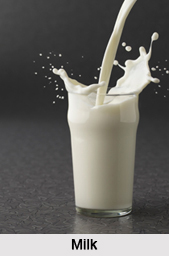
Milk is a very primitive member in the diaspora of Indian food. It occupies a special position both to the vegetarians as well as the non-vegetarians. A lot of Indian sweets are churned out of milk.

Milk, Indian FoodMilk (including its derivatives, ghee, buttermilk, cream, yogurt) is easily in the top bracket in the world of Indian food. It is the purest of edibles whose quality is sattvika (descriptive form of sattva): nutritive, agreeable, and conducive to serenity and spirituality. Sages and ascetics, who left all worldly ties behind and isolated themselves in the wilderness in search of higher metaphysical truths, subsisted on milk provided by local devotees. Milk was the one food that would not induce worldly desires or distractions in their minds. This belief in the semi-sacred quality of milk is also reflected in its consistent use as an offering to the gods. Rice pudding, for instance, is one of the commonest items offered to important household deities like Goddess Lakshmi, the goddess of wealth and prosperity. Even outside of Hinduism, milk retains its connotation of purity. The first food with which Lord Buddha broke his long fast after achieving Nirvana was milk-based.

Cow`s milk, as one would expect, is defined as second only to human milk in its wide-ranging benefits. Whatever the source, all milk was believed to have several properties in common: tasty, soothing, energizing, cool, rich, sperm-generating, reducing bile and gout and conducive to phlegm.

Milk was also an important part of the diet of ordinary people. It was not only health food par excellence; it had powerful symbolic value as an image of achievable prosperity. In agriculture-based Bengal, `milk-and-rice` became synonymous with the sustenance of a comfortable life. Vegetarians and non-vegetarians alike considered milk a precious food. Both the folktales as well as the substantial body of orally transmitted ditties (chharas) of Bengal are replete with images of milk that connote plenty and prosperity. Kings are anointed with milk and butter before their coronation. Princesses bathe in copiously flowing milk. Young girls hope to improve their complexion by washing their faces with milk. Rivers of milk, rippling waves of milk, lakes of milk, trembling layers of thickened milk, even oceans of milk recur with amazing frequency in myths, folktales, poems and songs.

It can be said that the use of milk and the general beliefs about its properties continued unchanged into the medieval period, as can be seen from literary evidence. In a tropical region, before the advent of refrigeration, the only way to preserve milk (without making it into kheer) was to repeatedly boil it, the notion of pasteurization being still far into the future. A by-product of all this boiling was the transformation of the fatty top layer into a `skin`. Each time the milk came to a boil, a new skin would form and it would be skimmed off, added to the previous layers and pressed together. These thick layers were used to make sar-based sweets. Dugdha-laklaki is layers of sar cut into squares and floating in mildly sweetened milk, sometimes flavoured with saffron. Sar fried in ghee and soaked in syrup becomes sarbhaja. Fried in ghee, layered with crushed almonds, khoa kheer and cardamom, and then soaked in sweetened milk, it becomes sarpuha.

(Last Updated on : 30/06/2010)
Recently Updated Articles in Indian Food
  • Indian Sweets
    Indian sweets are usually known as Mithai. They diverge in tastes, aromas, shapes and colours. They are the indispensable part of Indian culture for any auspicious occasion.
  •  
  • Fruit Cultivation in India
    Fruit Cultivation in India is one of the major exporting businesses which contribute significantly to the economy of the country, by earning international revenue.
  •  
     
  • Sanjeev Kapoor
    Sanjeev Kapoor one of the top chefs in the world is living the dream of making Indian cuisine truly the number one.
  •  
  • Indian Chefs
    Indian Chefs are the people working behind the unmatched food quality of unlimited varieties in different parts of India.
  •  
  • Uses of Tamarind
    Tamarind has multifaceted uses throughout India. The uses of Tamarind include culinary usage, medicinal usage, carpentry usage and various other uses.
  •  
    E-mail this Article | Post a Comment
    RSS Feeds
    Forum
    Forum on Indian Food

    Free E-magazine
    Subscribe to Free
    E-Magazine on Indian Crafts
     
     
    Milk, Indian Food - Informative & researched article on Milk, Indian Food
    Sitemap
    Contact Us   |   RSS Feeds
    Copyright © 2008 Jupiter Infomedia Pvt. Ltd. All rights reserved including the right to reproduce the contents in whole or in part in any form or medium without the express written permission of Jupiter Infomedia Pvt. Ltd.
