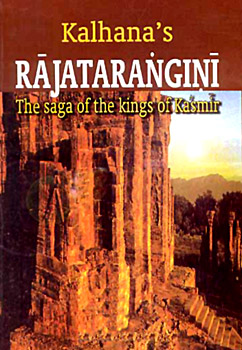
 Kalhana was one of the earliest Kashmiri writers who made a significant contribution not only to Kashmiri literature but all of ancient Indian literature as well. Kalhana is best known for his work Rajatarangini, "The River of Kings". It may be noted here that there is followed a peculiar trait of self-abnegation among the artists of ancient India. Indian architecture, sculpture, cave-temples and painting, in most cases, do not reveal the names of their authors. This is also noticed in the case of some of the literary and historical works. In the case of Rajatarangini, we at least know the name of the author, but, here again, the whole ancestry and the life of the author is hidden in oblivion. Kalhana shares the common fate of the Indian authors of note whose memory lives solely in their works.
The introductory note attached to the end of each book of Rajatarangini, gives the name of the author as `Kalhana`, `the son of the great Kashmiri Minister,` "the illustrious Lord Canpaka." Historical deductions reveal that he was a Brahmin by caste. The name Kalhana was derived through the Prakrit "Kalhan" from the Sanskrit language word "Kalyana", meaning "blessed". Kalhana wrote his work during the years 1148-1149. The style and the spirit of the work show that the author must have attained a mature age. The elaborate description of the unsteady conditions of Sussal`s reign (A. D. 1112-20) makes it clear that he must have been of age at that time. Hence, his probable date of birth might have been the beginning of the twelfth century.
Kalhana`s birth century was an important historical period in Kashmir. It was a period of extreme dynastic upheaval resulting in many political changes. King Harsha A.D. (1089-1101) seemed at first to give Kashmir a period of good government but he fell victim to his own lavishness and extravagances. After his murder, Kashmir, for seven years more, witnessed civil wars which brought death and destruction in its wake.
Kalhana was gifted with a scientific approach and a critical temperament. His portrayal of the various classes of Kashmiri people is very graphic and true to life. The reaction of the common folk to the disturbed political conditions of the time is full of realistic touches. He says that the people were "zealously prepared to welcome any change". His description of the idle and indifferent city crowds and their feelings shows that he thoroughly understood the nature of his countrymen. Kalhana has honestly and impartially related the events. While recording the contemporary happenings Kalhana has presented the principal figures in their individual character and not as types. Here he represents a contrast to Baina and Bilhan in treating historical personages, who have painted their heroes all white and enemies all black.
The unsettled political conditions of the time did away with all chances of patronage to the creative works of art; hence Rajatarangini was not written under the patronage of any King. Kalhana had a high sense of his responsibilities. He considers only historians "Worthy of praise, whose word, like that of a judge, keeps free from love or hatred in relating the facts of the past, and surpasses even the stream of nectar, and can place the past times before the eyes of men!"
It is interesting to note that Kalhana prepared himself for the role of a poet. The classical poetry in Sankskrit literature cultivated by Kalhana reveals that he had an intensive training in the Indian rhetoric, the Alankarshastra, and the equal mastery of Sanskrit grammatical lore. His literary studies were deep and comprehensive. All the literature of his time, beginning from the Epics to Kalidasa`s works Raghuvanisha and Meghaduta and Bilhan`s Vikramankadevacharita and Hanshcharita, were read by him. It therefore appears that his literary training was of the strictly traditional type. Kalhana thoroughly studied the original sources including inscriptions of various kinds before he started writing, the Rajatarangini. He also studied coins and inspected buildings.
Kalhana found all possible avenues to his hereditary career closed on account of unsettled political conditions of the country. So, the best way to employ his talents, he thought,, was to write down the history of his country from ancient down to his time. He was also inspired by regional patriotism. By painting a glorious picture of the past he wished that the countrymen should shed their inferiority complex, feel proud and try to follow their past traditions. Therefore he shows through his works the kind of Kashmir, whose examples were to be followed. It is Kalhana`s sheer patriotism when he says, "Kashmir may be conquered by the force of spiritual merits, but not by the force of soldiers."