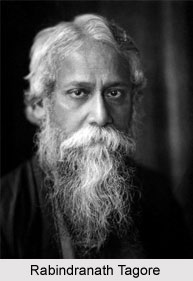
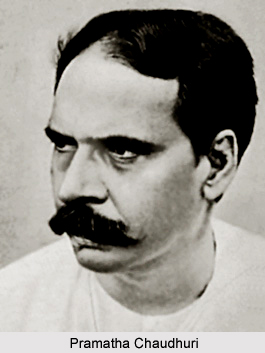
 Bengali journals in early twentieth century continued to grow in a big way. Literary journals have always held an important place in Bengali literature, not only by allowing writers to make their first appearances but also by providing the site for major debates and identifying new trends. There have been seen a number of journals in the nineteenth century which served as cultural forums for the Bengali literati- Bangabasi, Hitabadi, and Sadhana. In 1914, yet another journal, Sabujpatra (Green Leaf), came out under the stewardship of Pramatha Chaudhuri, a lawyer who taught in the Law Department of the University of Calcutta and who had married a niece of Rabindranath Tagore, the greatest Bengali literary figure. This journal, too, was initiated by Rabindranath. Chaudhuri`s incisive prose was lucid and thought-provoking, and the editorial choices he made strongly promoted the argument for the adoption of colloquial Bengali language as the standard of writing as well. Pramatha Chaudhuri wrote under the pseudonym of `Birbal`, the legendary courtier of the Mughal emperor Akbar, who was famous for his subversive wit and biting sarcasm. His important prose collections include Birbaler Halkhata (Birbal`s Accounts, 1917) and Chariyari Katha (Tales of Four Friends, 1916).
Bharati was another major journal in the twentieth century which was the revitalized and had been taken over by a younger group of writers. The most important prose writer to emerge from the pages of the new Bharati was Rabindranath`s nephew, Abanindranath Tagore (1871-1951). But Abanindranath was more a peer for the Bharati group (he was the father-in-law of its editor, Matilal Gangopadhyaya, than a product. He is better known as one of the pioneers of modern Indian art. His greatest contribution to Bengali literature lies in the large number of tales he wrote (and illustrated) for children, in ever so popular books like Bhutpatrir Dese (The Land of Ghosts and Goblins, 1915) and Khajanchir Khata (An Accountant`s Journal, 1916). Khirer Putul, his famous fairy-tale novella for children, continues to remain one of the best stories ever written for the young in the Bengali language. Abanindranath also wrote some scholarly monographs and articles on women`s folk rites in Bengal and their art, most notably Banglar Brata (Folk Ritual Rhymes of Bengal, 1919).
One notable factor about this era is that the literary scene at this time was not confined to the Hindu Bengali community alone. There was a considerable amount of literary activity in the Kolkata-based Bengali Muslim community as well. The work of the Mohammedan Literary Society needs to be mentioned, in this context, among the organizations that contributed to the literary fashions of this period. Also noteworthy were the contributions of publishers and editors like S. Wajed Ali and the journals Mihir and Mohammadi.