


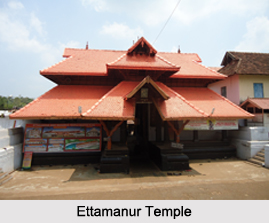
 The Ettamanur temple is dedicated to Lord Shiva. It is believed that Lord Ettmanur is a fierce deity. The prathishta itself at Ettumanur is as an Aghora (fierce) murti. Hence He instills fear and discipline in his devotees. He expects them to be pure in mind, word and deed and approach him with sincere devotion. There is no room here for hypocrisy or short-cuts. A number of legends are also associated with the temple of Ettamanur in Kerala. The Ettamanur temple is dedicated to Lord Shiva. It is believed that Lord Ettmanur is a fierce deity. The prathishta itself at Ettumanur is as an Aghora (fierce) murti. Hence He instills fear and discipline in his devotees. He expects them to be pure in mind, word and deed and approach him with sincere devotion. There is no room here for hypocrisy or short-cuts. A number of legends are also associated with the temple of Ettamanur in Kerala.
Location of Ettamanur Temple Ettumanur is located 11 km. to the south-east of Kottayam town. The temple is about a furlong from the bus stand. Ettumanur is also a railway station on the Ernakulam - Kottayam section of the Southern Railway. The temple is nearly 2 km. from the station. One can spot the lofty western gopuram which is the main entrance since the deity faces west and the golden flagstaff glittering in the sun from quite a distance. The Celebrated Big Lamp of Ettamanur Temple The temple is four or five feet below the road level. As once enters it through the Balikalpura or altar-house, one comes across the celebrated Valia vilakku or the big lamp, which one has to worship first before having darshan of the main deity. This lamp is said to have been installed in 1545 A.D. and its wicks have been burning ever since. An important vazhivadu or offering is pouring oil in this lamp. It can contain nearly 3 litres of oil. As every devotee pours oil, the overflow is collected in a huge vessel placed below the lamp. The spill-over thus collected is so much that it is sufficient for the annual festivals of the temple. The soot collected on the cover of the lamp is applied to the eyes as it is believed to cure eye diseases. People possessed by evil spirits also get liberated here by making vows after worshipping to this holy lamp. There is a story behind this lamp. The present temple we see is the one renovated in 1542 A.D. Soon after, one evening, some temple servants were standing in front of the west tower and passing their time gossiping. At this juncture a bell-smith came and placed reverently a beautiful lamp before them. With folded hands, he requested them to keep it for the temple use and give him something for the night's gruel. At this one of the servants admired the beauty and fine workmanship of the lamp. He thought it glittered like gold and wondered who could pay for it. He added that if it was lighted it would be very auspicious for the temple. Architecture of Ettamanur Temple It bears a close resemblance to the Vaikom Shiva temple though smaller in size. Its central shrine like the one at Vaikom is circular in shape surmounted by a conical roof covered with copper plates with a stupi of copper gilt at the top. In front of the garbhagriha is a raised platform, the mukhamandapa, square in form, where there are two images of Nandi (Bull) one finished in stone and the other made on an alloy of copper and tin. The metal bull used to contain paddy, the grains of which can be taken out through one of the holes. This is said to be an effective remedy for stomach trouble. Beyond the mukhamandapa are corridors or pillared halls, all round the sanctum and mukhamandapa. The whole edifice is rectangular in shape, and on its exterior has columns of lamps fixed on a wooden framework covered with metal trellis-work. In all, fourteen thazhika-kudams or stupis adorn the temple roof which is all covered with copper sheets. Outside the temple, beyond the balikalpura is the golden flagstaff. In line with the flagstaff there is the circumambulatory path for temple processions or for devotees taking rounds. Midway between the flagstaff and the gopura is the anakottil where elephants take their stand for the temple procession. Indeed the central shrine stands out for wall carving, a major art in Kerala. There are admirable pieces of wood sculpture, the whole of the Ramayana story is carved with striking beauty as also scenes from Santanagopala, Krishnaleela and Bhagavata. Deity of Ettamanur Temple The image of the Lord of Ettumanur which faces west is represented in a two-foot high Shiva linga installed on a high pedestal in the innermost recess of the sanctum sanctorum. To enable devotees to meditate on an image, a beautiful vigraha is placed in front of the Linga after the morning abhisheka. Adorned with flower garlands and decorated with diamond necklaces and gold ornaments the deity glitters and looks so attractive that one can hardly take off the eyes from it. To the north of the srikoil there is a Sasta shrine with its beautiful stone image. On the south side there are shrines of Ganapati and Dakshinamurti. Just at the back of the Shiva image i. e. on the east of the srikoil Goddess Parvati is imagined and worshipped. There is a door here but it is never opened. On either side of the entrance of srikoil there are images of Dwarapalakas which are very attractive. Festivals of Ettamanur Temple The annual festival at Ettumanur is in the Malayalam month of Kumbham (February-March). It lasts ten days and is a very major festival in Kerala. |
| |||



Home > Reference > Indian Temples > Indian Regional Temples > South Indian Temples > Temples of Kerala > Ettamanur Temple
Ettamanur Temple
| Ettamanur Temple of Kerala is known for the fierce form of Lord Shiva. Looking at the deity fear and awe is raised in the mind of a devotee. |
| ||||||||||||||||||||||||||||

