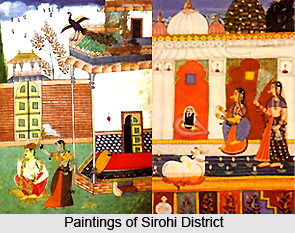
 Paintings of Sirohi are beautiful executions of colour and style. Each space and form is first enhanced by deep shadows and later curbed with light or dark lines on the deep and light parts equally. Sirohi paintings are mainly available in two sizes. One is manuscript paintings, very small in size, finding space between calligraphy and the text. Some pages are purely independent too, bearing the text on the reverse or even without text. These pages are usually rectangular in general layout. Manuscript paintings are usually on a single page, having a little border to the left and right with folio number and their information. Other paintings are executed on paste-board, like in the school of Rajasthan paintings. Paste-board or Vasali of Sirohi paintings is usually of three papers of about 8" x 10" in size. They don`t deal with much courtly matters or mundane subjects, and mainly revolve around the Ragamala School of paintings. These drawings reveal both the aspects i.e. folk as well as a refined way of execution with other subjects like nakiya, war scene, goddess Saraswati, Laila Majnu and Lord Krishna themes.
Colours of Sirohi paintings are bright and pure. These are skilfully executed with undertones and sub-tones to enhance the glow and contrast of colours. Pure white against pure black is a Marwar idiom. Use of scarlet, red, yellow and blue with pure shades of brown like reddish brown, brown etc. and bright and subdued greens, all are managed so well that the effect gives a sober look to the paintings.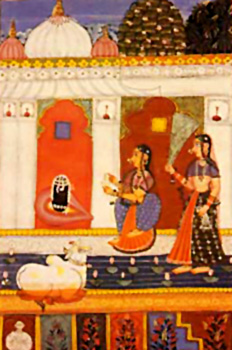 The line treatment is obvious in border which is always scarlet. Painting is divided with a border, a strong white thick line bearing two black lines on the inner and outer side. The border towards the paintings is deepened with crimson, covering half of the border with a vanishing tone in the centre. Sometimes, corners are controlled angularly and sometimes in a simple treatment of brush turning at the right angle. The dark tone is curbed with white thin line of white colour which creates an extra pleasing effect. This type of treatment of line can be seen in the whole composition, controlling figures and forms, architecture, flora and fauna etc. equally. Use of blue in its various tones is peculiar in Sirohi. Broad flat masses of different colours give a more balancing narrative in the composing.
Sirohi style of painting is inclined more towards folk. It includes Marwar and Mewar influences along with Mughal fashion which was rather mixed in Rajasthani culture. After deciding the provenance, the style became so distinct to viewers that a particular painting can be easily ascribed to this school due to its strong character and style, colour and format and above all limited subjects. It remains unclear as to why only Ragamala Painting was executed and why other courtly and mundane subjects were not painted. The only possible reason seems to be that there must not have been an atelier type of work place. Only some painters trained to paint Kalpasutra must have tried this subject on the basis of some source of drawings or a set. This style is their own version. Early paintings of Sirohi are related to Jainism. Amongst them, Darshan Chobeesia, Kalikacharya, Kalpasutra, Sangrahani sutra and Upadeshamala Devi Mahatmya etc are the painted manuscripts. The Kalpasutra resembles the earlier central Indian Gujarat style. This manuscript is also savachashma. Predominantly red and blue colours are used in flat masses as was the trend in those days.
Wall Paintings
Maharaj Akhairaj got the fort and palace at Sirohi constructed and decorated it with murals. We mainly find subjects like Krishna Lila, Indra Sabha and Shiva Lila etc. in the palace. Shiv Lila and Indra Sabha paintings of the palace have influenced the paintings in Durgeshwar Mahadev Temple. Unfortunately the Durgeshwar murals have vanished. Some photographic documentation has been maintained by Dr. Sohan Lal Patni. Some hermitages of ascetics devoted to Sharneshwarji temple contained wall paintings but now every such record has vanished due to continuous white washing. Technically there is not much variation in the execution of murals, manuscripts and miniature paintings of Sirohi, as compared to other Rajasthani schools of painting.