


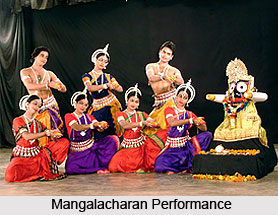
 Mangalacharan is the very first item of an Odissi performance and has a number of smaller items within it. Mangalacharn is an invocatory item of Odissi and hence is an essential part of it. In Mangalacharan the dancer first stands in Sthai Bhangi which is a tribhanga pose, with a handful of flowers in Puspaputa hasta. An essential component of the dance is when the musician starts playing his drum, the dancer moves a few steps backwards and drops the flowers on the ground as a mark of respect to the Ranga Bhumi. Mangalacharan is the very first item of an Odissi performance and has a number of smaller items within it. Mangalacharn is an invocatory item of Odissi and hence is an essential part of it. In Mangalacharan the dancer first stands in Sthai Bhangi which is a tribhanga pose, with a handful of flowers in Puspaputa hasta. An essential component of the dance is when the musician starts playing his drum, the dancer moves a few steps backwards and drops the flowers on the ground as a mark of respect to the Ranga Bhumi.
Puspanjali in Mangalcharn is followed by Sama Sthanaka and then the dancer soon adopts a Chauka pose and dances in that particular pose for a while. Mangalcharan also involves the process of Bhumi Pranam in the dance performance. In Bhumi Pranam the dancer is required to sit on the toes and touch the earth with both the hands and then touches the ground with the help of his forehead. After the Bhumi Pranam starts the Vandana, the invocatory part of the item. The Vandana or obeisance to a deity is accompanied by a Sanskrit sloka which is rendered by a vocalist. The Sanskrit sloka is enacted by the dancer with the help of abhinaya which in turn is accompanied by hastas and bhavas. The Sankrit slokas are mainly intended for the invocation to Lord Ganesha, Lord Shiva, Lord Krishna, Lord Jagannath, Goddess Durga and Goddess Saraswati. But most of the Sanskrit slokas in Mangalacharan are dedicated to Lord Ganesha which describes dancing as one of the important attributes. During the musical recitation of Sankrit slokas the Mardala is not played which contributes to the devotional atmosphere of the performance. The singing of the Sankrit slokas holds a very important place in the Sastras. When the singing of the sloka is over, the dancer begins an invocatory piece of dance in association with the Mardala. The rhythmic syllables which the drummer plays are traditionally fixed and are known as ukutas. The ukutas are also sometimes recited by the drummer. During the dance the hands mostly remain in Anjali Hasta and in this hasta the dancer concludes with three salutations one to the Gods over the head, one to the Guru in front of the face and the last salutation is to the audience in front of the chest. |
| |||



Home > Art & Culture > Indian Dances > Classical Dances of India > Odissi > Style of Odissi > Mangalacharan
Mangalacharan
| Mangalachran is that part of Odissi with which the dance begins and it contributes to the invocatory part of Odissi. |
| ||||||||||||||||||||||||||||

