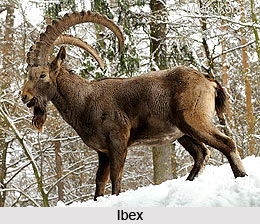
 Ibex is the name given to various forms of wild goats (the Walia and Nubian Ibexes for example), and are found in the more arid mountain ranges from the North Africa, Ethiopia, Arabia and the Caucasus stretching across Iran and Afghanistan to the Himalaya and Tien Shah mountains.
Types of Ibex
Within the subcontinent two distinct species occur. In the high inner Himalayan ranges, the Siberian Ibex Capra ibex sibirica, and in the southern mountain ranges across to the Sind Kohistan, the wild goat or Sind Ibex Capra hircus. Like all the goat tribes, they are sturdy beasts with relatively strong legs and are adapted to subsist upon the sparsest of xerophytic vegetation, depending for survival against predators on their uncanny ability to traverse the most precipitous cliffs and to climb into inaccessible crags.
Physical Appearance of Ibex
Sind Ibex are stocky animals with thick-set bodies. They have strong limbs. Female and young males in Sind Ibex, till their second winter, are yellowish-brown varying to reddish-grey in colour. Males have short beards, but females lack any beard. In mature male Sind Ibex, the belly and outside of the lower limbs, beard and forepart of the face vary from black to deep chestnut-brown colour. Their horns are sturdily keeled in front, sweeping upwards and outwards.
The Siberian Ibex is an altogether more massive beast, adult males having a dense woolly coat which is dark coffee-brown with whitish cream saddle and rough patches. The females and young males are more reddish brown and have short horns measuring fifteen centimetres which bear corrugations or annulations. A trophy head may have horns of one hundred and twenty seven centimetres or more with regularly spaced ridges or bosses on the flattened anterior surface. The fleece of the Siberian Ibex is so fine and soft that it rivals the Vicuna of the high Andes, and legend has it that shawls woven from pashm would pass through a signet ring. They are seen in North Western India.
Habitat of Ibex
The Sind Ibex is the same species as the Cretan wild goat and Persian Pasang and is believed to be the progenitor of domesticated goats. They are adapted to live in hot climates at altitudes as low as four hundred and fifty metres in cliffs along the Makran coast, and they can subsist on browsing such thorny bushes as Acacia Senegal and Zizyphus mummularia (ber) when grass is scarce in years of drought. The Siberian Ibex is confined to altitudes above three thousand and five hundred metres, preferring to remain near the limit of the permanent snow-line. There they can subsist on grass and Artemesia maritime, for which they can dig in the snow with their forefeet.
Both species are gregarious, young males and females of the Sind Ibex forming herds of about seventy or eighty individuals, though the Siberian Ibex is rarely encountered in herds of more than twenty to thirty. Old males tend to keep in small groups on the periphery of the main herd or to live a solitary existence until the rutting season. The gestation period is five to five and half months in both species and in years of good food-supply most females produce twins. In the Sind Ibex, the rut is at the end of the monsoon in September and young are born in February. In the Siberian Ibex, the rut is in late December, early January and young are born in the month of May.