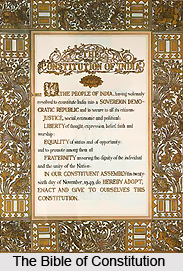
 The Indian Constitution has provided for the Amendment of the Constitution as laid down in Article 368. According to clause of Article 368, `Notwithstanding anything in this Constitution, Parliament may in exercise of its constituent power amend by way of addition, variation or repeal any provision of this Constitution in accordance with the procedure laid down in this article.` This power of the Indian Parliament is quite distinct from its ordinary law-making power.
Procedure of Amendment of Indian Constitution
The procedure is almost the same as in the case of an ordinary bill. Proposals for amendment are to be introduced in either House of Parliament in the form of a bill. An amendment bill is then to pass through the usual stages and when passed by one House, the other House will have to pass the bill in the same procedure.
Article 368(2) of the Constitution provides that `An amendment of this Constitution may be initiated only by the introduction of a Bill for the purpose in either House of Parliament, and when the Bill is passed in each House by a majority of the total membership of that House present and voting, it shall be presented to the President who shall give his assent to the Bill and thereupon the Constitution shall stand amended in accordance with the terms of the Bill.`
An Amendment Bill after passing through the hurdles requires ratification by the legislatures of one-half of the states in certain specific cases:
(a) Articles 54 and 55 which deal with the procedure of Presidential election.
(b) Articles 73 and 162 which deal with the extent of executive powers of the Union and of the states.
(c) Chapter IV of Part V which deals with Union Judiciary.
(d) Chapter V of Part VI which deals with High Courts of states.
(e) Article 241 which deal with High Courts for Union Territories.
(f) Chapter I of Part XI which deals with legislative relations between the Union and the states.
(g) Any of the Lists in the Seventh Schedule, i.e., the Legislative Lists.
(h) Article 368 which makes provisions for Constitutional Amendment.
An Amendment Bill relating to any of the above category referred to State Legislatures and ratified by a simple majority of each House of State legislatures will have to be assented to by State Governors. The bill then comes to its last stage, namely, the Presidential assent. It is only a formal affair. The President shall give his assent to all such bills. With the assent of the President, the constitution shall stand amended.
There are certain matters which if they require amendment, may be amended in the ordinary process of law-making. Such matters include (i) formation of new states, (ii) reorganisation of existing states, (iii) creation or abolition of Upper Houses in any state. But such changes shall not be deemed as constitutional amendments.
The 42nd Amendment Act provides that no Court shall have the power to determine the validity of any constitutional amendment made by Parliament. The 44th Amendment Act tried to delete this provision. But the amendment to this provision had to be dropped because the Rajya Sabha did not accept this.
From its inception since 1950, there have been 94 amendments in the Indian Constitution.
Amendment of Indian Constitution
Amendment of Indian Constitution brings about the necessary changes in the Constitution as and when required.