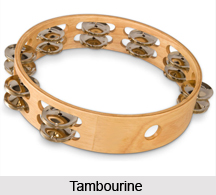
 The tambourine is a musical instrument belonging to the percussion family. The word tambourine finds its origins in the Middle Persian word tambur "lute, drum" (via the Middle French tambour). The tambourine has a long history behind it, and its usage can be traced as far back as certain Dionysian rites in 300AD. An interesting historical fact about the tambourine is that in ancient and prehistoric times and in medieval Europe, the tambourine was traditionally a woman`s instrument and continues to be so today in Islamic countries. Tambourines are found in many different shapes, with the most common being circular. The shape of the tambourine is symbolic. A traditional Middle Eastern tambourine, with five sets of moon-shaped jingles representing the five phases of the moon: birth, growth, fruition, dissolution, and death.
The tambourine or Marine, as it is also called, classically denotes an instrument with a drumhead, though some variants may not have a head at all. It consists of a frame, often made of wood or plastic, with a number of pairs of small jingles called zils. The cylindrical frame is about 21 inches high. There are four or more slots spanned by rods in the circular frame. Attached to each of these rods are one or two loose metal disks that make a jangling sound. Buckskin is stretched over the frame to make the drumhead. It is sometimes nailed to the frame, and sometimes held taut with a wooden or metal hoop and four to six tension screws. The instrument has a diameter of 814-14 inches.
In order to play the tambourine, it needs to be struck with the fingers, the knuckles the back of the hand or the ball of the hand, while at the same time being shaken back and forth. It is played by shaking, striking the rim, or rubbing the thumb around the head. When the tambourine is played in different ways it can be used to produce different sounds- that of the skin when struck in the center, that of the wood when struck close to the wooden rim, and that of the metal when played more delicately with the fingers striking individual cymbals and more raucously by shaking the entire tambourine.
The tambourine is used in many different forms of music. The most popular use of the tambourine is seen in Italian folk music, classical music, Roma music, Persian music, gospel music, pop music and rock music. Perhaps its most frequent use in modern times is as one of the musical accompaniments to the public meetings of the Salvation Army. There are many different forms and adaptations of the tambourine found in the different countries of the world. The pandeiora originated in Portugal and Brazil, the Rik in Arabic music, the Buben in the Russia and the East and many other central-Asian variations like the dayareh, daf etc. Extensive use of the tambourine is made even in classical Indian music by means of the kanjira. It is a South Indian frame drum belonging to the tambourine family. It is mostly used in Carnatic music concerts as an accompaniment to the mridangam.
Tambourine Muscial Instrument
The tambourine is a kind of percussion instrument which is used in many different forms of music; it is used in Indian classical music in the form of the kanjira.