


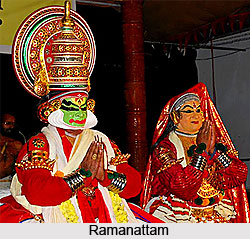
 The origin of Kathakali is steeped in legends and myths. Tradition avers that Raja Veera Kerala Varma of Kottarakkara once requested the Zamorin of Calicut to send his troupe of Krishnattam players for a performance in connection with royal wedding there. The Zamorin added insult to injury by not only declining the request of the Raja but also by jeeringly remarking that there were no scholars in the South who were capable of appreciating such a highly artistic and literary performance as Krishnattam. As a measure of retaliation arising out of righteous indignation, the king evolved a new type of dance, known as the Ramanattam. He dispensed with the expensive apparels that were generally used by the Krishnattam dancers and adopted simpler costumes which looked primitive. The origin of Kathakali is steeped in legends and myths. Tradition avers that Raja Veera Kerala Varma of Kottarakkara once requested the Zamorin of Calicut to send his troupe of Krishnattam players for a performance in connection with royal wedding there. The Zamorin added insult to injury by not only declining the request of the Raja but also by jeeringly remarking that there were no scholars in the South who were capable of appreciating such a highly artistic and literary performance as Krishnattam. As a measure of retaliation arising out of righteous indignation, the king evolved a new type of dance, known as the Ramanattam. He dispensed with the expensive apparels that were generally used by the Krishnattam dancers and adopted simpler costumes which looked primitive.
Ramanattam was first performed in front of the deity at the Ganapati temple of Kottarakkara. It is a convention that is followed by the Kathakali dancers that their first performance should be invariably be performed as an act of adoration of Lord Ganesha at this temple. Ramanattam is considered the origin of Kathakali which in its form, substance, depth and dynamism is unique. According to the tales that surround the origin of Kathakali it is said that the king of Kottarakkara, who lived between 1575 and 1605 AD, was the first composer and originator of Kathakali. A revolutionary revival of the old folk dance-drama in a new, attractive garb, this new form of art liberally borrowed from old and the new but sedulously preserved the trinity of harmonies as its precious heirloom. It was originally called Ramanattam, for the earliest theme theatrically represented was the story of Lord Rama, one of the avatars or incarnations of Lord Vishnu. The king of Kottarakkara drew inspiration from the episodes of Ramayana for all his eight plays. These events began from the birth of Lord Rama to his coronation after killing Ravana, the demon king Lanka. The next person to develop Kathakali further was the Raja of Kottayam. He developed it on the themes of Bharatham. He flourished between 1665 and 1743 AD. The author of four Kathakali plays, he set the standard for the subsequent writers. An inspired dramatist and accomplished actor, he once took by surprise the Zamorin of Calicut who was a great connoisseur of the art of Kathakali. The Raja of Kottayam, during his visit to the Zamorin, without the knowledge of the others, participated in the performance. The Zamorin was pleased with the new actor and was about to give his presents when he recognised to his great surprise, the fifty year old king as the actor. Besides him, the Raja of Vettathunad was the pioneer in improving upon the Ramanattam and making it brighter and more spectacular. Thus, it would not be wrong to state that Kathakali flourished in Kerala under the royal patronage. In fact, the king of Travencore was a patron of the various troupes of Kathaklali actors who carried on the remarkable art. In addition to Karthika Thirunal Maharaja, who was an authority on Bharatha Natya, was also a known patron of the art. Over the ages Kathakali was appreciated and encouraged by the royal households of Kerala. The art of Kathakali is older than its literature which is about four centuries old. There are certain evidences that claim that this form of Indian classical dance is four centuries old. History further narrates that Ammu Raja of Bali islands, nearly a thousand years ago, took some people from Travancore and they taught the people of Bali a kind of dance in which predominance was given to gesture. Later Kathakali spread to Java as well. A type of pantomime using a stylized gesture language, acted to the accompaniment of drums, songs sung by special singers and the whole set in a framework of dance, the Kathakali has no more counterparts elsewhere, except in the shadow dance and dramas of Java. |
| |||



Home > Art & Culture > Indian Dances > Classical Dances of India > Kathakali Dance > Origin Of Kathakali
Origin Of Kathakali
| Origin of Kathakali is rooted in ancient Kerala. Stories related to the origin of Kathakali narrate the contributions of several kings in developing it. |
| ||||||||||||||||||||||||||||

