 Nanda Devi Sanctuary is the centre-piece of the Garhwal Himalaya region. This glacial basin is surrounded by a ring of peaks between 6,000 metres and 7,500 metres high. Until the year 1934 the valley of the Rishiganga and the immediate area around Nanda Devi was the least known and most inaccessible part of the Himalaya Mountains. The mountain stands in a vast amphitheatre, seventy miles in circumference, and about 6000 m high. There is no depression in this cirque below 5200 m, except in the west where the Rishiganga, draining some 240 square miles of ice and snow, carves out for itself one of the most formidable valleys. Nanda Devi Basin being an inner Himalayan valley enjoys a characteristic microclimate. Here the conditions are generally dry with low annual rainfall, but during the monsoon there is heavy rainfall. The early Indian surveyors and mountaineers were unable to explore Nanda Devi Sanctuary. The Sanctuary is now a National Park, which officially disallows anyone to enter it.
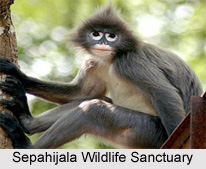
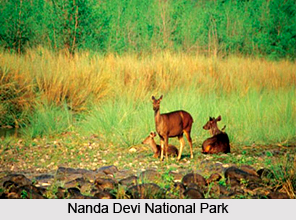
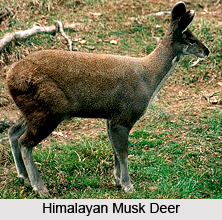
The Nanda Devi basin is well known for its abundance of ungulate populations, particularly Bharal (Pseudois nayaur). Beginning surveys show that Himalayan Musk Deer (Moschus chrysogaster), Himalayan Tahr (Hemitragus jemlahicus) and Mainland Serow (Capricornis sumatraensis) are also quite common. Moreover, in this park one can easily observe Snow Leopard (Panthera uncia) despite of the scarcity. The other large carnivores one can find in this park are Common Leopard (Panthera pardus), Brown Bear (Ursus arctos) and Himalayan Black Bear (Selenarctos thibetanus). The only monkey present in this park is Common Langur (Presbytis entellus). Around 83 different species have been reported from the biosphere reserve.
Further, a total of 114 distinct bird species were recorded during the Nanda Devi Scientific and Ecological Expedition in the year 1993. The plentiful species that are recorded in this park during May and June include Yellow-bellied Fantail Flycatcher (Rhipidura hypoxantha), Crested Black Tit (Parus melanolophus), Blue-fronted Redstart (Phoenicurus frontalis), Orange-flanked Bush Robin (Erithacus cyanurus), Indian Tree Pipit (Anthus hodgsoni), Nutcracker (Nucifraga caryocatactes) Vinaceous-breasted Pipit (Anthus roseatus) and Common Rosefinch (Carpodacus erythrinus). The richness of species was found to be at its highest point in moderate forests. From the biosphere reserve near about 546 species are reported. However, there is a lack of systematic surveys on spineless fauna. Around 27 species of butterfly have been recorded during May and June in the year 1993. It includes Common Yellow Swallowtail (Papilo machaon), Indian Tortoiseshell (Aglais cashmirensis), Queen of Spain (Issoria Iathonia), Common Blue Apollo(Parnassius hardwickei) and Dark-clouded Yellow (Colias electo).
 This sanctuary is generally divided into two chambers - Inner and Outer. The Inner Sanctuary bears some similarity to a wrong-way round letter E (3) with the middle horizontal stroke made up of Nanda Devi main and east peaks. It roughly covers two third of the entire area. The two major peaks of this glacier are Uttari Rishi Glacier (north) and the Dakkhni Rishi Glacier (south). The other major peaks which form on the other strokes of the letter comprise Latu Dhura (6392 m), Sakram (6254 m), Bamchu (6303 m), Deo Damla (6620 m), Mangraon (6568 m), Kalanka (6931 m) and Changabang (6864 m). Next to its south, lie Maiktoli (6803 m), Devtoli (6788 m), Devistan (6678 m), Panwali Dwar (6663 m) and Nanda Khat (6611 m). Most of these can be approached from outside the Sanctuary. On the outer edge lie Ronti (6063 m), Nanda Ghunti (6309 m), Trisul (7120 m), Bethartoli Himal (6352 m), Hanuman (6075 m), Dunagiri (7066 m) and Mrigthuni (6855 m). These are the prominent peaks on the Sanctuary Wall. The Outer Chamber engages the western third of the total area. It is separated from the Inner Chamber by high edges.
Some of the other variations on Nanda Devi comprise the north ridge and the west face. There are several notable peaks that are adjacent to the outer Sanctuary Wall. These are Hardeol (7,151 m), Trishuli (7,074 m), Nanda Kot (6,861 m) and Nanda Ghunti (6,309 m). Dunagiri (7066 m) on the Sanctuary wall lies across the Ramani glacier from Changabang.
Nanda Devi Sanctuary is reputedly considered as one of the most stunning wildland in the Himalayas. In the past few years, several scientific expeditions have been undertaken into the sanctuary in order to analyze the present situation and for organizing clean-up operations.