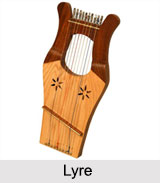
 Lyre also known as "lyra" is a stringed instrument with a distinctive shape. The strings of lyre run from under a tailpiece or front of the instrument to the crossbar. Most lyres are plucked, but a few are curved. Lyre is a musical instrument played by the ancient Greeks and was possibly the most important and well-known instrument in Greek.
History of Lyre
The history of the lyre is lost in the mists of time. It existed during the Sumerian civilisation and was played by the ancient Egyptians. However, the instrument is most frequently associated with ancient Greece. In Greek ancient times, Lyra was mainly an instrument for the amateur player. In the first millennium of western European civilization, the lyre is depicted in the illuminated manuscripts. During this time, the lyre was plucked with a plectrum instead of being strummed with the hand. The first lyre was made by god Hermes, the messenger of gods.
Types of Lyre
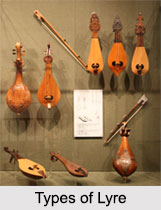 There are different types of lyre found the world over. "Crwth" is a bowed lyre that was especially popular in Wales. The curved lyre that persisted longest was the "Welsh crwth", known as early as the 11th century and still in use in the beginning of 19th century. The classic lyre has a hollow body, called the "sound chest". Two raised arms extend from this "sound chest". These are empty and curved, both outward and forward. "Box lyres" can be found only in Ethiopia and among the "Sebei" (Nilo-Hamitic people of Uganda). "African bowl lyres" vary from the Ethiopian lyres. "Rebec" (viol) has three strings which could be tuned and is played with a bow.
Structure of Lyre
The number of strings on the classical lyre varied with the different ages. Lyre usually has two fixed upright arms (pecheis) or horns (kerata) and a crossbar (zygos) with the tuning pegs (kollopes) of bronze, wood, ivory, or bone. Seven strings (neurai or chordai) of the same length but changing thickness stretched between the crossbars. Lyre is played while sitting or standing, holding in the hand and sometimes supported with a carrying band worn over the shoulder of the player. An additional crossbar, fixed to the sound-chest, makes the connection which transmits the vibrations of the strings.
The deepest note is that which comes from the player`s body with the most distant. As the strings do not differ much in length, more weight may have been gained for the deeper notes by thicker strings. This is similar to the violin and related to modern instruments. There are two ways of tuning:
•To tie up the strings to pegs which might be turned;
•To modify the place of the string upon the crossbar; probably both measures were used at the same time.
Lyre from various times and places is regarded as a division of the zither family.