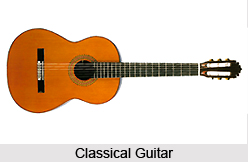
 A guitar is a string instrument that emits sound by the playing of its six strings with the sound being projected either acoustically or through electrical amplification. Guitar is one of those instruments that come in various shapes. For instance, the classical or Spanish guitar has a characteristic figure-of-eight shape and is approximately 19 inches long.
History of Guitar
The guitar is native to the Iberian Peninsula. Originally, the guitar was a folk instrument and the vihuela de mano, an instrument played by and for the nobility. The vihuela de mano was a kind of compromise between the guitar and the lute. It had the shape and size of a guitar, but the tuning resembled that of the lute, as did the stringing, which consisted of four double-strings. A fifth pair of strings was attached to the bass side in the course of the seventeenth century. The shape deviated slightly from that of the modern guitar. The sound box was smaller and deeper and the waist less pronounced. The sound hole was covered with a rosette.
In the mid-eighteenth century, the guitar assumed greater importance in music elsewhere in Europe. The reason for this was that the lute had gradually been supplanted by the harpsichord. The unmanageability and fragility of the lute (particularly when it came to tuning) contributed to its decline. When the stringing was reduced to six, making it suitable for playing by amateur musicians, its popularity rapidly increased. The new, simplified string arrangement was accompanied by an enlargement of the sound box, which was changed to its present shape. The rosette over the sound hole disappeared as well. This gave the guitar greater volume, aided by the deep body of the instrument. A solo guitar can be heard clearly everywhere in a large concert hall, while a harpsichord, heard from far away, is usually experienced as a faint tinkling.
Types of Guitar
Guitars are generally divided into two broad categories including acoustic and electric.
Acoustic Guitars
Interestingly, acoustic guitars are further classified into several subcategories like classical and flamenco guitars; steel-string guitars; twelve-string guitars; and the arched-top guitar to name a few.
Classical Guitar: The classical guitar is also known as Spanish guitar. This one is typically strung with nylon strings. It is played in a seated position. Classical guitar is mainly used to play a diversity of musical styles including classical music.
 Flamenco Guitar: The flamenco guitar is similar to the classical guitar. The only difference is that it is lighter in construction. It is designed with a cypress body and spruce top.
Steel-String Guitar: This guitar is a bit larger in size than compared to the classical guitar. It has a narrower, reinforced neck and stronger structural design. The steel strings are designed especially to produce a brighter tone.
Twelve-String Guitar: The usage of this guitar can be mostly seen in folk music, blues, and rock and roll. The 12-string guitar comprises of six courses made up of two strings each. The highest two courses are tuned in unison, while the others are tuned in octaves.
Archtop Guitar: The Archtop Guitar is popularly used in jazz music. It is designed with a large, deep, hollow body whose form is much like that of a mandolin.
Electric Guitar
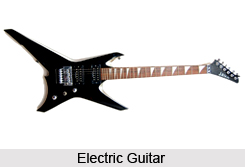
The electric guitars can have varied bodies like solid, semi-hollow, or hollow bodies. The guitars with solid bodies produce little sound without amplification. The electric guitar is used extensively in music like jazz, blues, R & B, and rock and roll.
In contemporary time, there are as many as seventeen types of guitars. But it is the electric guitar that is widely used in world music, especially in music like rock.