History of Indian Astronomy
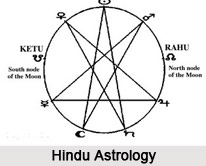 History of Indian Astronomy dates back over four thousand years. It is said that Indian astronomy actually had a huge influence on the science of astronomy. The study of astronomy in the country shows that the early Indian astronomers are amongst the most powerful in their respective fields. Moreover, some of the earliest references of the history of Indian Astronomy can be found in the `Rigveda`, that is a collection of hymns dating back to almost 2000 B.C. The elaborate study of the history of astronomy in India states that astrology and Indian astronomy were very closely associated. According to the ancient Indians, it is the position of the different planets (particularly Saturn and Mars) that determined the fortunes of the people. And these were the beliefs that created the basis of horoscopes and modern astrology. Ancient Indian astronomy makes use of sidereal calculations, which are based on the stars. Moreover, sidereal period is also defined as the time that is taken by the object to make one full orbit around the Sun.
The study of ancient Indian astrology clearly states that the sidereal astronomy is based upon the stars. The sidereal calculations can be traced to the final centuries BC. It can be attributed to the `Lagadha`, one of the circum-Vedic texts. This text describes rules for tracking the movements and motions of the moon and the Sun for ritual purposes. It was after the formation of the Indo-Greek kingdoms, astronomy in India was hugely influenced by Hellenistic astronomy and it adopting the zodiacal signs. Not only that, some identical arithmetical calculations for lunar cycles have also been found to be used in India. It was around 500 AD, Aryabhata I presented an arithmetical computation system, which took the Earth to revolve on its axis and he also considered the motions and movements of the planets with respect to the sun. Aryabhata also made a precise rough calculation of the Earth`s diameter and circumference. He also discovered how the solar eclipse and lunar eclipse happen and gave the radius of the terrestrial orbits in respect of the radius of the orbit of the Earth or the Sun (on the basis of their rotation periods around the Sun). He was also regarded as the earliest to find out that the courses of the different planets around the Sun are called as ellipses.
According to the history, Indian astronomy was developed during the Sunga Empire and most of the star catalogues were also produced during this time. Moreover, this period is also called as the `Golden age of astronomy in India`. Astronomy is considered as one such area that has attracted the mankind right from the beginning of the history. Initially, astronomy was intermingled with astrology and since the ancient times, in Indian the planets, which are called as the `Grahas`, have been closely involved with the determination of fortunes of the people. Brahmagupta was the chief of the astronomical observatory at Ujjain. During his term, he wrote an elaborate text on astronomy and associated sciences, the Brahmasphutasiddhanta (The Opening of the Universe) in the year 628. In fact, 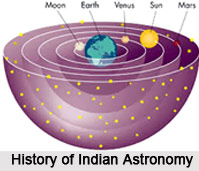 he was the earliest who used algebra for solving astronomical problems. Brahmagupta also developed several methods for calculations of the motions, movements and places of various planets, their conjunctions, rising and setting, and the estimation of eclipses. Next it was Bhaskara, who headed the astronomical observatory at Ujjain and continued the mathematical traditions started by Brahmagupta. He also wrote the Siddhantasiromani that includes two main parts and these are - Grahaganita (mathematics of the planets) and Goladhyaya (sphere). Moreover, he also observed and calculated the time taken by the Earth to complete its course around the sun to 9 decimal places. Mathematical as well as astronomical instruments were used for the general measurement of time at different periods of the day, computation of sunrise and sunset.
Early history of Indian astronomy also shows that this science just like other cultures was entwined with religion. In the country, the first documented mention of the several astronomical concepts comes from the Vedas (the religious Indian literature). Some of the significant chronological and astronomical references could be found in the Vedas. Like for instance, some Vedic notices mark the start of a year. In the book titled `Shatapatha Brahmana`, Yajnavalkya (1800 BC) defined the movements of the sun and the moon. Thus, the history of Indian astronomy proves that the whole concept of horoscopes developed out of complex astronomical observations and perceptions that are based on astronomical phenomenon.
Hindu Astronomy in Post Vedic Era
Hindu Astronomy in Post Vedic Era demarcates the period which followed the Brahmanic period in Hindu Astronomy. Hindu Astronomy in post Vedic Era mainly depended on the records which were included I n the Samhitas and Sutras of the Brahmanical period which formed the base of astronomical knowledge of Vedanga Jyotisa. The first major change which was recorded in Hindu astronomy was the beginning of Vedanga Jyotisa. Vedanga Jyotisa marked a difference from its past records by recording the summer and the winter season to begin with. It further marked the Beginning of Dhanishta.
Hindu Astronomy in Post Vedic Era included a new version of calculating the year which includes a year of 366 civil days which includes 67 sidereal months and 62 synodic months; it further includes 1,830savana or civil days; 1,835 sidereal days; 1,800 solar days; 1,860lunar days or tithis. This further divides one savana day into 30 muhurtas, 1 muhurta into 2 nadikas, and 1 nadika into 1/2 kalas 1 kala into 124 kasthas and 1 kastha into 5 aksaras.
Thus the biggest contribution of Vedanga Jyotisa in Hindu Astronomy in Post Vedic Era is the division of the year into various muhurtas. Due to its inaccuracy this invited a number of innovations in the following period.
Harappan Science and Astronomy
The Harappan people knew the measuring tools of length, mass, and time. They were the first in the world in developing a system of uniform weights and measures. Their measurements were extremely precise. Their smallest division, which was marked on an ivory scale found in Lothal, was approximately 1.704mm, the smallest division ever recorded on a scale of the Bronze Age. They also followed the decimal division of measurement for all practical purposes, including the measurement of mass as revealed by their hexahedron weights.
Brick sizes were in a perfect ratio of 4:2:1, and the decimal system was used. Weights were based on units of 0.05, 0.1, 0.2, 0.5, 1, 2, 5, 10, 20, 50, 100, 200, and 500, with each unit weighing approximately 28 grams. In addition, they evolved new techniques in metallurgy, and produced copper, bronze, lead, and tin. The engineering skill of the Harappans was remarkable, especially in building docks after a careful study of tides, waves, and currents.
The Harappans were well versed in astronomy. It is clearly evident from the excavations. The straight streets of the Indus cities were oriented towards the basic directions, which presupposes astronomical observations and the use of the sun-stick. The Aryans in India adopted the star-calendar used by the Vedic ritualists. But there are no references to it in the Avesta or in the oldest books of the Rigveda. On the other hand, astronomical evidence dates the compilation of this calendar at around the 23rd century B.C., when the Indus civilisation flourished at its peak. Linkages between ancient Harappan scripts and latter Vedic texts suggest that Harappan priest-astronomers tracked progress of Mercury, Venus and Saturn, and most likely all of the planets.
Contemporary Indian Astronomy
 The concept of Modern Astronomy was brought in India with the coming of the Europeans. The Europeans combined their knowledge with the concepts of Ancient Indian Astronomy and gifted India with new field of Astronomy with all kinds of modern appendages. The long period of exchange in ideas with the west brought about several modern ideas in the traditional system of Indian Astronomy. The result was the discovery of a class of texts called Siddhantas, which had a better scientific approach and more comprehensive treatment.
The land of India had undergone several conquests and reign of a number of foreign rulers. As a result all of them who had ruled India had left some or the other influence in the land. During the eighth century it was the Arabs who had conquered India. Consequently it was Islamic rule which was extended to India. Not only did the Arabs accept the advancements that had come about in India in the field of science but also they enriched the country with their own knowledge and theories. It was with their rule that Persian or Arabic Astronomy seeped in. They developed the construction and working of astrolabe. Many of the Indian astronomers had used the instrument a several times.
In the contemporary times a number of observatories were built in India in order to revive the astronomical learning. Another important reason which brought about revival as well as advancement of Astronomy of India was exchange of ideas from various countries.
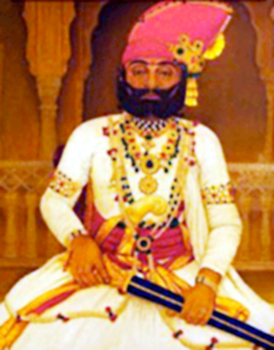
Jaya Singh had built around five observatories in India in places like Delhi, Jaipur, Mathura, Ujjain and Varanasi. These observatories later came to be known by the name Jantar Mantar. It was Jaya Singh who developed contacts with the Jesuit missionaries in India. As the contact with the Jesuit missionaries flourished India came to know about the telescope. It is true that Jaya Singh tried hard to revive the astronomical tradition in India but still his efforts remained limited to medieval India. In fact Modern Indian Astronomy flourished with the coming of the European merchants and missionaries. The merchants of the East India Company brought in several modern Astronomical instruments along with them which brought about a lot of modernization in the field of astronomy.
The British astronomers in the beginning had set up an observatory in Chennai. In the observatory of Chennai a lot of astronomical experiments were carried out. They had also set up an observatory in Kodaikanal to study the movements of the sun.
It was true that the trend of modernism in the field of astronomy had started with the coming of British but the development had not abated with the departure of the British. Even after Independence many modern instruments started crowding the observatories that had been built in India.
Not only modern instruments came in but also a number of observatories were set up in India after Independence. The first observatory after independence was set up in 1954 at Varanasi. Later this observatory was shifted to Nainital in the year 1961.
In India before Independence there were no radio telescopes but after Independence radio astronomical facilities exist in places like Ooty, Bengaluru, Gaurubidanur, Ahmedabad, and at Khodad near Pune. The first radio telescope was set up in Ooty in the year 1970. The radio telescopes are generally used to study the radio waves, pulsars and supernova remnants.
In the field of cosmic rays Indian Astronomy has done a wonderful job. Dr. Homi Bhaba had been a pioneer in this field. In the last few years a lot of advancement has also come about in the field of X-ray astronomy, infrared astronomy and atmospheric science.
Moreover in the present age the study of astronomy is highly coveted. A number of popular and universities of worth are providing degrees in the field of astronomy. Around a dozen universities in India are providing degrees in Astronomy and Astro-Physics. In order to make the knowledge of Astronomy propagated by the Universities more effective an Inter-University Centre for Astronomy and Astrophysics had been established in Pune in the year 1988.
Hence it can be concluded saying that it was with Sawai Jaya Singh India had come in contact with modern European astronomy. But later on with passing time it had advanced in the field of Astronomy with its own initiative. Presently India has all first class expertise and knowledge in the field of Astronomy.